by Courtney Hilden
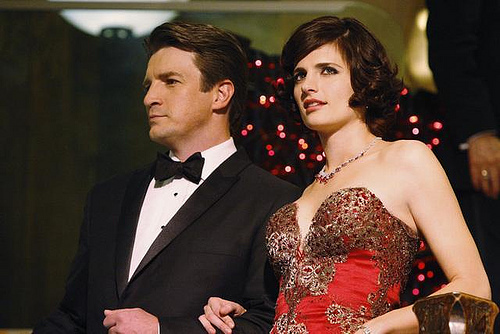
In the latest chapter of Castle's hunt for Becket's Mom's murderer, Becket gets a break when contacted by the detective originally on her case nine years ago. Just before he tells her what she needs to hear, he too is murdered, setting off a string of events that leads the cast to pursue two related cases: who murdered the retired cop and who murdered Becket's Mom.
The best thing about this episode was the guest casting. The actor playing Raglan was perfect. Even his younger-self picture was nice, making him look a lot like Sheldon from The Big Bang Theory. This episode's villain was possibly the best villain the show's ever had. He had a smooth voice and was confidently, quietly menacing. We really need to see this guy again.
Becket's smashing of the villain was also great. We so rarely get to see women express their rage, and it was so gratifying and such a relief to see her angry. We need more angry women; we need more women expressing their feelings without people reacting in fear and disgust but with understanding. Props to Castle for letting Becket's feelings always be understood by her male colleagues and never be considered hysterical.
Showing posts with label pictures. Show all posts
Thursday, January 27, 2011
Saturday, January 15, 2011
National Museum of the American Indian
The Museum of the American Indian should be a place where Native Americans/First People/Indigenous Peoples should be celebrated and where the ongoing issues these nations face can be discussed in an intelligent manner. Instead, the museum showcases the “acceptable” things about Native Americans (their material culture, mostly) and ignore the uncomfortable affects of imperialism.

The crowning achievement in what makes this museum offensive is in the atrium of the second floor, which opens up onto what at first appears to be a beautiful room. And then you look at the walls, which are decorated with images of ships and cargo being loaded onto docks, the signs of Western political and economic domination. In between these fresco are images of various conquerors, including Columbus, Verrazzano and Cortez.

For those of you who are not aware, Columbus landed in Hispaniola, where the native people were almost completely wiped out by disease, and then the rest were enslaved, their culture disappearing soon afterwards. Cortez conquered what is now mostly Mexico, and famously massacred unarmed native nobility in an attempt to scare them into submission. In addition to this, he owned a large number of slaves, almost all of them with African descent, another people of color who have been exploited by capitalism and imperalism.
This is offensive because this is a museum to Native Americans, and here, in a space that should truthfully depict history, there is art that glorifies the very forces and people who brutally conquered them. The art does not show native people being murdered, enslaved or dying of disease. There is not even an attempt to explain that this art was created before the mainstream realized the destructive nature of imperialism, instead, it is presented as simply art, as apparently ahistorical and apolitical. If this were a museum to the Holocaust or on Jewish history, this would be the equivalent of having art that depicted the Nazi war tanks and European leaders who discriminated and killed Jews as heroic, brave and admirable. Anyone walking into that room would realize the tonality and content were completely offensive and inappropriate, and in this way, this room in the Museum of the American Indian is also offensive and inappropriate.
Perhaps museum curators are afraid Americans (white Americans, right?) are uncomfortable with confronting the problematic nature of their privilege. But museums should make people think, even if it is uncomfortable kind of thinking. What this museum should be doing is showing how crushing discrimination and racism have destroyed, as much as possible, Native American political, economic and social power and celebrating Native American activists whose work have aided their communities.
Moreover, the building itself is problematic. The museum is in the Customs House, which holds, among other things, U.S. Customs and Border Protection. This is the government agencies who works to impede desperate Chicanos and Chicanas from entering the country (who almost always have Native ancestry), making this building particularly unsuited for this museum.
Native Americans deserve a museum, but maybe the problem is that the government is funding and providing for this one. The U.S. government has already taken their land; does it really need to take their cultural objects, put them on display, and then ignore the parts of their history that makes the government look bad? Apparently so. Native Americans, at the very least, deserve to run their own museum of their own history, one that tells their story appropriately and fully, in a building named after one of their leaders, not Alexander Hamilton.
The crowning achievement in what makes this museum offensive is in the atrium of the second floor, which opens up onto what at first appears to be a beautiful room. And then you look at the walls, which are decorated with images of ships and cargo being loaded onto docks, the signs of Western political and economic domination. In between these fresco are images of various conquerors, including Columbus, Verrazzano and Cortez.
For those of you who are not aware, Columbus landed in Hispaniola, where the native people were almost completely wiped out by disease, and then the rest were enslaved, their culture disappearing soon afterwards. Cortez conquered what is now mostly Mexico, and famously massacred unarmed native nobility in an attempt to scare them into submission. In addition to this, he owned a large number of slaves, almost all of them with African descent, another people of color who have been exploited by capitalism and imperalism.
This is offensive because this is a museum to Native Americans, and here, in a space that should truthfully depict history, there is art that glorifies the very forces and people who brutally conquered them. The art does not show native people being murdered, enslaved or dying of disease. There is not even an attempt to explain that this art was created before the mainstream realized the destructive nature of imperialism, instead, it is presented as simply art, as apparently ahistorical and apolitical. If this were a museum to the Holocaust or on Jewish history, this would be the equivalent of having art that depicted the Nazi war tanks and European leaders who discriminated and killed Jews as heroic, brave and admirable. Anyone walking into that room would realize the tonality and content were completely offensive and inappropriate, and in this way, this room in the Museum of the American Indian is also offensive and inappropriate.
Perhaps museum curators are afraid Americans (white Americans, right?) are uncomfortable with confronting the problematic nature of their privilege. But museums should make people think, even if it is uncomfortable kind of thinking. What this museum should be doing is showing how crushing discrimination and racism have destroyed, as much as possible, Native American political, economic and social power and celebrating Native American activists whose work have aided their communities.
Moreover, the building itself is problematic. The museum is in the Customs House, which holds, among other things, U.S. Customs and Border Protection. This is the government agencies who works to impede desperate Chicanos and Chicanas from entering the country (who almost always have Native ancestry), making this building particularly unsuited for this museum.
Native Americans deserve a museum, but maybe the problem is that the government is funding and providing for this one. The U.S. government has already taken their land; does it really need to take their cultural objects, put them on display, and then ignore the parts of their history that makes the government look bad? Apparently so. Native Americans, at the very least, deserve to run their own museum of their own history, one that tells their story appropriately and fully, in a building named after one of their leaders, not Alexander Hamilton.
Labels:
Alexander Hamilton,
Cortez,
curators,
docks,
domination,
massacres,
museums,
Native Americans,
pictures,
politics,
priviledge,
ships,
submission
Subscribe to:
Posts (Atom)