Showing posts with label Detroit. Show all posts

Monday, December 27, 2010

Christmas Concert with the Hard Lessons


by Courtney Hilden

The Hard Lessons, the best punk/indie band in Detroit, has been giving an annual Christmas concert (the day after Christmas, natch) for five years. This year, instead of their usual three or four bands playing, they had six bands, and it made it the best of their Christmas concerts yet.
The opening bands were surprisingly good. All three of them sounded similar to The Hard Lessons and gave solid performances. The only thing disappointing about their performances was the reaction from the audience, which was antsy and waiting for the main performance to start. Their loss, because if they had listened they would have heard how good these openers were.
The Barretts, a barbershop quartet featuring Koko Louise (the female vocals and piano of the Hard Lessons) was stunning perfect. They had the clear sound of choral music, and all four members were in sync with one another. The harmonies blended together like a delicious mixed drink, and was just as enjoyable. Their version of "Mr. Sandman" was inspired and fun. Can't these ladies perform more often?
After a brief break, Frontier Ruckus came on. I must here make the confession that I am somewhat biased when it comes to this band. I took a class a couple of years back with the drummer, Ryan. At the beginning of the class, I was familar with the band but unaware of his connection to them. I liked Ryan as a fellow student because he was smart, well-read, and engaged in the class. Only later another student in the class tipped me off that he was in Frontier Ruckus.
The band's been touring the US for quite some time now, and having them back in Michigan (which features heavily in their songs) makes their recent homecoming all the sweeter. Frontier Ruckus is more rock than Bon Iver and more twang than The Builders and the Butchers, with Bob Dylan's love of long, winding narratives thrown in for good measure. They are not the sort of band that needs to be seen live, but they are all excellent musicians. Watching them is watching a master's course in subtle performance. Zack's work, with multiple instruments including the saw, is particularly impressive. Matt is right to kneel down at his feet, a strange libation to make several times mid-perfomance.
Finally, the crowd could stop anticipating, because The Hard Lessons were finally on. Again, I have to pause to explain my bias. I attended a school where the guitarist and male vocalist, Augie, taught for about a year.
The Hard Lessons consistently give carthatic performances. Their albums pale in comparison with their live show. This was no different. Once again, they played a perfect set, one that reflected their entire career well. After their release of their B and G Sides, they were playing mostly off of that album, and for all it's strengths, it was a very different album than their previous work, and their live shows weren't quite as energetic as before or after. Their "Don't Shake My Tree," "Bamboo," "Milk and Sugar" and "Carey Says Alright" were all crowd pleasers. The audience was clearly loving it, singing along, screaming, dancing and throwing their hands up for "The Arms Forest." The band's Christmas concert is an excellent night out, and I personally cannot wait for the next one.

Wednesday, September 22, 2010

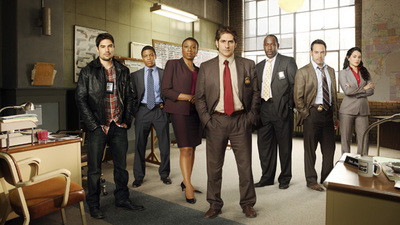
Detroit 1-8-7

by Courtney Hilden
Spoiler Alert!: The mystery's ending is revealed in this review.

Given the city of Detroit's reputation as the world's most dangerous city, Detroit 1-8-7, a cop show, should have probably existed before. Given the show's depiction of race, it might be possible to imagine that this was the reason the show as only just premiered. The show's depiction of race is not outright racist, but there are some strange moments that deserve dissecting:

1. Although it is great to see so many of the characters are people of color, it is sad that the main character, Finch, is white. Detroit, save its metro area, is predominately African American, and it feels wrong that the story is told from a white perspective. A story set in Detroit should be told by a person who does a better job of representing its population.
2. It is also really sad that the comedy is being done mostly by the sidekick African American character, Washington. He is inept, he is comical, he is suppose to be a minstrel character, which is so disappointing, again, considering that he is a better representation of the city's population than Finch.
3. Some of the suspects were white, which was a nice change of pace, considering so many of the bad guys on other cop/detective/procedural shows are minorities. Two of the suspects, including a drug addict, were white. The night's bad guy, James Burke, was white. Although many (white) people imagine that there is a lot of black-on-white crime, the case is actually the opposite. Within the episode, the bad guy committed violence against both whites and African Americans, again, different from the mainstream, white imagination. Of course, the drug dealers were African American, so for every bit of progress of racial subversion, something typical and cliche seemed to happen.
4. The episode also depicted an interracial family, one that was sadly dealing with a father in prison and a recently-murdered mother. No comment is made, by anyone, on the fact that a white woman was raising her biracial grandchildren with her African American daughter-in-law. Is this what the so-called post-racial America looks like? Imaginary Detroit?
5. The choice in homicide itself was significant. If you have ever watched Detroit News, you know that the most common murder appears to be the "Baby Momma Murder." By that, I mean husband/boyfriend kills his wife/girlfriend, who is almost always the mother of his children. It is so common that these murders are barely given more than thirty seconds on the news. Often, these murders involve only African Americans, but here it involved a biracial family, one where the white man was killed his African American wife and tried to kill his biracial kids and white mother. This was both confirming to certain ideas about murder in Detroit but also subverted it. It adheres to an all-too-common and tragic story, but it also changed the stereotype, by showing white men just as capable of that sort of violence that is so linked to African American men. It implicitly questioned the idea that this violence is inherently linked to African American men, who are so frequently stereotyped as dangerous savages.

Some other non-race-centric notes about the pilot episode:
1. I also loved how the medical examiner does roller derby in her spare time. Finally, a cop show where the characters at least make attempts at having a life outside the job. And points for giving her a cool, feminist-hailed hobby.
2. The phone conversations between our two main characters, Finch and Washington, were an interesting detail. Previously, the audience had been led to believe Finch is unable to express himself. Those calls show he is capable, he is just choosing not to do so.
3. And finally: Coney Islands! Any good Detroiter can tell you their favorite Coney, and usually knows what is best at a few of them. Points for adding something all too real.