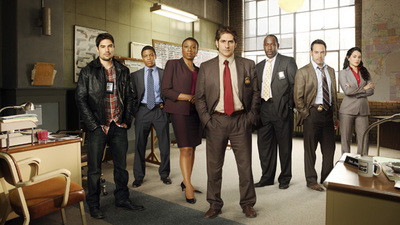
"Under the Gun" found Becket, Castle, Ryan and Esposito sleuthing around a man's death, which leads to a treasure map that no one but Castle believes is a treasure map.
Although there was a lot of delightful things about this episode, like most episodes of Castle, there was a lot about this episode that did not feel right. Using the radio devices, something the show never does, meant of course that it was going to reveal a clue. Even though the clue was important, the totally contrived way of finding it ruined it. It would be far more likely that Detective Ryan would knock the calculator off the desk, breaking the phone and revealing the bug in the process. In another totally expected moment, the old man suspect was faking his poor walking.
And in the most expected moment of the night, Royce, Becket's old friend, turned out to be apart of the plot, who removed Random and made sure he was never delivered to Central Booking.
And since I already mentioned there were good things about this episode, it is important to mention them. The bounty hunter calling Becket out on her ridiculous shoe choices (heels, natch) was a nice touch.
All the actors involved gave adequete perfromances. Brian Krause as a minister gave his typical subtle but strong performance. His character's story sounded totally suspicious and he managed to perfectly balance believeable and unbelievable as a suspect.
And in the most expected moment of the night, Royce, Becket's old friend, turned out to be apart of the plot, who removed Random and made sure he was never delivered to Central Booking.
And since I already mentioned there were good things about this episode, it is important to mention them. The bounty hunter calling Becket out on her
 ridiculous shoe choices (heels, natch) was a nice touch.
All the actors involved gave adequete perfromances. Brian Krause as a minister gave his typical subtle but strong performance. His character's story sounded totally suspicious and he managed to perfectly balance believeable and unbelievable as a suspect.
And in the nicest touch of all in this episode, when Royce called Becket and attempted to upset her and throw her off, she turned the tables on him and did the same. On another show, Royce calling Becket would have consisted of Royce psyching Becket out and screwing up the investigation. Instead, Becket psyched him out, telling him exactly what would upset him most and keeping him on the line longer to get a location. Too bad she cried at the end of the scene. It would have been nice to see some nerves of steel from this woman.
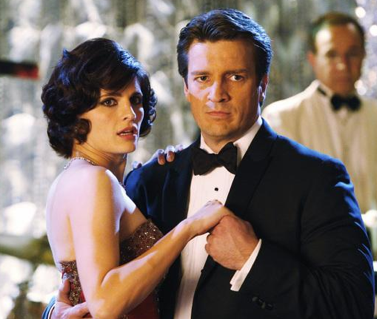
And finally "I can't based my entire case on your spidey sense" was a great line, but it was evocative of a certain line from Buffy the Vampire Slayer, a show our beloved Nathan Fillion was once on. Castle and Becket are quickly becoming a Mulder and Scully pair, with Castle espousing fantastic ideas and Becket staying closer to reality. Unlike in The X-Files, however, Becket is usually closer to being right. And if that was not nerdy enough for you, the geek references continued, naming one of the suspects Random, also a character from Hitchhiker's Guide.
And finally "I can't based my entire case on your spidey sense" was a great line, but it was evocative of a certain line from Buffy the Vampire Slayer, a show our beloved Nathan Fillion was once on. Castle and Becket are quickly becoming a Mulder and Scully pair, with Castle espousing fantastic ideas and Becket staying closer to reality. Unlike in The X-Files, however, Becket is usually closer to being right. And if that was not nerdy enough for you, the geek references continued, naming one of the suspects Random, also a character from Hitchhiker's Guide.