Showing posts with label YouTube. Show all posts

Monday, January 10, 2011

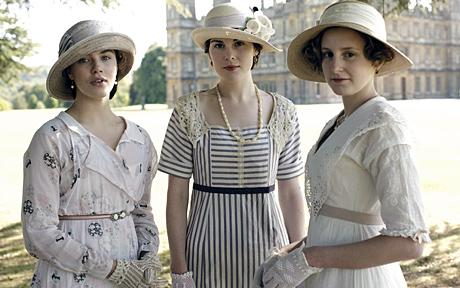
Downton Abbey: Episode 1

by Courtney Hilden
Spoiler Alert!: Some of the episode's best surprises are given away in this review.

Downton Abbey, Masterpiece Theatre's premiere show this season, centers on the title house and the two classes of citizens it contains: the elite, wealthy family and their servants. In this first episode, Robert, an Earl and patriarch, discovers two of his relatives, and heirs to the estate, have passed away aboard what is certainly but not named to be the Titanic. This causes Robert's wife Cora to try to gain part of the estate for herself and her eldest daughter, Mary, and for Robert to invite the new heir, Matthew Crawley, to the estate. Meanwhile, the "downstairs" family deals with a new servant, who, because he was wounded a war, has trouble fulfilling his duties, but much more trouble because most of the other servants treat him so poorly.
It's not as if anything is wrong with the show, it just feels very much like other movies and miniseries that also feature both the wealthy family and servants, and in fact, there doesn't seem to be anything different from this than other earlier shows. So we trend on the familiar ground of the servants and the family and their intertwining drama. The servants, of course, have the more interesting, lesser-seen drama. The family's drama has been part of so much of the Masterpiece stories and Austen adaptations as to be boring to anyone who is familiar with either. This is, after all, the same situation Mrs. Bennett was trying to prevent in Pride and Prejudice, which takes place some one hundred years before. At least in this version, the economic situation of the elite female characters is not avoided. Countess Cora spends time trying to get some money to live off of, but she is blocked even from trying to get her dowager money back out of the estate. In a system like this, the economy is structured to take from women (their bodies, ones that are forced to stay sexually monogamous) and give them nothing or close enough in return.
There are some highlights in terms of great characters. The eldest daughter, Lady Mary, shows a delightful lack of care towards her dead fiance, a perfect reminder of the love that was not present in these marriages.
The show also deserves credit for having a "lame" character. John Bates had served Robert in the "war with the Boers", and now has taken a job as Robert's valet. The show does an excellent job at depicting both how relatively fine Bates is at his job and the way the majority of servants look down on him for his disability. "Crippled" characters are few and far between on television, so it is nice to see a show that depicts him in a way that is judgemental of those who are judgemental of him.

Unfortunately, the depiction of homosexuality leaves much to be desired. Thomas, the first footman, spends time scheming (first against Bates, then later against his former lover). The other gay character spends time manipulating Thomas and Lady Mary. Gay men are not evil, and showing them this way just plays into stereotypes and homophobia.
As for the next episode, it seems obvious that the solution to the problems of the estate rest with the lawyer, Matthew Crawley. Countess Cora would be wise to enlist Crawley to figure out how to separate her money from the rest of the estate or to simply let her have it, as that is what would make both him and Cora happy.
So, even though the show manages to create sympathetic female and disabled characters, ones who are forced to fight through difficult circumstances, the show fails a rounded depiction of homosexuality. It acknowledges their difficulties of being so closeted, but tonally makes the judgement on them that they are dangerous. Coupled with the already-explored aspects of the story, Downton Abbey is somewhat admirable but in no way splendid.

Tuesday, January 4, 2011

From Dead to Worse

by Courtney Hilden
Spoilers: This review gives away almost all of the surprises of this books.

When sitting down to review From Dead to Worse, the eighth book in the Southern Vampire Series, I found myself wondering what I could possibly say as to what the plot was. The plot was really several episodes thrown in together. One involves Sookie meeting a new, mysterious (of course he’s mysterious, this series is nominally a mystery series) relative, another has a Nicene war within the local werewolf pack, another features a hostile takeover, and finally there’s a broken marriage thrown in for good mix. The plot sort of meanders along, and although this would usually be a good thing, it is unlike previous books in Harris’s series, and feels less controlled. This tight, no-flab writing was one of the most admirable things about Harris’s series, which lacked the bloat of other popular urban fantasies and romances. The book felt like Harris is setting up for something else (what I do not know, as I have yet to read further), maybe giving us pertinent information for future books, but otherwise feeling like a letdown.
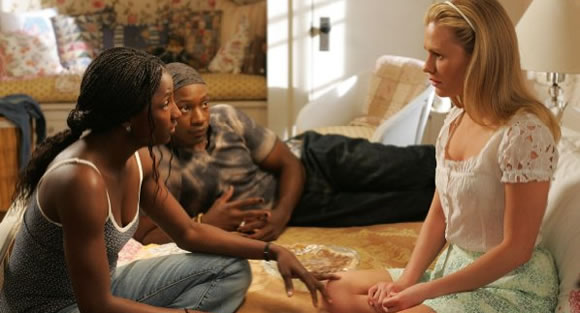
The other majorly disappointing thing about the book is staving off (yet again!) the romance between Sookie and Eric. Eric, finally remembering everything that took place four books ago, has yet to have an important “talk” with Sookie. This is getting dragged out to the point of boredom. And also, when is Bill going to disappear? His earliest scene, talking to an undressing Sookie, felt forced, and in light on the events of the book, was totally unnecessary to the rest of the plot. His later moments in the book, talking to her on her porch and then arriving at her house during a crisis, felt more like a way to insert an otherwise useless character into the plot and way to compensate Bill/Sookie shippers for having thrown in their lot with not only a jerk of a character but a bland jerk of a character. He is the sort of person, excuse me, vampire, who desperately needs a hobby.
It seems increasingly unlikely that Sookie would still want Bill, given that he has not done much other than talk about wanting to love her. Meanwhile, Eric has shown all the initiative to respect her enough to be there for her when she meets her mysterious relative (telling her he’s there for her but backing off and allowing her to make her own decisions.) And he has shown pragmatism and care for his followers and employers. Of all the tyrants in this series, he is the least interested in power for power’s sake and the unhappiest with what power he has. Why can’t Sookie see that?
Also getting more “page time” in the series is Sam, who was also steadfastly by Sookie’s side throughout the book, helping her when he could. His back story near the end felt a bit rushed, but otherwise Sam’s a lovable character, and a great match for Sookie too.
The last quibble with this book is over lesbian relationships. Even though Amelia could be in either a heterosexual or homosexual relationship, and the book flirts briefly with Amelia and Pam as a couple, Amelia’s longer relations are always with me. Other women with women pairings are shown in earlier parts of the series as dangerous, and there’s something deeply sad and disappointing about this.
Readers could do worse than this series or even this book, which is one of the lower books within the series. The writing is still interesting, the world still imaginative, and there was even a surprise or two.

Monday, December 27, 2010

Christmas Concert with the Hard Lessons


by Courtney Hilden

The Hard Lessons, the best punk/indie band in Detroit, has been giving an annual Christmas concert (the day after Christmas, natch) for five years. This year, instead of their usual three or four bands playing, they had six bands, and it made it the best of their Christmas concerts yet.
The opening bands were surprisingly good. All three of them sounded similar to The Hard Lessons and gave solid performances. The only thing disappointing about their performances was the reaction from the audience, which was antsy and waiting for the main performance to start. Their loss, because if they had listened they would have heard how good these openers were.
The Barretts, a barbershop quartet featuring Koko Louise (the female vocals and piano of the Hard Lessons) was stunning perfect. They had the clear sound of choral music, and all four members were in sync with one another. The harmonies blended together like a delicious mixed drink, and was just as enjoyable. Their version of "Mr. Sandman" was inspired and fun. Can't these ladies perform more often?
After a brief break, Frontier Ruckus came on. I must here make the confession that I am somewhat biased when it comes to this band. I took a class a couple of years back with the drummer, Ryan. At the beginning of the class, I was familar with the band but unaware of his connection to them. I liked Ryan as a fellow student because he was smart, well-read, and engaged in the class. Only later another student in the class tipped me off that he was in Frontier Ruckus.
The band's been touring the US for quite some time now, and having them back in Michigan (which features heavily in their songs) makes their recent homecoming all the sweeter. Frontier Ruckus is more rock than Bon Iver and more twang than The Builders and the Butchers, with Bob Dylan's love of long, winding narratives thrown in for good measure. They are not the sort of band that needs to be seen live, but they are all excellent musicians. Watching them is watching a master's course in subtle performance. Zack's work, with multiple instruments including the saw, is particularly impressive. Matt is right to kneel down at his feet, a strange libation to make several times mid-perfomance.
Finally, the crowd could stop anticipating, because The Hard Lessons were finally on. Again, I have to pause to explain my bias. I attended a school where the guitarist and male vocalist, Augie, taught for about a year.
The Hard Lessons consistently give carthatic performances. Their albums pale in comparison with their live show. This was no different. Once again, they played a perfect set, one that reflected their entire career well. After their release of their B and G Sides, they were playing mostly off of that album, and for all it's strengths, it was a very different album than their previous work, and their live shows weren't quite as energetic as before or after. Their "Don't Shake My Tree," "Bamboo," "Milk and Sugar" and "Carey Says Alright" were all crowd pleasers. The audience was clearly loving it, singing along, screaming, dancing and throwing their hands up for "The Arms Forest." The band's Christmas concert is an excellent night out, and I personally cannot wait for the next one.

Sunday, December 19, 2010

Colombo Oreo

by Courtney Hilden

The episode, "The Doctor in the Photo," was heavier than a Thanksgiving dinner and surprisingly angst-y, though in a quiet way. Bones got a case involving a brilliant scientist who was murdered in a dangerous neighborhood. Like Bones, the victim had rejected the love of a coworker who was polar opposites from her, and probably regretted it. Bones begins to over-identify and spirals into a magical realism episode.
This was an interesting opening, showing some of our characters, having Thanksgiving dinner. Don't worry, it wasn't a mushy scene, as Bones even had some time to use her forensic powers to tell how the turkey died.
Watching Bones suffer through the love of her life's great love life with someone else, who is normal and slightly imperfect but impossible to truly demonize, was painful. Watching her struggle over how unmissed this episode's victim was torture. The team mostly went unaware of her unhappiness and there was something quietly sad about that too, especially Booth's ignorance of Bones's emotional state, though given the last year of this show, where Booth has struggled to understand Bones's emotionally, this is typical. "Doesn't anyone know me?" Bones asks Sweets when everyone does say something to him about her emotional state. Then Sweets gave us an analysis that anyone watching this show would be able to give us. (Can't we give Sweets more to do? Can't he say profound things that haven't already been beaten into the audience's head?) The person Bones really needs and wants to have these heart-to-hearts with his Booth, not Sweets, but to some degree, Booth is unavailable for them.

Possibly this is one of the best episodes of Bones, ever. It was a challenge to show, within the course of only one episode, her progression to the conclusions she made, but this episode handled it brilliantly and without the usual cliches. More episodes should have us diving into the psyches of the characters, and show how bizarre and thoughtful they are.

Wednesday, November 24, 2010

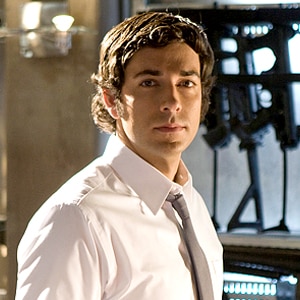
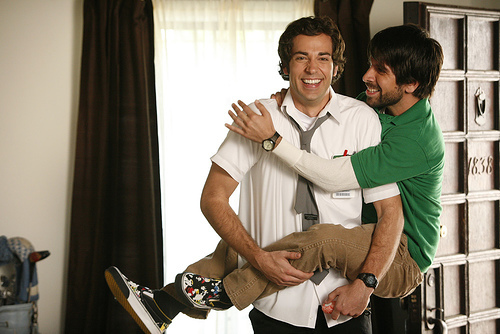
Chuck Versus Phase Three

On the most recent episode of Chuck, Sarah tries desperately to find Chuck.  Sarah became, in the words of Casey, "unpredictable."  Casey discussed how he disliked Sarah pre-Chuck, which is really interesting, because it implies that Casey saw something good in Sarah and Chuck's relationship.  It gives Casey's character an extra and interesting shade, since he's never said anything on the subject before and he so rarely says anything positive at all.  The episode also showed off Sarah as emotionally invested and the actress's chops.  She's always a strong character, and that's great, but seeing the intimate moment of her grief was a wonderful quiet moment in a show that usually is about the flash bang.  The episode also featured far more of the other characters and not Chuck himself, again, a nice change up from the usual. 
The best part of this episode is that it acknowledged Chuck's fear for marrying Sarah, who Morgan called "a big fish."  But then we see that Chuck wants to get over that; he doesn't want his fear of a strong woman to stop him from being with her.  It might not quite be feminism, since Sarah felt the need to say that she was nothing without Chuck, but the show positively depicts both a strong woman and the man who wants to be with her.  Sadly, you don't see that on tv too often, so in this way, the show has not only done something unique but positive for how people see gender on tv.  The only thing that isn't okay is that Sarah was in some ways "crazy" without her man.  Casey acknowledged that, given the circumstances, she had the right to be upset, but Beckman still wanted her watched.  It was borderline "hysterical woman" meme, and that's tired. 
The dream sequence that the episode opened up on was delightful strange, especially considering that it featured the show's favorite freak, Lester.  (Does Lester ever wear normal clothes, or is it only work uniforms and costumes for this guy?)
This episode also featured some great villians.  "The Belgian" was so creepy, especially with his glasses magnifying his eyes so he looked like an insect.   


In terms of disappointments, the episode tried hard to skirt around the issue of torture, which was really a pity.  Torture has been such a difficult issue in American politics lately, that it seemed too easy for Sarah to just talk a Thai diplomat and terroritsts into giving pertinant information.  Not that torture needed to happen, but the lack of dialogue over it was a little too American.  The closest they got to dialogue on violence at all was when Morgan suggested maybe they shouldn't use guns.  Again, Morgan has been aware of Chuck's situation for long enough that it seems strange that he is now opposed to guns.  And that the dialogue was limited to Morgan not wanting to be sacrificed, so then of course he's okay with guns.  And then even Casey had to admit that guns were unnecessary when they tried another tactic.  The show only kind of deals with violence in a comical way, almost never in a serious way.  Again, no dialogue on the subject.   
The episode also discussed how as spies, Casey and Sarah didn't have juristiction over certain places.  Why are we several years into this show and only now discussing bureaucracy?  Usually it's the first excuse a show like this would use to justify certain actions and storylines. 
It would also be nice for Casey to actually put his foot down and truly tell Morgan no.  The show has already established how tough Casey is, so why doesn't he just throw Morgan into a cell or tie him up to a chair?  Morgan trailing along on these missions is far too unrealistic.  "I definetely know how to use this, dirtbags"?  I would have riddled his body with bullets if he said that to me. 
And, even though the show had some good pro-women moments, how disappointing that Sarah can't save herself.  I would much rather watch her save Chuck without anyone's help.  And there was no need for her to make herself wet, except for the male gaze.  So even though yes, she's a strong woman, and yes, Chuck loves that about her, why is it her power is always being subverted by other things?  Can't we just have her be a badass without everything els
e becoming an issue?
And wouldn't it have been great if Ellie got exposed to the Intersect when she got into that computer?

Sunday, September 26, 2010

Nepotism

by Courtney Hilden
Spoiler Alert!: Everything except the B-story line is spoiled in this review.

"Nepotism" the opening episode of The Office's last season with Steve Carrell, was about Michael hiring his nephew from a part of his family he is estranged from (which itself might have been a good story.) Luke, Michael's nephew, was every awful stereotype of "kids these days." He was lazy, he seemed almost gleefully incompetent (in a far more malicious way than his Uncle), and he liked The Boondock Saints. Given the audience make-up of this show, there was something strangely nasty about this character, and it felt like a commentary on those who actually watch The Office.
The opening, featuring (almost) the entire Office trying to make a YouTube video, was entirely too cute. And from there, the episode rolled from one great moment to another. Michael's stupid God and Jesus argument was another classic moment of Michael narcissism and stupidity. Most shows in their seventh season start to slow down, but this was a relatively strong episode, even by Office standards.
There was an unusually high amount of awkward-funniness. The spanking comes to mind. Michael's spanking of Luke was horrifying on some basic level, and then the various characters replicating the moment was awkward, especially Dwight's spanking of poor Andy, who has gotten metaphorically spanked enough on this show.
The episode contained a few surprises. The first was Gabe and Erin now in a romance. Gabe and Erin make a lot of sense, since both of them are so socially awkward and well-meaning. Erin acknowledging that she felt compelled to date him because he is her boss's boss was uncomfortable. It was also sad that the show has not (so far) alluded to what a problem in the workplace this is, especially for women. Part of me hopes Andy handles it as relatively well as he has so far, but part of me would love to see him descend back to that angry place he was when he first joined the show. Andy's anger problem was so tidily solved a few seasons back that it seems appropriate to bring it back, and show how a problem like that never really goes away.
Great lines of the episode:
"It got infected, even though I peed on it." -Michael, explaining an infection, completely unaware that peeing on something is for sting rays.
"Nard Man is my Father." -Andy, explaining why he is suppose to be referred to as "Nard Dog."
"What's up, Venus?" -Luke, to Phyllis.
"My favorite part of an ice cream party is the bagel chips." -Oscar
"He can swim in my pool; he can't come in my house." -Jo, explaining to Michael how she treats her nephew.
"He's totally going to get Pammed!" -Pam on her prank for Dwight.
"Everywhere I look it's Betty White this and Betty White that." -Creed, on Twitter.

Saturday, September 25, 2010

The Mastodon in the Room

by Courtney Hilden
Spoiler Alert!: Some of the early details of this episode are totally spoiled in this review. The crime itself, however, is not.

In this episode, where they "get the band back together," as it were, opened up on vacation clips of what various characters were doing. It was about as boring as actually vacation clips of characters doing things. It was sort of a lost opportunity, since the episode could have shown various characters doing legitimately interesting things in their various locales. Having a few episodes that focused on characters that were finding themselves deeply embedded in mysteries where ever they were and realizing they missed the work and their teammates would have been great. They would have given the actors, especially the lesser characters, a chance to have an episode all to themselves. Instead, they were just suppose to give us a taste of what they were doing, which was apparently exactly what you expected: Daisy still be annoying in Indonesia with Brennan stoically carrying on, Booth saving the day in Afghanistan, and Cam about to douse her career into flames.
Why was Cam's apparently impending career fail the genesis for bringing these characters back together? Somehow, this felt totally false. The case felt like a reject case from lots of other police procedural shows. Another case, a much bigger case, should have brought the characters together, or even better, a character's death should have been the case that called all the characters back to D.C. (Maybe they could have killed off one of those annoying interns. I'd still vote for Daisy, who is still so annoying and socially clueless that it's a shock Sweets has not diagnosed her on the autism spectrum.)
The episode was unrealistic in a lot of other ways. Daisy was beyond stupid to bring her engagement ring to Indonesia. She was dressed totally inappropriately with her skimpy underwear and cute clothes. (And was the camera's focus on her butt in an early scene necessary? No, it wasn't.) The only good thing about these Indonesian scenes is that Brennan was at least capable of wearing clothing that was practical for the environment and that did not do her any favors.
The costume choices continued to be strange throughout the episode. Sweets looked terrible doing the jazz look, but this was hard to notice, giving his terrible facial hair. His new look makes him look like an extra from Shakespeare in Love, and not in a good way.
On a feminism note, Brennan's comment to Booth that she had to beat people up because he "wasn't there to save her" was totally out of character, considering the pilot episode showed her perfectly capable of beating people up herself and not needing the least bit of help from Booth. What happened to that Brennan? Is she still lost out in the jungle?
Cam's anger at Brennan for pursuing the career she clearly loves was uncalled for. It smacked of all that "women need to sacrifice everything for everyone else" rhetoric. If Brennan had been a man, no one would have blinked at the decision to go do research in Indonesia. It also just reeked of trying to create drama for drama's sake. And it was another example of how unrealistic this episode was. If a program was that important to both the Jeffersonian and the FBI, someone would have stepped in to keep it going. And, given the reputation that Brennan apparently has, forensic anthropologists would have probably fought over it.
This doesn't mean everything in the episode was bad. For example, most of the interns are now out of the picture, leaving the least irritating one, Wendell. (Too bad about Nigel Murray. He had real potential.)

Wednesday, September 22, 2010

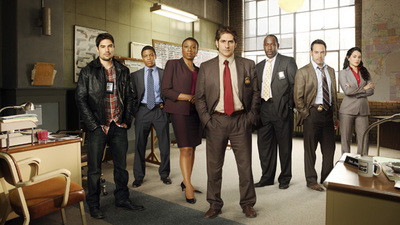
Detroit 1-8-7

by Courtney Hilden
Spoiler Alert!: The mystery's ending is revealed in this review.

Given the city of Detroit's reputation as the world's most dangerous city, Detroit 1-8-7, a cop show, should have probably existed before. Given the show's depiction of race, it might be possible to imagine that this was the reason the show as only just premiered. The show's depiction of race is not outright racist, but there are some strange moments that deserve dissecting:

1. Although it is great to see so many of the characters are people of color, it is sad that the main character, Finch, is white. Detroit, save its metro area, is predominately African American, and it feels wrong that the story is told from a white perspective. A story set in Detroit should be told by a person who does a better job of representing its population.
2. It is also really sad that the comedy is being done mostly by the sidekick African American character, Washington. He is inept, he is comical, he is suppose to be a minstrel character, which is so disappointing, again, considering that he is a better representation of the city's population than Finch.
3. Some of the suspects were white, which was a nice change of pace, considering so many of the bad guys on other cop/detective/procedural shows are minorities. Two of the suspects, including a drug addict, were white. The night's bad guy, James Burke, was white. Although many (white) people imagine that there is a lot of black-on-white crime, the case is actually the opposite. Within the episode, the bad guy committed violence against both whites and African Americans, again, different from the mainstream, white imagination. Of course, the drug dealers were African American, so for every bit of progress of racial subversion, something typical and cliche seemed to happen.
4. The episode also depicted an interracial family, one that was sadly dealing with a father in prison and a recently-murdered mother. No comment is made, by anyone, on the fact that a white woman was raising her biracial grandchildren with her African American daughter-in-law. Is this what the so-called post-racial America looks like? Imaginary Detroit?
5. The choice in homicide itself was significant. If you have ever watched Detroit News, you know that the most common murder appears to be the "Baby Momma Murder." By that, I mean husband/boyfriend kills his wife/girlfriend, who is almost always the mother of his children. It is so common that these murders are barely given more than thirty seconds on the news. Often, these murders involve only African Americans, but here it involved a biracial family, one where the white man was killed his African American wife and tried to kill his biracial kids and white mother. This was both confirming to certain ideas about murder in Detroit but also subverted it. It adheres to an all-too-common and tragic story, but it also changed the stereotype, by showing white men just as capable of that sort of violence that is so linked to African American men. It implicitly questioned the idea that this violence is inherently linked to African American men, who are so frequently stereotyped as dangerous savages.

Some other non-race-centric notes about the pilot episode:
1. I also loved how the medical examiner does roller derby in her spare time. Finally, a cop show where the characters at least make attempts at having a life outside the job. And points for giving her a cool, feminist-hailed hobby.
2. The phone conversations between our two main characters, Finch and Washington, were an interesting detail. Previously, the audience had been led to believe Finch is unable to express himself. Those calls show he is capable, he is just choosing not to do so.
3. And finally: Coney Islands! Any good Detroiter can tell you their favorite Coney, and usually knows what is best at a few of them. Points for adding something all too real.

Tuesday, September 21, 2010

Chuck Versus the Anniversary

Spoiler Alert!: This review reveals everything about the episode.
by Courtney Hilden

In the season premiere of Chuck, our title character tries to both find his Mom and find a job (neither of which work out,) Chuck's Mom makes a few appearances (in a flashback, watching her son look for her, fighting bad guys), Sarah and Casey are so busy on missions they never see Chuck, and the Buy More is resurrected.
There was something reckless and sloppy about this episode. There was way too much they were trying to cram in to one episode. A lot of the other things that usually make this show delightful fell flat or felt lackluster. The humor was not nearly as funny as it once was, and this is probably attributable to the lack of everyone's favorite comic duo, Jeff and Lester. Something about the show feels very wrong and off without them.
Once again, Chuck is making a mistake he has already made: lying to Sarah. This always turns out badly, and Chuck never seems to think about this. Too bad the writers cannot allow Chuck the chance to think about things more. Sarah seemed completely unsurprised by the news that Chuck was lying about something, again. Even with the spy business being what it is, the lying that goes on between Chuck and Sarah is disappointing to watch. It also stretches a certain amount of believability, because it is hard to imagine any smart woman staying with someone with Chuck's history.
The show is wise not to rely too much on Chuck's intersect abilities. On another show, these abilities could easily morph into a deus ex machina, but on this show, they at least are smart enough to use it as sparingly as possible. The truth is that the show is at its best when it adheres to more realistic things, which is why Ellie's comment that jobs "are hard to come by," rings totally true, especially to anyone currently in the job market.
In terms of fight scenes, the best for this episode goes to Chuck's Mom, who had the most badass (but sadly quick) fight scenes. She and this episode's bad guy almost seemed friendly at the beginning of the episode, but that quickly turned sour.
Olivia Munn's acting left much to be desired. Usually the show does a decent job with acting, but her attempts at frigid were more like monotone.
Costume-wise, Sarah has one of the cutest tiered skirts on while discussing with Casey how Chuck does not want to come back to the spy world.
And finally, the show had a wonderful joke about spies when this episode's bad guy mentioned that Chuck and Morgan were smart to use public transportation to avoid detection. There was something about that joke that poked spies and spy movies right in the nose and allowed the audience to consider how too easy it often is for these characters. Getting Sarah and Casey on a bus? Perfect.

Wednesday, September 15, 2010

Evil is Going On

Spoiler Alert!: Almost all (but not the last) spoiler for this episode are revealed in this review.
by Courtney Hilden
"Evil is Going On," the final episode in this season of True Blood, opened up on Eric trying to kill Russell by lying out in the sun with him. After having a conversation with Godric (who, yes, is still dead), decided to punish Russell rather than just kill him. Meanwhile, Talbot's bloody pulp-remains took a trip through the plumping system, Jesus comes out as a witch, and Sam runs after Tommy. Oh, and finally, Sookie broke up with Bill. Hopefully for good.
Dealing with one of the worse things about the episode: Was it really necessary to bring Eric's maker back? Godric was a great character, but using him in some kind of vision is about as original as the heaven world that Sookie and Bill have been making regular visits to. Godric was a great character when he was simply undead, but as an angel/figment of Eric's imagination felt contrived and silly. Even Eric's motivations are obvious through his interactions with characters (like Pam), or they are not. Either way, it could work. But using Godric-back-from-the-dead smacks of some bad tv show I am so unfamiliar with I cannot even give an example.

Sookie's power (whatever it is) has become a deus ex machina. Great, now one of the other good things on this show, conflict, will be sacrificed to make things even easier for the uncompelling character. The only good thing about this is that it gives Sookie her own power within a world where mostly white, supernatural men have power.
The only good thing about Sookie scenes was that, for once, Sookie showed some character and dumped the remains of Talbot down the drain. Her evil laugh was so liberating to watch. Talbot's remains are still gross, but we have assumably seen the last of them.
There were some good moments on the show. Tara and Sam's morning breakfast started out so cute. Tara's reluctance did a good job of capping off her recent struggles with accepting vampires and other supernatural stuff. There's something sad about watching her hate all supernaturals because of the terrible things a few of them have done, but if she really is gone for a season or two, she will come back wiser and more accepting.
Hopefully, Jason is actually going to take care of the people of Hotshot. And it's going to make him a better person. Hopefully.
Jesus's betrayal of Lafayette was awful. Poor Lafayette. He finally gets a good relationship going, and, of course, Jesus has been lying to him. And obviously manipulating him. Lafayette should not trust Jesus.
The scene between Tara and Sookie was great. It was one of the few true friend conversations that have happened. Tara should not have apologized to Sookie, since she was the one trying to help her out of what was clearly a bad relationship. Tara is always setting herself aside for her white friend, and it is so sad to watch. If the show does depict where Tara goes next, it should include her sticking up for her own feelings.
Bill continues to be a disappointment. Eric is one of the few good characters, and although it is nice to embrace my hatred of Bill now that it's clear he truly is in it for himself, I am already missing Eric.
His instance of killing anyone who has tasted Sookie is another great moment of creepy misogyny. "Tasting" here is obviously a metaphor for sex, and to here Bill claim he is going to destroy all of those who share a sexual link with her is just another one of the things to add to the "Nasty Anti-Woman Things Bill Says."
And finally, some positive things about this last episode. One of the things not cover in these reviews is how good the music has been. Every episode has ended with perfect music. The incidental music during the last scene between Tommy and Sam was particularly nice.
Also: Terry has an armadillo?

Wednesday, August 25, 2010

"Pretend You're All Normal"

A review of "I Smell Rat"
by Courtney Hilden


In this episode of True Blood, Bill revealed to Sookie that she was a fairy, Jason revealed to Tara that he had killed Eggs, Hoyt revealed his true love for Jessica, Crystal revealed her true nature to Jason, and Lafayette and Jesus revealed their mutual familiar histories with magic. Oh, and Eric may be a bad guy now since he appears to be sacrificing Sookie.
The revelation that Sookie is a fairy was as bad as the other things involving Bill this season. In the books, it happens later in the series, and with such absolute casualty as to be funny. Here, it felt like they were reaching for something genuine and failed. It was the closest the show as ever gotten to feeling like a soap opera. Much of the rest of the episode felt like it belonged in a soap opera, since much of the episode dragged, had random craziness that made no sense, and had bad background music.
Finally, there are some consequences for the murdering that Jason has made a habit of on this series. It was nice to see those flashbacks, as a reminder to the audience that Jason has never killed anyone that wasn't a minority in some way.
That said, the best flashbacks on this show are the short ones, and even the flashbacks about beloved Sam were bad. Heartbreaking, of course, because so much of what happens to Sam is heartbreaking, (including all the tiptoeing that went on around him after his fight with Calvin) but still the flashbacks always slow down the momentum of the show, and not in a good way.
Bill did do one good thing this episode: he promised to give up feeding on Sookie's blood to gain her trust. It was good to hear that, and the one redeeming feature of Bill.
Speaking of trust, it's too bad that Crystal didn't decide to stay with Lafayette and Jesus, because I would trust them far more than Norris, who is far more of a racist on the show than in the books.
Though maybe it's best that she didn't, considering that Jesus wanted to do V. This didn't make a lot of sense given that Jesus was angry at Lafayette for selling drugs. It makes even less sense when you consider that trippy drug scene was boring. The only thing that worked was that grin on Lafayette's face as they were walking into the second room.
By far the worse and most boring episode of the season. A lot of this may be because they are setting things up for their two final episodes, but this was True Blood at its worse.

Wednesday, August 18, 2010

Everything is Broken

by Courtney Hilden
Spoiler Alert!: Almost all of the surprises in this episode are revealed in this review.

In the latest episode of True Blood, "Everything is Broken," Sookie and Hadley met up in an aquarium to see Hadley's son, Eric gave a testimony to the Authority, white womanhood continued to be the chief concern of Jason, Tara continued to heal from her rape, and Sam cut loose after another series of struggles over parenthood.
First and foremost, our show's heroine: Sookie. It's interesting to note that even though Sookie would provide a safe sanctuary for Eric and Pam, he chooses someone else. Even though Eric has decided to get his revenge, he also is still loyal to Sookie.
Sookie will probably never be able to appreciate Eric's loyalty, because, as the episode showed, she is too busy being happy with Bill. Her and Bill shared one of the show's few calm moments with an intimate shower between the two. Then Bill and Sookie had a conversation about the secrets Bill has been hiding from Sookie. She rightly asserted that she is not a thing and not something that needs protection, especially now when she has been through so much. It was a nice change of pace from the usual powerless Sookie that fans are always complaining about.
As discussed in the review of the last episode, there is a lot of defending white womanhood. A lot of it apparently centers on Jason, who this episode was taking care of Crystal, his new potential girlfriend. Parts of it were admirable, since Jason told Crystal's boyfriend that Crystal was allowed to do what she wanted. But parts of it weren't, since it quickly turned into him controlling her.
Black womanhood, in the form of Tara, continues to be sidelined, though she too has gone through a terrible, traumatic event. (And unlike Sookie, recognizes how much danger she was in.) Sam wisely suggests that she consider a shrink. These scenes are troublesome because, again, it's a man protecting a woman, but nice in that they show that these characters do really care for one another. It was so wonderful to see Tara yell at Franklin for being a rapist. But again, as part of the whole "men saving women" meme on this show, Jason ended up saving Tara. For once, can a woman be the one to defend herself?
I will credit the show for at least trying to be progressive. It was also great to see women coming together to support each other. Hopefully, this group will help Tara deal with her situation and save herself from further emotional damage. Women coming together to help each other and fight rape culture? That's feminism. It doesn't make up for the rest of this show, but it's a start.
In terms of race, the show introduced a really interesting concept: snitching. Snitching has been an issue within minority races, particularly African Americans. But the connection between meth-doing, rapist shapeshifters and the African American community is a very dangerous one to make. The outside community doesn't understand why they are the way they are, but at the same time they beat Crystal. It's an unflattering portrait of people of color at best.
One of the many nice things about this episode was the lack of Bill. Sadly, one of the scenes we did get with Bill included another romp through the heaven-garden, which was even more boring than the first time when it was Sookie running around.
Eric and Pam's scene together afterward made up for it. Eric and Pam genuinely do care for one another and it was nice to see that. Eric is not just loyal, he's strong. And far more admirable than Bill.
Finally, after waiting a few episodes, the audience got to see this mysterious Authority, which, unsurprisingly, is represented in the form of Nan Flanigan, the spokeswoman for vampires across America. This Authority is just as unfrightening as it sounded it would be, though Eric took it seriously enough. (Seriously, though, web cams? Those things are scarier in dystopian novels.) Eric has a lot on his plate these days, and Alexander Skarsgaard does a great job of making himself look like a scared puppy. (He even swallows dramatically.) Watching him rat out Russell was a joy, especially since giving this kind of information is usually a thankless task. Watching Russell becoming unhinged at the end of the episode was also a pleasure. His speech almost came off as a piece of slam poetry. And unlike the Authority, he was slightly scary.
Sam is basically a parent now, and managing it better than Bill has done so far with Jessica. At least Sam tries to be a positive influence and guide his adopted kid to being a normal, successful citizens. It's too bad that parenting Tommy is such a thankless task. (Sam parenting Jessica would also be fun to watch, though she would probably realize what was for her own good.)
Gross out moment of the night was brought to you by Talbot, whose remains were disgustingly pawed by Russell at the beginning of the episode. It was creepier than what happened later in the episode, when Russel started carrying around a jar with Talbot's remains inside. It's so macabre and strangely Victorian. Quote of the night goes to Andy, who discussed how he has an ulcer so big coffee was coming out of his bellybutton. The cutest nickname of the night award goes to Lafayette, who was referred to as "Lala" by his Mom. Aww. And the fashion moment of the night was also brought to you by Lafayette (who has by far the best wardrobe on this show) wearing a rosary as a necklace. Haven't seen that look since the late nineties with the Spice Girls. Nice.
Also, as a final note, Holly seems like a wonderful and kind person, which means that she is probably really evil and about to destroy someone's life.

Monday, August 16, 2010

The Sorcerer's Apprentice

by Courtney Hilden

The Sorcerer's Apprentice starts out when Merlin is defeated by Morgana le Fey. Before Morgana has a chance to destroy the known world, she is thwarted by two of Merlin's apprentices, Balthazar and Veronica. Meanwhile, the other apprentice, Horvath, betrayed Merlin, making him another enemy of Balthazar, the last apprentice last standing, who much search for the Prime Merlinian, the greatest sorcerer. At this point, the person watching the movie turned to me and said "Okay, this movie is already ridiculous, and we're less than five minutes in." Indeed.
Another popcorn movie made by Jerry Bruckheimer would probably make most people feel fatigued. And indeed, this movie feels slightly sluggish, like everyone involved was out on a bender the night before, but still wanting to make something fun.
And parts of the movie are fun. The movie expertly blends modern New York City with fantastical elements, making a perfect Urban Fantasy of a movie. Dave Stutler, the main character, brings an incredible amount of warmth and nerdiness. His nasally delivery of lines comes in and out, but when he does it right, it sounds exactly like many physics geeks sound.
The film even manages to give strength and abilities to its non-magical characters, notably Becky. Like Dave, she is flawed, but she too can contribute to bringing down Hovath and Morgana le Fey. But the film still manages to be touchy. On one hand, it gives significant power to female characters, Morgana and one of the witches of Salem. But those women are also evil. The only woman sorcerer who isn't evil is Veronica, and she answers to a patriarchal system in the form of Merlin.
The film is also a race fail, since there's only one person of color in the story, Benet, the token African American and best friend of Dave. For a story set predominately in New York, it lacks people of color. And it is pretty telling that none of the magicians in the story are anything other than white. Balthazar travels the world looking at various magically gifted children, but only a young white man living in one of the most expensive apparently is good enough to become the Prime Merlinian.

Sunday, August 15, 2010

Two Essays on The Wizard of Oz

by Courtney Hilden

Salman Rushdie, the author of books such as The Satanic Verses, writes about The Wizard of Oz, the movie that everyone loves in two short essays "A Short Text About Magic" and "At the Auction of the Ruby Slippers" in a short book called, naturally, The Wizard of Oz.
"A Short Text About Magic" explores the world of The Wizard of Oz comparing it, interestingly enough, with Bollywood films, with Rushdie, an Indian native, is familiar with.
Rushdie also gives the audience some fine trivia as part of his essay. He discusses the differences between the movie and book, including the ruby slippers originally being silver shoes. He discusses the story of the actors and actresses who played the Munchkins. He even tells the audience about how the tornado that transports Dorothy to Oz was made. (Muslin stiffened with wire, naturally.) The one detail he wishes the movie hadn't changed was the realism of Oz itself, explaining that within the original book, there was no question that Oz was a real place, but in the movie, it is simply make-believe. Rushdie believes this introduces "bad faith" into the audience, and is a pity that it did so. Rushdie here ignores the way most viewers construct the film: they ignore the suggestion it was all a dream and see it as a place that exists beyond what most humans can see, like other mythical places in modern literature, notably Hogwarts or Alice's Wonderland.
Rushdie also explores the women of the film, concentrating much of his time comparing the witches of the story. He notes that the Witch of the East (the one who dies in the beginning of the movie) was probably not much of a despot, since the streets were clean and homes well taken care of and that she didn't rely on soldiers of any kind to keep her world safe.
"At the Auction of the Ruby Slippers" is less an essay in the traditional sense and more a (possibly fictional) exploration of what the ruby slippers mean to an unnamed narrator. Rushdie is famously part of the magical realism movement within fiction, and this story/essay/whatever is not different, moving through with a dreamlike pace and tone. There are lots of details, but they feel random, as if plucked from a generator.
Both pieces feel strangely nice together in this tiny little package. It was a dream reading both of these essays, and both complement and contain the magic of their subject.

Friday, August 13, 2010

Night on the Sun

by Courtney Hilden
Spoiler Alert!: The first and last spoilers of this episode of revealed in this review.

"Night on the Sun," the latest episode of True Blood, opened up on what fans have been waiting for seasons now: the breakup of Sookie and Bill. Although it was probably heartbreaking for Sookie to break up with Bill, there was something deeply relieving about it. Too bad Bill is still going to be an important part of the show and that the breakup did not last. One of the other reasons it is too bad the breakup did not last was because there are lots of sweet-hearted male characters on this show for Sookie to have a relationship with, and Bill, is well, either boring or annoying. The only good thing about this episode's opening was that it was a nice change of pace to have an opening not dependent on guts, blood, violence, or a naked Eric. (Though the last is always welcome.) Instead, we got to see a scene that is usually reserved for the end of episodes, where Bill breaks up with Sookie.
One of those great male characters includes Terry Bellefleur. It's nice to see him, since it has been MIA for the last few episodes. It is too bad that his sweetheart Arlene is obsessing that the baby she is about to have is an evil ex-boyfriend's.
The most troubling aspect of this show continues to be the rape that Sookie suffered from. Jason was right to suggest that Sookie press chargers, though not because Bill was a "fanger" but because he had raped her. Since vampires are often meant to stand in for other sexual or racial minorities on this show, having a vampire be a rapist is problematic, since it suggests that minorities are a threat to white womanhood. This is not to say that Sookie deserves to be raped, but as a critique of the collective imagination of the Other being sexually dangerous.
One of the other storylines about domestic violence, Crystal and Jason's relationship, shows a white man, Jason, defending a white woman, furthering the idea that white men are the defenders of women. All the white men on this show are always protecting Sookie: Eric, Bill, Alcide, Jason and Sam. This kind of storyline would make a Birth of the Nation fan proud, but on a show that is meant to be forward-thinking, just embarrassing.
The other rape metaphor working on the show, Tara's dominance by Franklin, is slightly more progressive. At least in this storyline it acknowledged the tragic psychological damage rape can do, when Tara has a nightmare of Franklin visiting her in the shower. Not that I really wanted Tara to be mentally raped by anyone, but at least here there's an acknowledgment of the violation she suffered and how difficult that is to deal with.
This tragic moment led Tara to try to talk to Sookie. Sookie, sadly but not unsurprisingly, ignored her. Tara and Sookie's relationship isn't even capable of existing outside of a man's world, since that is the only thing they seem to talk about. It was great that finally someone was able to tell Sookie that Bill was dangerous, even if Sookie ignored it. Tara is one of the few female characters on this show who seems to have it together enough emotionally to realize when something is a bad idea.
The only domestic relationship that is working out right now appears to be Bill and Jessica. Bill might actually be capable of being a good father figure to Jessica, if he applies himself. Again, good for Jessica for sticking up for herself and asserting her needs, which right now includes having someone to show her the ropes of being a vampire.
Best lines of the episode go to Jason for his line about a cult "washing" his brain.

Friday, August 6, 2010

Is Salt a Feminist Movie?

A review of Salt.
by Courtney Hilden
Spoiler Alert!: Part of this plot, though not the final twist, is given away in this review.  

There was a lot of talk on blogs and forums on the Internet about Salt, a movie starring Angelina Jolie.  Before the movie came out, there was a lot of enthusiasm over how the movie was originally written with a male main character, but once Jolie became interested in the project, the gender was changed to reflect their star's.  Feminists celebrated this as a moment where gender didn't determine the casting of an actor.  After the movie came out, the movie was given mixed reviews, discussing it as a fun and well-made popcorn movie, but complaining it was not especially deep.  But it must have captured someone's attention, as it managed to make $70.8 million in ten days
But after the movie came out, there was not much of a discussion about if the film was feminist in and of itself.  And, given that other reviews have already dissected so much of the other aspects of the film, it seems important to talk about how this movie, being the only film I can think of where the gender of its main character was purposeless changed, about how gender operates in the movie
First and foremost, it was a relief to see Jolie not play up her sexiness or body.  She wore frumpy work clothes that looked unflattering and unfashionable.  She had a miserably bad haircut throughout the beginning of the movie, her blond locks looking like a bad dye job.  (While her character's actually dye job looked utterly normal on her, the kind of hair someone who only washes it every other day looks.)  Considering Jolie is the woman who, about ten years ago, played Lara Croft, where, because she apparently was not what the directors and producers wanted, had to wear fake breasts.  In a world where one of the most beloved film stars has an imperfect body, you know the standards are far too high.  It almost felt like Salt was purposeless not more than just a woman with a government job.  It was nice to have a heroine who was relatively ordinary.
But the plot's reliance on Salt's dedication to her husband is troublesome.  Early on in the film, Salt's husband, Mike, is taken by Orlov's group.  After he is killed by Orlov's men, it becomes Salt's apparent motivation, leading her to follow enough of Orlov's plan to dismantle it.  (I say apparent motivation here because it is possible that other things are motivating her, but her husband's murder is the only clear force propelling her.)  Salt's dedication is admirable, but it's troublesome that her only motivation throughout the movie is her love for her husband.  If this movie really had been about a man, it is hard to believe that it would follow this same plot.  A male character in those circumstances would have other things motivating him.
It is also important to note the lack of female character, beyond Salt.  All the other characters are male, and apparently, other than Salt, everyone important at the CIA is male.  Although women have historically struggled with jobs in the CIA, they do exist.  The complete lack of other female characters within the story just serves to remind the audience that even if the main character's gender was changed, that it was because one of the biggest stars in the world became attached to the project, not because it was a moment to make a statement about gender and characters in the movies.  And of all the things about this movie, from the ludicrous chase scenes and the McGuyver moments and the unbelievable idea that Russia has trained children to eventually bring down the U.S., that indifference to gender within the story is the most disappointing. 

Wednesday, July 28, 2010

"He May be Blood, but He Ain't Family"

A review of "I Have a Right to Sing the Blues"
by Courtney Hilden
Spoiler Alert!: Some of the surprises at in this episode of True Blood are given away or eluded to.


In the latest episode of True Blood, Jason continued to woo Crystal, only to discover that she is engaged to another man (who also looks like he is perpetually in a bar fight.)  Crystal is bringing out the sweetest and gentlest aspects of Jason and will hopefully this will distract him from his desire to become a cop without doing anything to earn being a cop.  Lafayette spent a day and evening with Jesus, only to have it ruined by a bunch of rednecks who beat up on Lafayette's new car with a baseball bat.  Tara was able to con Franklin into letting her out of her chains, and attempted to save herself and Sookie. Sam discovered what was really happening to his little brother, and went out to try and save him.  And the King of Mississippi discussed how much he hates normal humans. 
Lafayette and his new beau, Jesus, deserve the award for cutest couple on the show.  I'm terrified that Jesus is going to turn out to be a bad guy, as so many of the romantic potentials on this show turn out to be exactly that, especially when he got going on his religious beliefs over the Gods that Lafayette has in his house.  It was heartbreaking to watch a group of homophobes take down Lafayette's car, because it lead to Jesus realizing he didn't want to be around them.  
Erik's desire for his father's crown looks like it's going to be his motivation for the rest of the season.  It's a pity, since Erik is usually so much more interesting and complex than this.  The only good thing that has come of this storyline so far is that it has allowed the audience to see a man using sex to get what he wants, instead of just the female characters on this show. 
The costume people deserve points for their great work with Lafayette's costumes alone, but this show also had a great moment in women's costumes, when a customer at Merlotte's was wearing curlers in her hair.  What a hilarious costume.  Sophie-Ann, meanwhile, is also rocking out a great queenly look crossed with a business power suit crossed with the 1920s.  All the blood on the Lorena's costume in the second half of the episode was also perfect.  It's a little sad to see such pretty clothes being destroyed, but it also looks great and goes well with the horror tone of the show.  Melinda's nice blouse and combed hair was also a nice change for her, who has always looked liked she was rolling around in mud.  
It's also a relief to see Tara attempting to gain some control over her situation with Franklin.  It's good to see she is smart enough to realize how to get to Franklin and how to manipulate him, hopefully to her gain.  It's also a pleasure to see Tara and Sookie planning to save each other.  So many shows have men saving a damsel in distress, or, if the audience is lucky, a woman saving the day.  It is a nice change of pace to see a woman attempting to save herself and another woman.
The season seems to have a lot of people trying to save each other, or save themselves.  In Sam's case, he's trying to save his family, which are doing things he has only started to glimpse.  His own mother's belief that he isn't truly family is heart-breaking, given how much he does want to save them.  
In the not-so-good department, Sookie and the King's question and answer game was one of the longest, drawn-out and boring scenes, which is sad because it's suppose to be one of the most terrifying moments on the show.  The entire storyline involving Bill's time in Mississippi is long and boring.  The more characters it brings in, even the great ones, do not help the situation.  The only good thing that has come out of this storyline is Bill's small speech to Lorena about how much he wished he could have seen her before she turned.  It was the beginning to the great break moment between Lorena and Bill. 

Thursday, July 22, 2010

Trouble


Spoiler Alert!: Certain details of the latest episode of True Blood are revealed in this review.
by Courtney Hilden

Given the nature of True Blood, with it now multiple storylines all moving at once, it seemed more effective to simply work through each plot instead of trying to analyze the work has a whole, which it in some ways is not. Let's get started:
-The scene with Franklin texting for Tara was funny, but still very squishy, given how messed up Franklin is. It was such a relief to see her get out of her robes and make a run for it, especially since watching her confined episode after episode was disheartening. They're obviously working the battered woman syndrome, where Tara feels genuinely bad for hurting Franklin, though he's obviously the one hurting her.
-Kenya is so smart and capable. Hopefully we'll see more of her soon. Given the storylines with some many female characters who are submissive to men, it is nice to have one who demands respect from her co-workers. Also nice is the power that Sookie appears to be developing. Hopefully this will allow her real power amongst the mostly male supernatural characters.
-Looks like Jason is not going to leave the whole "being a cop" thing. It's too bad, because after last season, I was hoping that Jason would evolve as a character, and instead he's doing the same thing he always does, just with more resources at his disposal for trouble. Although it seems clear from his running Crystal down in a cop car that he at least understands what cops do in porn films, so maybe that is a sign of progress. In the books, the "romance" between Crystal and Jason is mostly physical, but here they have decided to change it so that it is more of a Romeo and Juliet style story, in which both of them are from different groups of people. Of course, what Jason does not yet know is that she's not just from Hotshot, she's also supernatural, and will change him into something supernatural. The actress who plays Crystal is lovely.

-Would someone put a gallery together of all the great outfits Lafayette wears? That man has a great sense of style. Lafayette being so unfamiliar with romantic attention was so cute.
-Also dealing with romantic attention was Jessica. Hoyt showing up to her workplace with a girl was the ultimate in hurtful.
-Sam's family problems are so hard to watch. Sam is not stupid, which given the majority of the other characters on this show, is refreshing. It's good to see that he at least sees things as a problem, unlike Jason who does not even try to improve or Sookie who runs into everything and every man that looks like a bad idea. Again, Sam's family problems seemed centered around abuse, just a slightly different abuse than the one poor Tara is experiencing.
-Speaking of family, Eric is clearly worried for his vampire daughter. His loyalty to his own is admirable, especially considering how everyone else concentrates on what a jerk he is. His backstory about being a Viking prince has been, by far, the only interesting backstory this entire series. Not that we need more of them, since they generally do not illuminate much about the characters they show.
-And finally, Terry Bellefleur is so sweet. Watching him cry over his about-to-be normal life was so darling.

Wednesday, July 21, 2010

"Hell is the Truth Learned Too Late"

Or, a Review of "Third Girl"
by Courtney Hilden

"Third Girl," the latest in this series of Poirot's adventures, is by far the most messy and difficult to understand story. The story involves a young woman named Norma, who visits Poirot, telling him that she believed she had committed a crime. This is apparently all Poirot needs, because he is off, tracking this girl down and trying to decide if she, indeed, has done something wrong. He discovers her involvement in a crime, including that of her two roommates, Frances, an actress, and Claudia Reese-Holland, a secretary and lover of Norma's Father, and Norma's boyfriend David, a painter. It's an embarrassingly bad and bland attempt at making a mystery interesting.
Other than that, it is hard to know where to begin with this dead carcass of a mystery. It is slow moving. The majority of the characters are impossible to care for, and Mr. Rodderick and Norma's interactions feel more like a creepy incestuous relationship than that of a father or daughter. At least one of them was suppose to believe that they were in a real relationship. Sonia and her relationship with a much older man was also creepy. The music was also melodramatic and miserable. Music is only suppose to be that on the nose in soap operas.

Once again, Jemima Rooper manages to give a great, relateable and believable performance as the title character. If her miraculous work making her the only consistently good thing on Hex and this episode of Poirot is any indication, Rooper deserves bigger and better roles, because she can clearly work material into something good.
There are other, smaller things that made this better. Poirot being insulted several times for being too old was a nice touch of levity (and perhaps another meta comment on the series, as part of the inclusion of a stand-in for Christie herself.) It was also nice to show Poirot being compassionate and solving this mystery for genuine concern for Norma, and not for being harsh and unyielding like he has become in other outings. Next time, he should be allowed to feel for his victims. Helping others should be his motivation, not enforcing the law on other's.

Thursday, July 15, 2010

Crimes

by Courtney Hilden


In True Blood land, Bill has officially (thankfully) dumped Sookie.  A normal girl would get angry, break some glass bottles, and then move on.  Sookie, of course, decides to take denial to new levels by staying in another state to look for him.  Sam tries to right his family, Jason attempts to bypass become a police officer the traditional way, Tara is held hostage by Franklin, Lafayette fails to sell his drugs, and Eric's club is sacked.  A lot happens in these episodes, so let's focus on the good and the bad.  
It's really bothersome that Sookie takes two seconds to be attracted to Alcide, especially after he's involved in violence.  Is Sookie attracted to violence and emotional baggage?  She's almost as bad as Bella Swan.
In the books, the audience does not see Bill's stay in Mississippi, and now that the audience can see it on screen, it's easy to see why Harris, the author, left it out.  Bill's plotline continues to be boring and slows down the rest of the episode.  The other irritating plotline is Arlene's anti-vampire screed.  Once again, this show has decided that women are all crazy and bitchy, especially when they are pregnant.  
Some of the other problems with this episode included originality.  Jason's little football-playing-rival Kit called himself the "QB" which is exactly what Kevin called himself on Daria.  And apparently the writers have watching high school rom coms from the nineties, because Sookie got a makeover in order to impress a guy. 
But some things are worth watching for.  The acting by the secondary characters continues to amaze.  Franklin and Tara's scene where Franklin dictated her call was spot on, both scary and terrifying, like a particular moment in the "Midnight" episode of Doctor Who.  Tara's scenes where she was tied up was great too, showing us that Franklin is a rapist, using not just sex but people's mind against them.  Points also to Sookie and Eric, who once again have chemistry in a line of dialogue that outdoes everything Sookie and Bill have had this entire show.
The interesting juxtapositions with faith have also continued, though this is by far the bizarrest way yet.  This time, vampires donating blood in a ritual meant to imitate the Christian ceremony of drinking Jesus's blood.  How exactly the audience should interpret this on-the-nose reference has not been yet revealed, but probably will be as the season continues, just like the show's thoughts on evangelicalism was fleshed out over the course of season two.  
There are also great friendships on this show.  At the end of the last season, the show highlighted Andy and Jason, which continues to be wonderful but now slightly painful.  It's too sad the relationship between Andy and Jason is souring, because so many shows lack friendships that feel as real and faithful as the ones in our lives. This episode showed Eric and Lafayette in a different kind of friendship.  Scenes where Lafayette is discriminated against because of his sexuality, his race and his connection to vampires is hard to watch, but seeing Eric protect his own was a relief, though not as empowering as "AIDS burger" from season one.
And no show can be bad if it uses a song from Massive Attack, so the show, despite having clunky elements to it, also has moments of genius.