Showing posts with label books. Show all posts

Thursday, June 16, 2011

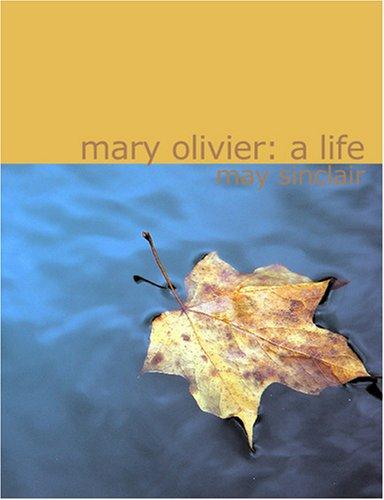
Mary Olivier: A Life

Spoiler Alert!: Some details of the novel, like the death of a certain character, is revealed in this review.
by Courtney Hilden

Mary Olivier: A Life by May Sinclair, is exactly that: the life story (though, interestingly, not necessarily her death) of the title character, who comes of age in Victorian England, struggling with an unsympathetic family, uncaring men, and a passion for intellectual pursuits.
The writing is marvelous. Like The Awakening, the novel begins as the main character is just swimming out of consciousness, and the reader moves through the first part of the book as if in coming out of a dream, becoming more aware of details as the story progresses. Sinclair, who coined the term "stream of consciousness," gives a lovely example of the technique that has so famously become a part of modern novels. The novel is incredibly impressive just because of the writing.
Mary Olivier is often compared to Jane Eyre. Both novels feature smart, meditative young women growing up in Victorian England. Because Jane Eyre is often considered a cult masterpiece by feminist scholars, I wanted to briefly compare the two characters, Mary and Jane, and to write about the issue of control within the novels.
Mary's and Jane's families, especially the women in those two families, attempt to control the main characters. Mary's mother is a Mommy Dearest: passive aggressive, inducing guilt trips, and manipulating her daughter, even when Mary is middle-aged. She disapproves of Mary's love of German, poetry, philosophy, and other subjects, so she takes books away from her. She hates that Mary is an atheist, so she constantly nags her about her beliefs and makes Mary read the Bible to her. She does not want her daughter to get married, so she continually sabotages any relationships Mary has with men. She isolates Mary alone in a home with her for decades, where Mary has little interaction with others, cannot do what she likes, and becomes increasingly cowed by her mother. This is the one of the things that was anti-feminist about the novel: as a young woman, Mary fights this oppression, but eventually allows herself to be controlled. It gets to the point where her mother no longer needs to throw her weight around; Mary makes choices based on her mother's "needs." Like a prisoner who has been watched for too long, she polices herself. Jane, of course, never knows her mother, though other women in her life (such as her aunts and her female cousins) attempt to control her. For the most part, Jane does not let them.
Then, there are of course, the men and how they attempt to control both characters. For Mary, there are multiple men that she considers for suitors: Maurice Jourdain, Lindley Vickers, and Richard. All of them disappoint her in the end. Jourdain likes her as a little girl and pays for her education. He finds that he does not like her with a real mind and that she is too headstrong, and, after being unable to change her, he marries someone else. Vickers courts her while simultaneously sleeping with another young woman in the village. And Richard grows impatient with her and her issues with her mother, so he too marries someone else. And Mary never marries, which to many readers might seem sad, but the novel ends happily, with her, in third person narration discussing how the little things in her life make her happy. Jane's Mr. Rochester infamously treats her with disdain, manipulating her and lying to her about his own marital status. And St. John tries to compel her to marry him and be his sidekick on his suicidal missionary trip. And Jane marries Mr. Rochester, who becomes less handicapped because of her in the epilogue of the novel.
Jane Eyre is a complicated novel when we consider the feminism question. On one hand, it is hard to see her as much of a feminist character or hero because she marries a man who shows her little respect, but one the other hand, she is otherwise fiercely independent when it comes to anyone else in her life. The novel suggests that one should not give up one's independence until the man of your dreams comes along. Mary, conversely, inevitably spurs the advances of all her suitors by being herself, and yet she becomes completely controlled by her mother in her later years. Mary is only happy after her mother conveniently dies. Both Jane and Mary claim to be happy at the end of their novels, and yet I am more convinced that Mary is and will continue to be relatively happy, since she has lost the last controller (her mother) of her life.
Mary Olivier is a fascinating novel in terms of its depiction of women's lives (other female characters make surprising choices not covered in this review). The novel is a great choice not only for Jane Eyre fans, but readers who enjoy Victorian and modernist literature, particularly those who enjoyed The Awakening, "The Yellow Wallpaper" or the works of Virginia Woolf. (The novel was published in 1919 but is set much earlier.)

Tuesday, January 4, 2011

From Dead to Worse

by Courtney Hilden
Spoilers: This review gives away almost all of the surprises of this books.

When sitting down to review From Dead to Worse, the eighth book in the Southern Vampire Series, I found myself wondering what I could possibly say as to what the plot was. The plot was really several episodes thrown in together. One involves Sookie meeting a new, mysterious (of course he’s mysterious, this series is nominally a mystery series) relative, another has a Nicene war within the local werewolf pack, another features a hostile takeover, and finally there’s a broken marriage thrown in for good mix. The plot sort of meanders along, and although this would usually be a good thing, it is unlike previous books in Harris’s series, and feels less controlled. This tight, no-flab writing was one of the most admirable things about Harris’s series, which lacked the bloat of other popular urban fantasies and romances. The book felt like Harris is setting up for something else (what I do not know, as I have yet to read further), maybe giving us pertinent information for future books, but otherwise feeling like a letdown.
The other majorly disappointing thing about the book is staving off (yet again!) the romance between Sookie and Eric. Eric, finally remembering everything that took place four books ago, has yet to have an important “talk” with Sookie. This is getting dragged out to the point of boredom. And also, when is Bill going to disappear? His earliest scene, talking to an undressing Sookie, felt forced, and in light on the events of the book, was totally unnecessary to the rest of the plot. His later moments in the book, talking to her on her porch and then arriving at her house during a crisis, felt more like a way to insert an otherwise useless character into the plot and way to compensate Bill/Sookie shippers for having thrown in their lot with not only a jerk of a character but a bland jerk of a character. He is the sort of person, excuse me, vampire, who desperately needs a hobby.
It seems increasingly unlikely that Sookie would still want Bill, given that he has not done much other than talk about wanting to love her. Meanwhile, Eric has shown all the initiative to respect her enough to be there for her when she meets her mysterious relative (telling her he’s there for her but backing off and allowing her to make her own decisions.) And he has shown pragmatism and care for his followers and employers. Of all the tyrants in this series, he is the least interested in power for power’s sake and the unhappiest with what power he has. Why can’t Sookie see that?
Also getting more “page time” in the series is Sam, who was also steadfastly by Sookie’s side throughout the book, helping her when he could. His back story near the end felt a bit rushed, but otherwise Sam’s a lovable character, and a great match for Sookie too.
The last quibble with this book is over lesbian relationships. Even though Amelia could be in either a heterosexual or homosexual relationship, and the book flirts briefly with Amelia and Pam as a couple, Amelia’s longer relations are always with me. Other women with women pairings are shown in earlier parts of the series as dangerous, and there’s something deeply sad and disappointing about this.
Readers could do worse than this series or even this book, which is one of the lower books within the series. The writing is still interesting, the world still imaginative, and there was even a surprise or two.

Sunday, August 15, 2010

Two Essays on The Wizard of Oz

by Courtney Hilden

Salman Rushdie, the author of books such as The Satanic Verses, writes about The Wizard of Oz, the movie that everyone loves in two short essays "A Short Text About Magic" and "At the Auction of the Ruby Slippers" in a short book called, naturally, The Wizard of Oz.
"A Short Text About Magic" explores the world of The Wizard of Oz comparing it, interestingly enough, with Bollywood films, with Rushdie, an Indian native, is familiar with.
Rushdie also gives the audience some fine trivia as part of his essay. He discusses the differences between the movie and book, including the ruby slippers originally being silver shoes. He discusses the story of the actors and actresses who played the Munchkins. He even tells the audience about how the tornado that transports Dorothy to Oz was made. (Muslin stiffened with wire, naturally.) The one detail he wishes the movie hadn't changed was the realism of Oz itself, explaining that within the original book, there was no question that Oz was a real place, but in the movie, it is simply make-believe. Rushdie believes this introduces "bad faith" into the audience, and is a pity that it did so. Rushdie here ignores the way most viewers construct the film: they ignore the suggestion it was all a dream and see it as a place that exists beyond what most humans can see, like other mythical places in modern literature, notably Hogwarts or Alice's Wonderland.
Rushdie also explores the women of the film, concentrating much of his time comparing the witches of the story. He notes that the Witch of the East (the one who dies in the beginning of the movie) was probably not much of a despot, since the streets were clean and homes well taken care of and that she didn't rely on soldiers of any kind to keep her world safe.
"At the Auction of the Ruby Slippers" is less an essay in the traditional sense and more a (possibly fictional) exploration of what the ruby slippers mean to an unnamed narrator. Rushdie is famously part of the magical realism movement within fiction, and this story/essay/whatever is not different, moving through with a dreamlike pace and tone. There are lots of details, but they feel random, as if plucked from a generator.
Both pieces feel strangely nice together in this tiny little package. It was a dream reading both of these essays, and both complement and contain the magic of their subject.

Friday, May 28, 2010

The Ten Most Beautiful Experiments

by Courtney Hilden

The Ten Most Beautiful Experiments by George Johnson is a short book chronicling the scientists and science surrounding the ten most eloquently simple and clever experiments of all time. You won't find the classic moments of Galileo's infamous observation about movement or Newton's gravity apples, but you will find some of the better known scientists and their least known experiments, with illustrations and personal stories as part of the narrative.
Sadly, the most boring part of each chapter is the explanation of the experiments. Science is best explained and understood in a more visual form, and even though the book has illustrations, it was hard to discern what Johnson was saying, even when dealing with Pavlov’s famed dog and saliva experiments, which is usually understandable in most textbooks.
The most interesting thing about this book is the human drama going on in tandem with these experiments. Johnson says in this introduction that he doesn’t want to talk about the personal lives on scientists, but then discusses it at the beginning and end of the chapter. It is unfortunately the best parts of the book, and too bad that so little time is dedicated to it.
There’s something very narrow about the author’s view. Johnson seems most interested in science happening in Western Europe from about 1810 to 1850. If he wanted to write a book about those experiments, the relationships between these scientists, he should have done so. In addition to that, much of the book focuses on the work done to understand electricity. There’s little in the way of biology, except for a chapter on the heart and (shockingly!) electricity. I don’t know what exactly Johnson’s background is, other than what is in the book’s biography, but I get the distinct impression he’s an electrical engineer. The lack of life sciences in the book is disheartening and gives the reader an impression that somehow life science is not capable of great experiments.

There’s an annoying change in point of view and verb tense within the chapters. He tells the scientist’s background in one tense, then switches to another to explain the experiment, then occasionally tell his own story in another tense. There’s something irritating in how jarring the switch is from one to another, even though they are often clearly separated within each chapter.
Overall, this book is an excellent read, but only if you already have a technical background. Otherwise, it's only interesting in small sections.