Showing posts with label Hilden. Show all posts

Monday, July 18, 2011

The Green Lantern

Spoiler Alert!: Some of the best and juiciest bits of the movie are revealed in this review.

by Courtney Hilden

With all the superhero movies made in recent years, like Batman, Spiderman and Ironman, the competition for the high-flying, mutant-spider-bitten, and spandex wearing can be tough. And yet, The Green Lantern, a lesser-known superhero, gets a decent movie.
The story picks up with Hal Jordan, a hotshot pilot, who, since he is being played by Ryan Reynolds, puts the hot in "hotshot." At work, he flies suicidally in an effort to beat drone planes, and it is a Pyrrhic victory: he beats the planes, but in the process, loses his company a government contract, and half of the employees will be fired. His ex-girlfriend, his boss, also worries about his safety, since his own father also died while flying.
Despite all this, The Green Lantern is never as dark or brooding as Batman or the later Spiderman movies. Instead, there's something wild about this character, something recklessly stupid. He shows up to his ex's in full costume, risking her discovering his identity (which takes her all of a minute to uncover.) And although he decides to save Earth solo, he does so in a way that almost destroys his life. Hal Jordan is a go-for-broke kind of character, and there's something refreshing about someone who does not brood about his decisions before or after. He simply does.
The true knockout performance in this movie is not Ryan Reynolds, although he delivers and understands his character. Peter Sarsgaard's Hector Hammond is quite possibly the most Shakespearean villain ever on screen. He is constantly being criticized and passive aggressively pushed around by his father, he is in the thankless job of a university professor and he never got the girl, and at the first hint of power he decides to use it on murdering his own father. (The writers smartly decided to concentrate the story of Hector's poor relations with his father instead of his rejection at the hands of the one female character.) Hector becomes literally bloated with his new-found power, and turns into a Frankenstein's monster of his own and his father's making: he is pitiable and evil at the same time. Sarsgaard balances these perfectly, never laying it on too thick. And his screams of pain are heartbreakingly tortured. The singer/screamers of metal bands work years to perfect their howls, and none of those come to the ones that Sarsgaard delivers.
Lastly, Mark Strong as Sinestro gives a solid performance as well. Strong is better known for playing intense enemies in movies and television shows across the pond. Strong's best characters were ones with rage bubbling beneath their surfaces. Strong does a slight turn here; instead of rage, his Sinestro is fierce, but in a subtle, strangely nurturing way. If there is going to be a second movie (and honestly, I am not opposed to the idea), then let's hope we get to see more of Strong and Reynolds together, saving the world.

Thursday, July 14, 2011

Heavier Than Heaven: A Biography of Kurt Cobain

by Courtney Hilden
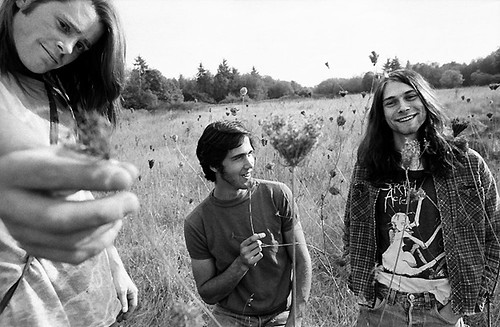
Heavier than Heaven: A Biography of Kurt Cobain by Charles R. Cross, covers the life and infamous times of the well-loved musician. The book charts the struggles within his family, his adolescent stints as both homeless and creative, his lovers (some of whom are famous in their own right), and, of course, the explosive band he served as frontman for, Nirvana.
The most difficult things about biographies is the tone. The feelings of the biographer inevitably come out, and usually this is either admiration or hatred, with little in-between. Cross manages to avoid writing a hagiography, but it is still a mostly admirable view of Cobain, and, depending on your view of Cobain, may or may not have been deserved.
Cross gives all sorts of interesting, and often surprising, details about Cobain. Cobain, famous for jumping into drum sets, destroying sets, and yes, smashing guitars, drove like "a little old lady" in the words of his bandmates, to the point where they often did not want him to drive.
Despite being fairly long, there were multiple parts of the book that begged for more details. As a teenager, Cobain became a born-again Christian while living with and befriending other born-again Christians. Given that Cobain seemed, at the least, agnostic later on in life, and famously covered Christian songs, this section of his story deserves more research, especially given that a clear reason for his falling out with Christianity never is explained.
The book focuses mostly on Cobain, but his relationships with his bandmates is only glanced at. The book does spend time discussing Chad Channing's split from the band, and how it was handled relatively maturely by Cobain and his fellow bandmate and best friend, Krist Novoselic. Minimal time is spent on Cobain's relationship with Novoselic and less on Dave Grohl, who, among other things, was Cobain's roommate.
The book also comes with a collection of black and white photos of Cobain. One of the things missing is photos of his art, which was Cobain's other great creative expression. As a fan (yes, yes, I will admit that I am really a fan of Nirvana), this could easily be a whole other book, probably in coffeebook style.
The most fascinating thing about Cobain was actually the women around him. Cobain struggled with his relationship with his mother, who Cobain seems to have seen as what we would now call a cougar, but was also put in impossibly difficult situations, with at least one unwanted pregnancy and an abusive husband. (Not Cobain's father but stepfather.) Cobain's younger sister is a lesbian, and this was almost entirely brushed over. Cobain's girlfriends, Tracy Marander, Tobi Vail, Mary Lou Lord, Courtney Love, were all interesting in their own right. The later three were all musicians themselves; Vail was a member of the seminal Bikini Kill and Love famously fronted Hole; Lord was a folk singer. Marander in particular sacrificed for Cobain, economically supporting him when Cobain was out of work. It is too bad that there are not books (or in some cases, more) about these women, who unfortunately, have become footnotes in Cobain's life and not the full people they obviously are, though this is through no fault of Cross.
For a fan, Heavier than Heaven is a must read. The less interested in Nirvana, though, the less interested most readers would be in this book.

Wednesday, September 15, 2010

Evil is Going On

Spoiler Alert!: Almost all (but not the last) spoiler for this episode are revealed in this review.
by Courtney Hilden
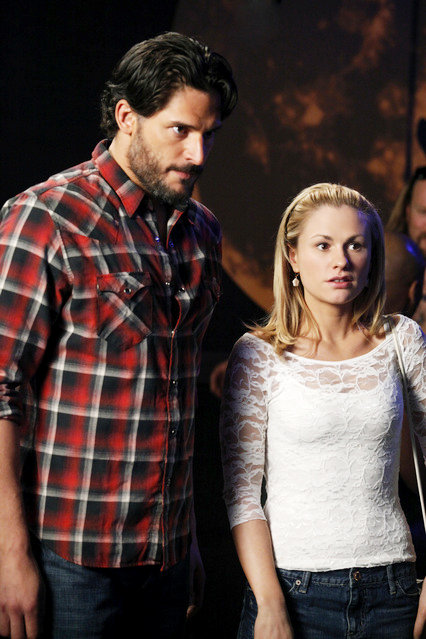
"Evil is Going On," the final episode in this season of True Blood, opened up on Eric trying to kill Russell by lying out in the sun with him. After having a conversation with Godric (who, yes, is still dead), decided to punish Russell rather than just kill him. Meanwhile, Talbot's bloody pulp-remains took a trip through the plumping system, Jesus comes out as a witch, and Sam runs after Tommy. Oh, and finally, Sookie broke up with Bill. Hopefully for good.
Dealing with one of the worse things about the episode: Was it really necessary to bring Eric's maker back? Godric was a great character, but using him in some kind of vision is about as original as the heaven world that Sookie and Bill have been making regular visits to. Godric was a great character when he was simply undead, but as an angel/figment of Eric's imagination felt contrived and silly. Even Eric's motivations are obvious through his interactions with characters (like Pam), or they are not. Either way, it could work. But using Godric-back-from-the-dead smacks of some bad tv show I am so unfamiliar with I cannot even give an example.

Sookie's power (whatever it is) has become a deus ex machina. Great, now one of the other good things on this show, conflict, will be sacrificed to make things even easier for the uncompelling character. The only good thing about this is that it gives Sookie her own power within a world where mostly white, supernatural men have power.
The only good thing about Sookie scenes was that, for once, Sookie showed some character and dumped the remains of Talbot down the drain. Her evil laugh was so liberating to watch. Talbot's remains are still gross, but we have assumably seen the last of them.
There were some good moments on the show. Tara and Sam's morning breakfast started out so cute. Tara's reluctance did a good job of capping off her recent struggles with accepting vampires and other supernatural stuff. There's something sad about watching her hate all supernaturals because of the terrible things a few of them have done, but if she really is gone for a season or two, she will come back wiser and more accepting.
Hopefully, Jason is actually going to take care of the people of Hotshot. And it's going to make him a better person. Hopefully.
Jesus's betrayal of Lafayette was awful. Poor Lafayette. He finally gets a good relationship going, and, of course, Jesus has been lying to him. And obviously manipulating him. Lafayette should not trust Jesus.
The scene between Tara and Sookie was great. It was one of the few true friend conversations that have happened. Tara should not have apologized to Sookie, since she was the one trying to help her out of what was clearly a bad relationship. Tara is always setting herself aside for her white friend, and it is so sad to watch. If the show does depict where Tara goes next, it should include her sticking up for her own feelings.
Bill continues to be a disappointment. Eric is one of the few good characters, and although it is nice to embrace my hatred of Bill now that it's clear he truly is in it for himself, I am already missing Eric.
His instance of killing anyone who has tasted Sookie is another great moment of creepy misogyny. "Tasting" here is obviously a metaphor for sex, and to here Bill claim he is going to destroy all of those who share a sexual link with her is just another one of the things to add to the "Nasty Anti-Woman Things Bill Says."
And finally, some positive things about this last episode. One of the things not cover in these reviews is how good the music has been. Every episode has ended with perfect music. The incidental music during the last scene between Tommy and Sam was particularly nice.
Also: Terry has an armadillo?

Friday, August 6, 2010

Is Salt a Feminist Movie?

A review of Salt.
by Courtney Hilden
Spoiler Alert!: Part of this plot, though not the final twist, is given away in this review.  

There was a lot of talk on blogs and forums on the Internet about Salt, a movie starring Angelina Jolie.  Before the movie came out, there was a lot of enthusiasm over how the movie was originally written with a male main character, but once Jolie became interested in the project, the gender was changed to reflect their star's.  Feminists celebrated this as a moment where gender didn't determine the casting of an actor.  After the movie came out, the movie was given mixed reviews, discussing it as a fun and well-made popcorn movie, but complaining it was not especially deep.  But it must have captured someone's attention, as it managed to make $70.8 million in ten days
But after the movie came out, there was not much of a discussion about if the film was feminist in and of itself.  And, given that other reviews have already dissected so much of the other aspects of the film, it seems important to talk about how this movie, being the only film I can think of where the gender of its main character was purposeless changed, about how gender operates in the movie
First and foremost, it was a relief to see Jolie not play up her sexiness or body.  She wore frumpy work clothes that looked unflattering and unfashionable.  She had a miserably bad haircut throughout the beginning of the movie, her blond locks looking like a bad dye job.  (While her character's actually dye job looked utterly normal on her, the kind of hair someone who only washes it every other day looks.)  Considering Jolie is the woman who, about ten years ago, played Lara Croft, where, because she apparently was not what the directors and producers wanted, had to wear fake breasts.  In a world where one of the most beloved film stars has an imperfect body, you know the standards are far too high.  It almost felt like Salt was purposeless not more than just a woman with a government job.  It was nice to have a heroine who was relatively ordinary.
But the plot's reliance on Salt's dedication to her husband is troublesome.  Early on in the film, Salt's husband, Mike, is taken by Orlov's group.  After he is killed by Orlov's men, it becomes Salt's apparent motivation, leading her to follow enough of Orlov's plan to dismantle it.  (I say apparent motivation here because it is possible that other things are motivating her, but her husband's murder is the only clear force propelling her.)  Salt's dedication is admirable, but it's troublesome that her only motivation throughout the movie is her love for her husband.  If this movie really had been about a man, it is hard to believe that it would follow this same plot.  A male character in those circumstances would have other things motivating him.
It is also important to note the lack of female character, beyond Salt.  All the other characters are male, and apparently, other than Salt, everyone important at the CIA is male.  Although women have historically struggled with jobs in the CIA, they do exist.  The complete lack of other female characters within the story just serves to remind the audience that even if the main character's gender was changed, that it was because one of the biggest stars in the world became attached to the project, not because it was a moment to make a statement about gender and characters in the movies.  And of all the things about this movie, from the ludicrous chase scenes and the McGuyver moments and the unbelievable idea that Russia has trained children to eventually bring down the U.S., that indifference to gender within the story is the most disappointing. 

Tuesday, July 27, 2010

Appointment with Death

by Courtney Hilden

Appointment with Death follows Poirot as he travels to the so-called "Middle East" to see a dig of an ancient city, where a Biblical character is said to be buried.  As always, there's murder in store when the archeologist's wife, who supplies him with the financial resources to dig, turns up dead at the site.  As always, Poirot is on the case, and, as always, there are several red herrings to distract everyone from the crime at hand. 
Poirot, like all great detectives, is all about the details, and in this outing the show itself was all about the details. Poirot, for example, was doing things in style, using an interesting cane device with a built-in binocular that allowed him to see things in the distance.  Some of the details were even creepy, like one man referring to his much younger fiance as his "child bride."  The first victim's unshuttable eyes were also a nice detail, as they emphasized how horrifying her death was.  Even Poirot himself was a little creepy, telling someone that his "gray cells" were "singing" to him while he was trying to solve the case. 
Some of details were also pertinent to the place.  They made a point at depicting the call to prayer, and then later showed a group of local men praying.  It's nice, given that this story is almost chiefly about British characters, that the show's producers and director and creators remembered to show that they are not the only ones around, although almost none of these "Arabs" (a word that is itself very troubling) had speaking parts in the story.  They're more like set pieces, in someways, much like Wedgwood plates and Edwardian furniture in those houses that Poirot so frequently inhabits.   
Speaking of faith, just as is Murder on the Orient Express, this episode emphasized Poirot's Catholic faith.  One of the villains of the story was masquerading as a nun, but Poirot stayed with his faith, even passing it on to one of the ultimate victims of the story, the four children who were brutally abused by the the first murdered victim.  It's too bad that the child abuse aspect of the story was kept at such a minimum, since it was the most interesting and depressing part of the story. 

Wednesday, July 21, 2010

"Hell is the Truth Learned Too Late"

Or, a Review of "Third Girl"
by Courtney Hilden

"Third Girl," the latest in this series of Poirot's adventures, is by far the most messy and difficult to understand story. The story involves a young woman named Norma, who visits Poirot, telling him that she believed she had committed a crime. This is apparently all Poirot needs, because he is off, tracking this girl down and trying to decide if she, indeed, has done something wrong. He discovers her involvement in a crime, including that of her two roommates, Frances, an actress, and Claudia Reese-Holland, a secretary and lover of Norma's Father, and Norma's boyfriend David, a painter. It's an embarrassingly bad and bland attempt at making a mystery interesting.
Other than that, it is hard to know where to begin with this dead carcass of a mystery. It is slow moving. The majority of the characters are impossible to care for, and Mr. Rodderick and Norma's interactions feel more like a creepy incestuous relationship than that of a father or daughter. At least one of them was suppose to believe that they were in a real relationship. Sonia and her relationship with a much older man was also creepy. The music was also melodramatic and miserable. Music is only suppose to be that on the nose in soap operas.

Once again, Jemima Rooper manages to give a great, relateable and believable performance as the title character. If her miraculous work making her the only consistently good thing on Hex and this episode of Poirot is any indication, Rooper deserves bigger and better roles, because she can clearly work material into something good.
There are other, smaller things that made this better. Poirot being insulted several times for being too old was a nice touch of levity (and perhaps another meta comment on the series, as part of the inclusion of a stand-in for Christie herself.) It was also nice to show Poirot being compassionate and solving this mystery for genuine concern for Norma, and not for being harsh and unyielding like he has become in other outings. Next time, he should be allowed to feel for his victims. Helping others should be his motivation, not enforcing the law on other's.

Monday, July 12, 2010

Despicable Me

by Courtney Hilden

Despicable Me
, the latest from Pixar, follows Gru, a bad guy from some Eastern European country. (I thought he was Hungarian, though I've seen others identify him as Russian.) His latest scheme is to steal the Moon, and to do so, he's decided he needs the shrink ray of Vector, another evil villain who spends time building various rays that shoot out sea life. Vector has ordered cookies from a group of girls, who Gru adopts.
At this point, you probably don't need to hear about the rest of the plot, because this is a Hollywood movie, so you can already guess that Gru will soften to the girls and then reverse his evil plan for stealing the Moon. The plot is standard, but only if you think about it. It's handled well-enough that it's easy to just sit back and smile. The art is now standard for Pixar, which is not to say it's bad, but it isn't game-changing. It mostly just is.
This is not to say that there are some interesting flourishes along the way, because there are.
The opening scene, including the American family on a trip to Egypt, merit an entire movie in their own right, maybe one following their trips around the world. Pharrell Williams, the more famous member of the duo the Neptunes, is given credit for scoring the music. The song he recorded for the movie is delightful. It combines a Hitchcockian beat with a slight side of gangster. Pharrell should consider doing more music for movies, because he's clearly talented at doing more than remixes and making great dance songs. There was even an on-the-nose joke likening Lehman Brothers to the fictional Bank of Evil, a rare shoutout at current events.

Saturday, July 10, 2010

The Big Bang

by Courtney Hilden

Usually, with the second part episode, it picks up exactly where the audience left off. Doctor Who decides to open in media res, with young Amelia, a believer in stars, goes to a museum and opens up the Pandorica. If you watched the last episode, you'd expect the Doctor to be inside. Instead, Amy is, flipping the audience back to Roman Britain, when Rory is given directions from the Doctor.
The only bad thing about this episode was Amy's attire. It's too bad that given the controversy over Amy's wardrobe that she was forced to wear pants instead of her cute, and totally normal, skirts.
This finale included some well-planned and perfectly executed time-travel. The writers behind the show must have realized how exhausting, and now boring, the quicken exposition is, so they took their time now, even joking that it wasn't slow enough for Rory. The episode also included a great reference at Richard Dawkins, saying that he was a cult leader. Somehow, that feels totally right, which was just like the rest of the episode. Cheers to the people behind Doctor Who for writing story arcs that go beyond just one season and for integrating all of our favorite things, including River Song. Can't wait to see more of her.

Thursday, July 1, 2010

The Blue Geranium

by Courtney Hilden
Spoiler Alert: Though the murderer is not revealed in this review, other details are.

"The Blue Geranium" is a unique episode of the latest Miss Marple series. Instead of opening up solely with the crime, it opens up with the second crime, then moves forward in time by six months to the trial of the believed killer. Miss Marple, at home and doing some gardening, realizes that the wrong killer is on trial, and then tries frantically to get to the Old Bailey in time to save the day, since the killer, if convicted, will be hanged.
The original short story, one which this episode is based, actually had Miss Marple telling the story to a group of friends and amateur sleuths at her home. Deciding not to introduce these characters, the episode opted instead for Marple to be narrating many of the events to an old friend. This is a nice change-up from the typical Marple episode, in which things are not told from any character's point of view. It also makes the mystery harder to solve, since changing from time to time means the audience has to put together a coherent timeline before even getting to the crimes. In addition to that, the audience has two murders to solve and two mysteries (who is the real killer and who is on trial).

The rest of the story is sadly not as interesting or as engaging as past Marple outings. Toby Stevens, playing the believed killer, Mr. Pritchard, and Claudie Blakley, playing his ex-girlfriend and sister-in-law Phillipa Pritchard, give serviceable performances. Sharon Small plays Mary Pritchard, Pritchard's wife, and she brings the crazy. People on the edge of insanity are often unbelievable, and this role is difficult because she has to be both irritating enough that the audience can see why Pritchard would hate her, but can't over do it. Small manages to make Mary unlikeable, but keeps the full-blown crazy to a minimum. More than anything, she's just unpleasant and paranoid, saying nasty things to the maid and harassing the police inspector. The costumes and set are decent, though the eagle decorated podium within the church was far too much.

Wednesday, June 30, 2010

It Hurts Me Too

by Courtney Hilden
Spoiler Alert: Some of the twists from this episode are given away in this review.

The next installment in the plotline juggling show that is True Blood started out with a literal bang: Sookie shot at a werewolf that had let himself into her house. (Is her house possibly some supernatural magnet? Seems like a lot of bad guys just waltz all over it, including Marianne, who turned it into a brothel mixed with a cult headquarters last season.) There were some other fun twists in the episode, including the revelation that Arlene is pregnant, not with her boyfriend's baby, but with Rene's baby. (For those of you not in the know, Rene was the villain from season one.) It also looks like Jason will become a police officer. It's a smart move, since it'll allow the audience to see more of the Andy/Jason bromance that brought so much comic relief to the last episodes of season two.

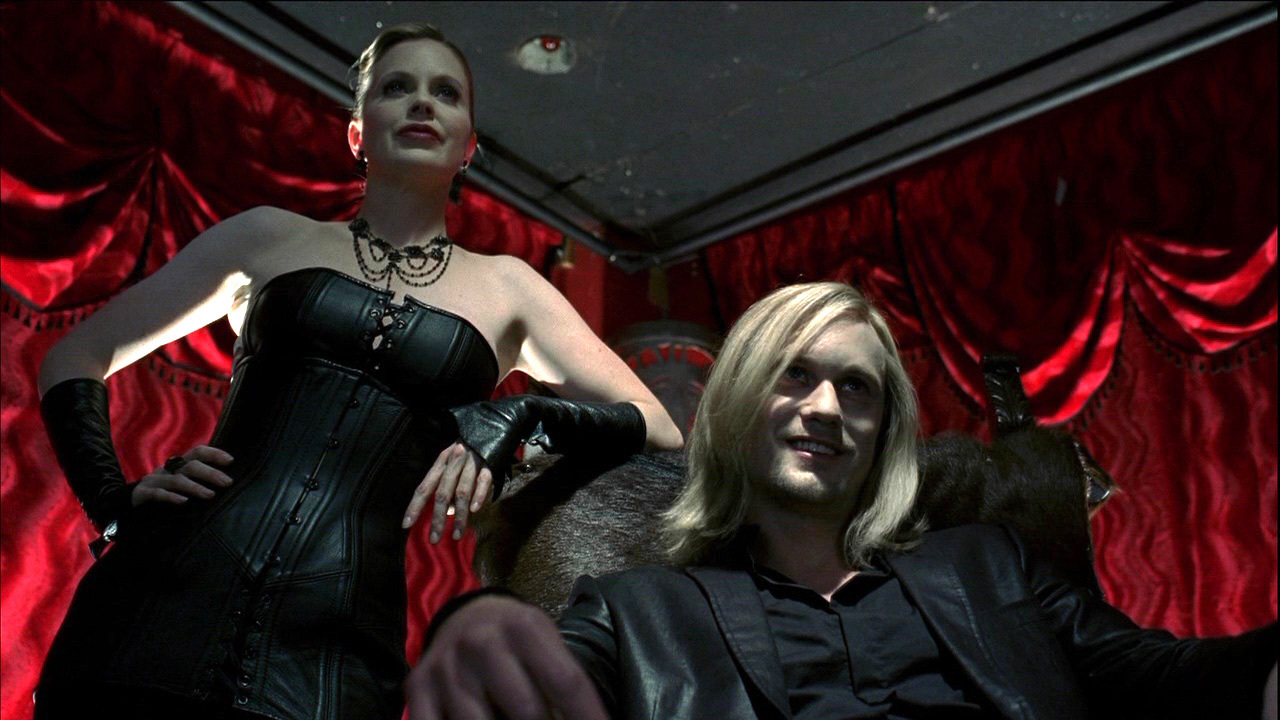
Alexander Skarsgard once again gave a stellar performance. He perfectly blends Eric's bad boy posing and his inner romantic. He gives great small touches too, like the patting of the funeral wreath after he buried the dead werewolf in an already recently-buried grave. But make no mistakes about Eric; Skarsgard can still give the menace. He's a brilliant leader, one that Machiavelli could be proud of.
Good quotes were brought to you from Lafayette, of course, who commented that it must feel new when Jason said he had a lot on his mind. Talbot had a good zinger too, telling Cooter that it was insulting to boxes to compare werewolves to them. It's hard not to love sarcastic, teenager little brother, who noted that if Sam threw a punch, he would "totally be one of them."
It might be interesting to see what they're going to do with the Sam storyline, since Sam's little brother seems surprisingly like a sociopath. It's nice that they brought Sam's family to Bon Temps, instead of having the rest of this season's Sam storyline happen elsewhere. My guess is that Sam's family is going to abuse their relationship with him, sucking money from him.
Also making an appearance is Alcide. He's a much more attractive man in this show than I thought he'd be. The other new-ish man, Franklin, is total scum, since he's clearly into blackmailing poor Jessica and Tara. He's not much of a villain, since the only thing lamer than Franklin's come-ons is his theme music.
The plotline that is the least interesting? Bill's. It's hard to care what happens to him, even with the information that he is important to Sophie-Anne. It's hard to even believe he's that important to her, since Sophie-Anne said several episodes ago that she was happy to hear he was out of the way. The flashback featuring Bill and Caroline was decent, given the flashbacks are usually dry and uninspired on this show. It's too bad we can't spend more time with Bill and Caroline, because they're a legitimately interesting couple. Lorena's lines are as terrible as Franklin's, like her whole "Your only loyalty is to your own sentiment," which she said to Bill.
Other not good things about this episode included the stilted post-coital dialogue between Tara and Franklin. It sounded more like a bad film from the forties than two modern adults talking to one another. (Bill and his wife Caroline were also somewhat stilted, though not nearly as bad as much of what came out of other vampire's fang-framed mouths.) The lack of chemistry between Tara and Franklin was particularly noticeable given the easy and sweet dialogue between Sam and Sookie and Tara and Jason. This episode was not as good as the first two of the season, but still fun and with some interesting changes to the storyline of the books.

Tuesday, June 29, 2010

Night Junkies

by Courtney Hilden

Night Junkies, a small independent horror film, is about a vampire named Vincent who accidentally turns Ruby, a stripper, into one of them. Normally, this would simply mean she becomes a vampire, but in this film vampires are more like addicts (interested in blood instead of something like drugs), and Ruby vows to break her addiction with Vincent at her side.
The movie knows how silly it is, since it opens up on a discussion of vampires and how they are all about sex. Sex is actually one of the last things this movie is about, since it makes the connection between vampires and drug junkies, which is a nice change of pace from the usual stuff audiences associate with vampires. She meets a vampire, not in a club, but in a cafe. Vampire Vincent eats a muffin.
Vincent, played by Giles Alderson, is delightful creepy and slightly awkward, sniffing the air. He has this weird nostril thing that would never work on any other character but a vampire. The chemistry between him and Ruby (Katia Winters) is prefect. It's nice that these actors aren't afraid to look like crap, with Ruby's makeup and sweat mixing in that gross way that girls are all too familiar with. These actors actually do look like people who are coming off of addictions.
There are some weak parts of this movie, including the monologues of Vincent, which would be fine if it was just to introduce the movie, but it gets used too often. He also has a strange lisp that makes him sound more like a Muppet than a vampire. Also, there's no need to be listening to the Boss carry on and on about unnecessary metaphors; just get to the point. The villain of the story, one of Ruby's old pimps, wastes our time creeping around her apartment building, harassing old ladies. He's one of the least scary villains, being almost all campy, and not, sadly, in a good way. The villain even gets a monologue, one that is boring and only stalls the obvious conclusion, which is drawn out and corny in its own way. And if that weren't enough, several bits of dialogue that are meant to be funny fall utterly flat.
From such a promising beginning and such subversion of the genre, it might give you the impression that this film is worth watching all the way through. You'd be wrong. The film loses much of its momentum about mid-way. It's an interesting idea, and certain parts of the film work, but what doesn't work ruins the few successful things about it.

Saturday, June 26, 2010

The Lodger

by Courtney Hilden
Spoiler Alert!: The ending for this episode is revealed in this review.

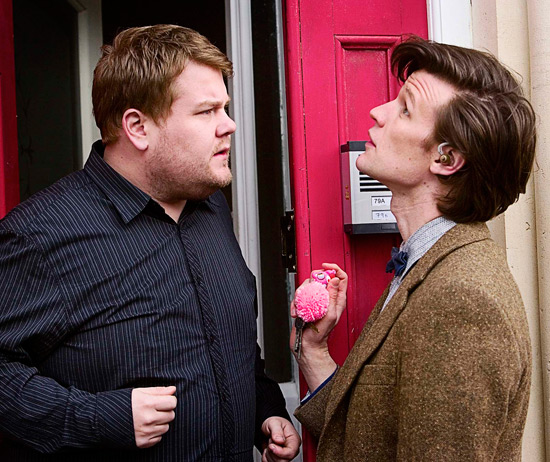
"The Lodger" follows the Doctor after he has been rejected out of the TARDIS into a small English town.  Amy can't seem to land the TARDIS, and the Doctor follows whatever is making it so into a set of flats.  He becomes the lodger at Craig's (James Corden) place, who is trying to ask out one of his best friends, Sophie (Daisy Haggard).  
It's good to see that this episode wasn't a recycled plot from a recent episode.  Instead, we got to see what Amy and the Doctor are like without each other in each other's environments, which was a nice change of pace.  It was nice to see the Doctor do "normal" things, like having a flatmate and playing football.  On the last bit, it would have also be fun to see the Doctor muck up at football, but it worked better in the overall storyline for him to be good.  Seeing the Doctor shirtless was also nice.  Maybe Matt Smith should think about playing a Greek god.  
The couple featured was way too cute.  They both like each other, they both know they like each other, but they're both way too shy.  The Doctor has turned into a matchmaker, realizing very quickly at the romance blooming.  It seemed obvious that Sophie was going to be captured by whatever it was in the upper flat which would finally galvanize Craig and Sophie to confess their love for one another. 
Sometimes it seems like the crew needs to scout out some more shooting locations, because the town that was featured in this episode looked exactly like the one featured in the first episodes of the series.  But it was a great penultimate episode, setting us up for the conclusion of the this series and the promised resolution of what the cracks all about the universe are about. 

Friday, June 25, 2010

Sex and the City 2

by Courtney Hilden

Does this movie need an introduction? Sex and the City 2 is based on the television show hit of the same name, where four women (Carrie, Samantha, Charlotte and Miranda) all interact with one another and the city (most importantly, apparently, its men) around them. In their latest outing, they head to the Middle East to scout out a hotel for Samantha to represent.
All well and good, right? Hardly.
Since this review is coming so late, it seems silly to take it down in all the ways it deserves to be: as homophobic, racist, and other miscellaneous forms of insensitive. Stanford and Anthony, two gay men who previously hated each other, are getting married. This would be fine, if Anthony didn't insist that he be allowed to cheat. For a movie written by a gay man and created by various LBGT allies, it still feels the need to create a stereotype of a gay man. And once again, New York is incredibly whitewashed, with one African American woman playing Samantha's assistant. And the section of the movie on the Middle East is filled with every stereotype they can find about Muslims. (They're so sexually repressed! They hate women!) Why this movie had to go to the Middle East and not somewhere else, where the story could have refrained from such poor depictions. (The franchise has managed to make it to L.A. and Paris, why not London, Rome or Milan, all big fashion cities?) The movie exists in a universe where yes, the recession has hit, but not realistically, since Carrie can still afford her old apartment and the girls can complain about having to fly couch. The movie was conceived before anyone apparently realized that depicting people's lives, even rich people's lives, this way was going to smart with an audience that is not so lucky.
The problem with these movies, other than their cultural fails, is that they remind the audience of how much better this material works in a television series format. At least there the audience has time to explore the storylines that get sidelined, allowing them to unfold at a more leisurely pace. The movie is long, but because it keeps moving, it rarely feels so. And mostly, it still works, since the girls are, despite their flaws, fun to be around.

Tuesday, June 22, 2010

The Secret of Chimneys

by Courtney Hilden
Spoiler Alert!: The mysteries are revealed in this review.

"The Secret of Chimneys" finds our heroine, Miss Marple, visiting an old friend and niece, Virginia, at the family's lavish country estate. A count from Austria comes to visit them to secure a business deal, and in the process, is killed. Marple, as usual, is on the case, this time aided by an Inspector Finch, who doesn't bumble around but holds his own and respects her abilities.
It's this Inspector Finch who is the most enjoyable part of the episode. It seems clear that the show is setting up a possible love interest for Miss Marple, who always plays such a quiet role in this series. Possibly Finch is not just a love interest but someone who is spying on her. It would be interesting to see if Finch returns, in what capacity, and what motivations of his will be uncovered.
There were also some lovely touches. The Count was hilariously overdressed in a Dracula-like black cloak and red-ribboned medal. Several of the characters attempting to decode the musical message with a piano was delightful. Having Marple find the diamond and then pull it out of her purse, revealing the rest of the mystery's clues, made for a shocking conclusion, because Marple herself so rarely becomes directly involved (or puts away a brother-in-law.)
Although not as good as previously episodes, it's still a solid entry in the series.

Monday, June 21, 2010

Beautifully Broken

by Courtney Hilden

The latest episode of True Blood continues each of the separate storylines the audience has been watching. Lafayette shows Tara what happened to his mother (and answering the question of what Lafayette does with all the money he makes off of V), Jason and Andy bust a meth lab, Sookie continues to search for Bill, and Sam reunites and bonds with his family.
Lafayette's Mom was the most interesting part of the episode, since she brought a subtle crazy to her character. (And also illuminated why Tara's Mom is such a pain in the ass.) The friendship between Jason and Andy continues to be both funny and sweet. Meanwhile, the audience got to see a flashback including Eric and Godric. It's a pity Godric is dead, because he is far more interesting than so many of the other vampires, since he is so much more cool-headed than most of them. But Eric is no longer a one-note character, and beginning to see his vulnerability to Sookie, who he has some connection with but doesn't know how to express.
The most boring parts of this episode? The main characters: Bill and Sookie. Bill has been kidnapped by the King of Mississippi and Sookie tries to desperately search for him. At this point, it seemed obvious that Lorena was going to show up, though not that he would try to burn her with what looked like a kerosene lamp.
Although this episode is important in terms of setting up other storylines for the show, it was, for the most part, boring. It's almost too bad there are so many storylines in the air right now, because it would be better to just follow the interesting characters, and leave others to rot with the King of Mississippi.

Saturday, June 19, 2010

Vincent and the Doctor

by Courtney Hilden

“Vincent and the Doctor” finds our favorite Doctor running after a monster he sees in an Van Gogh painting, dragging companion Amy along. The entire episode was about image and impression, since the episode (visually) referenced Van Gogh’s paintings and contained a machine that could take impressions of things to find what they really were.
The actor playing Van Gogh (Tony Curran) was delightful, sympathetic, elusive and intense. He has created some wonderful villains, and has such large, dark pupils it is possible to drown in them. Even so, it was hard not to think about the cartoon doppelganger of Van Gogh from Clone High. Bill Nighy, who played the art academic, was adorable and sweet. (Seriously, why didn't anyone consider him to be the new doctor?) As always, Karen Gillan brought a wonderful sense of delight and compassion, combining the best aspects of Rose and Donna. Matt Smith did a serviceable job as the Doctor. He's grown into the role, but sometimes he lacks any charisma to set him apart from previous doctors. (Though of course he has the hard job of following what might be the best doctor, David Tennant.) The episode still had tons of fun and well-delivered Doctorism, including the Doctor wondering if time really passed that slowly and in the right order. It was, as a whole, an uplifting episode less about the monster and more about art and loving life.

Thursday, June 17, 2010

She's the Man

by Courtney Hilden


She's the Man follows around high schooler and high society girl Violet (the charming Amanda Bynes) as she impersonates her twin brother Sebastian at his new school to prove to her former high school soccer coach and captain that girls can play soccer as well as boys. While at her/his new school, she befriends Duke (Channing Tatum) and Olivia (Laura Ramsey). Olivia falls in love with Sebastian and Duke falls for Violet at a carnival. Violet pretending to be Sebastian must make win the big game aganist her old school and navigate relationships and she pretends to be two different people. The plot is obviously a modern remake of Shakespeare's Twelve Night, similar to 10 Things I Hate About You.
Bynes gives another winning performance. She has wonderful facial expressions and uses her body to give a Chaplin-like performance. She manages to play an awkward but well-meaning young man, and blends in relatively well.
Unsurprisingly, everything ties up neat in the end, just as most of Shakespeare's comedies do. It's too bad that even the remake is unable to address the issues of identity and sexuality that the film does it's best to avoid.

Wednesday, June 16, 2010

Bad Blood

by Courtney Hilden
Spoiler Alert!: Certain surprises within the episode are revealed in this review.


"Bad Blood," the first episode of this season of True Blood, picks up where the last episode left off, with Tara still reeling over the death of Eggs, Sookie looking for a kidnapped Bill, Eric trying to sell V (vampire blood used as a drug) to fund the Queen of Louisiana, and Sam out looking for his family.  Although the episode was fascinating and moved all these storylines forward, like most episodes of the show, there wasn't much tying these things together. 
The episode opened with what has to be the longest "previously on..." segment in the history of television.  The show is juggling way too many balls at this point not to be confusing, even to those viewers who have been loyally following (including your's truly.)
It's good also to see some of the book's most interesting characters, including Kendra Jones.  Kendra is always in the background of the early books, and in this episode she gets a brief cameo.  Also seeing the Bellefleur cousins bonding over their mutual killer status was nice.  No other character manages to both be badass and sensitive like Terry Bellefleur.  That badass might be rubbing off on Andy, since he went through Jason's window.  (Also: can someone make a techno song of Andy and Jason's mantra?)  The only thing that's sad is to see Eric at his trashiest and horndoggediness.  As a fan of the books, I want to see Eric like he is in the fourth or later books.  Tara was also hard to watch.  Tara's a great character, but seeing her act like a stereotypical black woman (crazy and violent) was disappointing, since this show is supposed to be all about subverting stereotypes, though the show has always struggled to do so with non-white, non-male characters. 
The show, at this point, is espousing an atheist point of view, which would be fine, if this was a simplistic show.  It would be nice to see the show to work to show an complicated answer to God.  It's also sad that the characters often interested in God are stupid or African American.  In the latter case, it's racist, but in the former, it's simple unimaginative.  Also, in the case of race, is it necessary to make one of the few African American characters to be made a slave to white people and sell drugs, as they have with Lafayette?  Aren't there enough of those stereotypes on tv?  The only thing that was good about it was the interesting commentary about blood and drug use.  The magistrate mentions that using vampire blood for drug use was "blasphemy," a word associated with this simplistic evangelist model.  (The magistrate also mentioned that this situation was "moral anarchy.")  Maybe the show will depict drug use as not so bad or terrible in the same way that sexuality is depicted by fundamentalist Christians.   
Overall, a decent episode, one that was funny in its now-standard way and allowed all the characters the chance to naturally grow. 

Tuesday, June 15, 2010

My Sister's Keeper

by Courtney Hilden
Spoiler Alert!: The ending is given away in this review.

My Sister's Keeper is about a young girl named Anna (Abigail Breslin) who decides to persue medical emancipation from her parents so that they won't use her body to help save her older sister, Kate (Sofia Vassilieva) who is dying from cancer.
Obviously, this is a weepie movie, and only someone with a heart of stone could watch this and not feel anything for this family, which struggles not only with death but with neglect. The characters also seem far more kind and calm than anyone could reasonably expect them to be, given the circumstances.
Parts of the movie are poorly concieved. For instance, the early part of the film allows each character a monologue, and after the second one they start to feel like the screenwriter is incapable of more subltly and creatively introducting its characters. The movie also moves around in time, but because there are few points of reference, it's hard to tell where the narrative is at times, highlighting how contrived much of the action.
What is most disappointing in this movie is the attempt at romance. As Kate begins chemotherapy, she meets another cancer patient, Taylor (Thomas Dekker), and they fall in love. After Taylor dies, Kate apparently loses all the will to live, because her next move in the story is to facilitate her own death by manipulating her sister to manipulate her brother to manipulate her Mom. After all her fighting to stay alive, a boy she barely knows becomes the factor that determines how she lives or not? This is either incredibly poor motivation or a reminder of how pathetic heterosexual girls become within our society.

Saturday, June 12, 2010

Cold Blood

by Courtney Hilden


"Cold Blood," the latest episode of Doctor Who, picks up where the last episode left off, which finds our heroes, the Doctor (Matt Smith) and Amy (Karen Gillan), trying to negotiate peacefully with the Silurians, aliens that once inhabited the Earth and mean to go back.
If the Daleks are meant to be the Nazis, then these aliens are apparently the Bush Administration, since they apparently "don't negotiate with apes." Points to the show for using science fiction as a way to discuss moral problems and political issues. This is where the show should go instead of recycling previous ideas from the last few seasons.
It's possible to read the Silurians as not an alien species but as another race. It would be easy to see them, given that they were the original owners of the planet, as indigenous people. The Doctor at least encourages both sides to negotiate instead of out-right war between colonizers and the native people. Unfortunately, the humans, the colonizers, are weak enough to be goaded into killing one of the Silurians. What makes this problematic is that the hero, the Doctor, defends the humans, the colonizer, and not the oppressed group. It's also dangerous that the oppressed are depicted as unhuman, literally green and scaly.
The episode was a solid entry in the series, especially since it ditches the overused plots and characters and goes for something different.