Wednesday, July 6, 2011

AngelMonster

by Clare MacGregor
Spoiler Alert!: Some spoilers are revealed in this review

AngelMonster by Veronica Bennett tells the story of Mary Shelley, the author of the classic novel Frankenstein. AngelMonster begins when Mary is sixteen and ends when she is twenty-one. Mary’s life events are interwoven with the lives of her stepsister, Claire Clairmont, and Percy Bysshe Shelley. Throughout the course of story Mary, Percy, and Claire travel from England to France, Switzerland, and Italy. The reader is drawn into the story like a close friend of the characters. Though the novel is based on actual events and follows Mary Shelley’s life very closely, AngelMonster is not devoid of twists and turns that are sure to keep readers on the edge of their seats. During a summer visit to Lord Byron’s villa near Geneva Mary, Percy, Claire, Lord Byron, and John Polidori, take turns telling ghost stories and the beginnings of what would become Mary's Frankenstein-filled mind. Mary’s novel further develops in her imagination as her husband grows more and more dependent on laudanum, she reflects on her own mother’s death, and Claire’s life is torn apart by Lord Byron. Some of these events are conveyed in dream-like intervals sprinkled throughout the story.
Bennett provides such richly vivid historical detail that the reader feels as though they are in the same room as the characters. The story of Mary Shelley’s life is skillfully told by Bennett. AngelMonster is a must read for anyone who loves Frankenstein and wishes to learn more about the author, or any fans of Gothic novels.

Wednesday, June 29, 2011

Creepy Creatures

by Courtney Hilden
Spoiler Alert!: Some of the endings of the stories are revealed in this review.

Earlier, we here at Recommended reviewed Terror Trips, a collection of horror stories from Goosebumps told in a graphic narrative style. Creepy Creatures is the same basic format: three horror stories from R.L. Stine. Because this is Goosebumps, the stories are meant to still be appropriate for younger readers. "The Werewolf of Fever Swamp" is about a family that moves into a new neighborhood and finds there may be werewolves living in the forest. "The Scarecrow Walks at Midnight" is about two siblings whose trip to their grandparents farm is ruined by animated scarecrows. And "The Abominable Snowman of Pasadena" is about a scientist father and his children bringing home Bigfoot.
The artwork is all three stories is distracting. Both "The Werewolf of Fever Swamp" and "The Scarecrow Walks at Midnight" have art that is relatively realistic, particularly the latter. The art for "The Abominable Snowman of Pasadena" is much more cartoony, but the eyes are really distracting, with uncolored pupils.
The two superior sections, in terms of storytelling, are "The Werewolf of Fever Swamp" and "The Scarecrow Walks at Midnight." In the werewolf story, in the end, the young man and narrator turns into a werewolf, which, considering these stories are meant to be for children (just about no one ever dies), is surprising. "The Scarecrow Walks at Midnight" is actually interesting because it depicts one of the grandparents' employers, Stanley, who is depicted as having some kind of special need.
It is this character who is the most problematic. Stanley is the bad guy in the story, who has created zombie-like scarecrows based on things he read in a magic book. People with disabilities are often depicted as stupid, pathetic, evil or combinations thereof. In this story, Stanley is depicted as all of them. He is evil enough to use his scarecrows to threaten the grandparents and the siblings, but too stupid and pathetic to effectively control or destroy the scarecrows. No real motivation is given for his actions; apparently his "inabilities" do that for him. No critique of the family that employs him or society that marginalizes someone like him is given (which would have served for a more reasonable and sympathetic motivation.) Instead, he is just bad. Instead, he is just like his zombie-scarecrows; dangerous and needing to be controlled by the employers (easily read here as capitalists) and the abled.
Creepy Creatures is not as good as Terror Trips, both in terms of art and storylines. Creepy Creatures also has some problematic depictions of those with special needs, which discerning parents might want to shield their children from or at least discuss with them.

Thursday, June 16, 2011

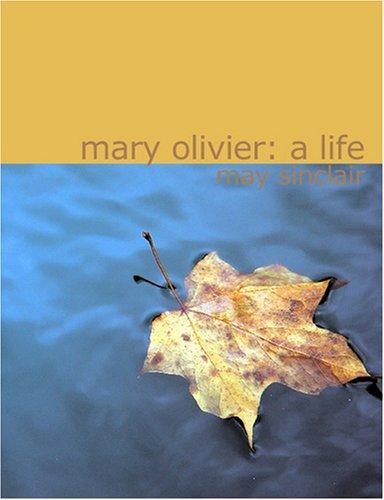
Mary Olivier: A Life

Spoiler Alert!: Some details of the novel, like the death of a certain character, is revealed in this review.
by Courtney Hilden

Mary Olivier: A Life by May Sinclair, is exactly that: the life story (though, interestingly, not necessarily her death) of the title character, who comes of age in Victorian England, struggling with an unsympathetic family, uncaring men, and a passion for intellectual pursuits.
The writing is marvelous. Like The Awakening, the novel begins as the main character is just swimming out of consciousness, and the reader moves through the first part of the book as if in coming out of a dream, becoming more aware of details as the story progresses. Sinclair, who coined the term "stream of consciousness," gives a lovely example of the technique that has so famously become a part of modern novels. The novel is incredibly impressive just because of the writing.
Mary Olivier is often compared to Jane Eyre. Both novels feature smart, meditative young women growing up in Victorian England. Because Jane Eyre is often considered a cult masterpiece by feminist scholars, I wanted to briefly compare the two characters, Mary and Jane, and to write about the issue of control within the novels.
Mary's and Jane's families, especially the women in those two families, attempt to control the main characters. Mary's mother is a Mommy Dearest: passive aggressive, inducing guilt trips, and manipulating her daughter, even when Mary is middle-aged. She disapproves of Mary's love of German, poetry, philosophy, and other subjects, so she takes books away from her. She hates that Mary is an atheist, so she constantly nags her about her beliefs and makes Mary read the Bible to her. She does not want her daughter to get married, so she continually sabotages any relationships Mary has with men. She isolates Mary alone in a home with her for decades, where Mary has little interaction with others, cannot do what she likes, and becomes increasingly cowed by her mother. This is the one of the things that was anti-feminist about the novel: as a young woman, Mary fights this oppression, but eventually allows herself to be controlled. It gets to the point where her mother no longer needs to throw her weight around; Mary makes choices based on her mother's "needs." Like a prisoner who has been watched for too long, she polices herself. Jane, of course, never knows her mother, though other women in her life (such as her aunts and her female cousins) attempt to control her. For the most part, Jane does not let them.
Then, there are of course, the men and how they attempt to control both characters. For Mary, there are multiple men that she considers for suitors: Maurice Jourdain, Lindley Vickers, and Richard. All of them disappoint her in the end. Jourdain likes her as a little girl and pays for her education. He finds that he does not like her with a real mind and that she is too headstrong, and, after being unable to change her, he marries someone else. Vickers courts her while simultaneously sleeping with another young woman in the village. And Richard grows impatient with her and her issues with her mother, so he too marries someone else. And Mary never marries, which to many readers might seem sad, but the novel ends happily, with her, in third person narration discussing how the little things in her life make her happy. Jane's Mr. Rochester infamously treats her with disdain, manipulating her and lying to her about his own marital status. And St. John tries to compel her to marry him and be his sidekick on his suicidal missionary trip. And Jane marries Mr. Rochester, who becomes less handicapped because of her in the epilogue of the novel.
Jane Eyre is a complicated novel when we consider the feminism question. On one hand, it is hard to see her as much of a feminist character or hero because she marries a man who shows her little respect, but one the other hand, she is otherwise fiercely independent when it comes to anyone else in her life. The novel suggests that one should not give up one's independence until the man of your dreams comes along. Mary, conversely, inevitably spurs the advances of all her suitors by being herself, and yet she becomes completely controlled by her mother in her later years. Mary is only happy after her mother conveniently dies. Both Jane and Mary claim to be happy at the end of their novels, and yet I am more convinced that Mary is and will continue to be relatively happy, since she has lost the last controller (her mother) of her life.
Mary Olivier is a fascinating novel in terms of its depiction of women's lives (other female characters make surprising choices not covered in this review). The novel is a great choice not only for Jane Eyre fans, but readers who enjoy Victorian and modernist literature, particularly those who enjoyed The Awakening, "The Yellow Wallpaper" or the works of Virginia Woolf. (The novel was published in 1919 but is set much earlier.)

Monday, June 13, 2011

The Dark-Hunter Companion

by Clare MacGregor

Sherrilyn Kenyon’s Dark-Hunters books draw readers into a world of hunters whose duty it is to protect the human race from supernatural forces that would harm them both in the waking world and in their dreams. Each group of hunters has strict rules they must live by. These rules not only dictate their interactions with humans, but interactions with each other. Because there are so many factions in the world of the Dark-Hunters, readers might easily find it difficult to keep the relationships between the various Hunter factions, the Demons and Gods clear in their head. The Dark-Hunter Companion by Sherrrilyn Kenyon is a companion book for the Dark-Hunter, Dream-Hunter, and Were-Hunter series’ is written as an instruction book for a new Dark-Hunter. In the book each subdivision of Hunters has their own chapter. The first chapter is made up of the dos and don’ts of the Dark-Hunters’ world. Included in each chapter has a “directory” for the Hunters of that subgroup. The “directory” also notes which books in the series feature certain characters. In the Were-Hunters’ chapter includes descriptions of and menus from the Were-Hunters favorite hang outs. Some of the restaurants/clubs sound so amazing readers will wish they were real places. Each chapter explains the origin of each group of Hunters. If readers are familiar with mythology (particularly Greek) the easiest characters to remember will be the Gods and Goddesses. The Dark-Hunter Companion includes deleted scenes from some of the Dark-Hunter novels and an interview with Sherrilyn Kenyon.
The Dark Hunter Companion is a wonderful book to have on hand when reading the Dark- Hunter, Dream-Hunter, and Were-Hunter series to use as quick reference.

Monday, June 6, 2011

Beyond Heaving Bosoms: The Smart Bitches' Guide to Romance Novels

by Clare MacGregor

Sarah Wendell and Candy Tan are the founders of Smart Bitches, Trashy Books website and blog have published a book that has caught the eye of romance authors and romance readers alike. Beyond Heaving Bosoms: The Smart Bitches’ Guide to Romance Novels by Sarah Wendell and Candy Tan is a wonderful laugh-inducing literary criticism of the romance genre. The authors of this book, both avid romance readers, delve into everything romance readers’ love and love to laugh at about the genre. Subjects discussed in Beyond Heaving Bosoms include “Cringe-Worthy Plot Devices”, “The Covers, and The Reasons to Snark Them”, and “Defending the Genre”. There are also in depth analysis of heroines and heroes. The book also includes “The Ten Commandments of Heroine Conduct” and “The Bitches’ Dictionary” which provides definitions of stock characters and situations that can be found in nearly every subgenre of the romance novel. Beyond Heaving Bosoms includes lots of fun and games such as “Choose Your Own Man Tatty”, the Romance genre’s answer to Choose Your Own Adventure, a color by numbers Romance cover, and “Write Your Own Romance” (a Mad-Lib game) just to name a few. While some games and activities like the Romance maze allow for only one player, others like “The Smart Bitches’ Big Mis Game”, “Create Your Own Deflowering Scene”, and “Anatomy of a Truly Excellent Romance Cover Treasure Hunt” are great for a Girls’ Night In.
Reading Beyond Heaving Bosoms is like chatting with friends. Beyond Heaving Bosoms is great light-hearted read for both avid romance readers and fans of other genres alike.

Friday, May 20, 2011

Crash Love

by Courtney Hilden

Although I might be later embarrassed to admit this, I am an A.F.I. fan. I first became aware of them when they were mostly a punk band, and I liked the supernatural melodrama of their album The Art of Drowning, which struck me as a perfect soundtrack to shows like Buffy the Vampire Slayer. Later on, when they released their Sing the Sorrow, I was impressed by the breath of influences (80s neoromantics, metal, punk, goth, pop) and their lyrical content, which focused on the same apocalyptic themes but with more imagery. In songwriting, it is so easy to tell listeners; it is so much harder to show them. Then Decemberunderground came out, and I was so disappointed by the B-side-esque quality of the most of the music, I was simply to afraid to try their next album, Crash Love. If it was bad, it would break my heart, because then it meant that A.F.I. was no longer the band I had loved. So I put off listening to it, even though I purchased it in late 2009.
What a mistake putting that off was.
Crash Love is not a perfect album, but it would be hard for anyone to beat out Sing the Sorrow. Crash Love is still wonderful, and breaks new ground lyrically for A.F.I. The album's lyrics are mostly centered around a souring relationship, which, considering the focus of some of their earlier work, is both new ground for them and old hat for most bands, which usually focus their work of this exact subject. What makes A.F.I.'s take on the subject interesting is how unrelentingly and unembarrassingly messed up and melodramatic this whole unraveling relationship is. Several of the songs, like "Beautiful Thieves" talk about committing crimes together, in a way that strangely conjures up Bonnie and Clyde, if they were modern criminals who shopped at Hot Topic. Many of the songs discuss pretending within the relationship, like in "Veronica Sawyer Smokes" mentions "feigning falling" and "Okay I Feel Better Now" where the singer admits "faking for you." The song "Too Shy to Scream" prophetically works through the breakup, noting that the other person will not even pause their life after ending a relationship, just simply move on. Hughes films are even referenced in "Veronica Sawyer Smokes."
The song that is actually the most interesting (and perhaps the most lyrically impressive) is "Sacrilege." It is the only song that is not obviously about a deteriorating relationship. Instead, it appears to be a critique of religion from an atheist point of view. It brings up multiple aspects of religion, calling it obsolete, filled with "hysteric fairy tales" and "one big joke." It twists and flips religious imagery and phrases in clever ways. "Say your prayers, they're the final punchline./I don't see the love/below or above," Havok sings. "Please believe I'm doing just fine." Given that so much of A.F.I.'s previous music has referenced apocalypses and religious imagery, this song is particularly interesting and sheds a new light on their older work.
The album is a perfect distillation of the power punk pop that A.F.I. is so famous for. There is something invigorating about the overall sound of the album, and unlike most pop out there, the songs deal in uncommon ways with love, and in the case of one song, critiques religion in an impressively passionate way.

Friday, April 22, 2011

Terror Trips


Spoiler Alert!: Some of the endings to these short stories are revealed in this review
by Courtney Hilden

Terror Trips is a collection of three Goosebumps stories done as graphic narratives. "One Day at Horrorland" chronicles a family's misadventures at a theme park, "Deep Trouble" is about a boy visiting his scientist uncle and meeting a mermaid, and "A Shocker on Shock Street" is about two kids trying out a new theme park ride.
Each story stands up at least reasonably well within the graphic narrative (or as the kids would probably read these call them, comics.) There is plenty of action and monsters to make each story fun.
The two stories for "Deep Trouble" and "One Day at Horrorland" are predictable. "Deep Trouble" has the hero, Billy, comes to the inevitable conclusion that the mermaid, captured for scientific study and confinement, should be released. "One Day at Horrorland" is slightly less predictable, with the children remembering a detail about the theme park that leads them to the discover the weakness of the monsters that are about to kill them. It is the sort of detail that seems to obvious in retrospect. In terms of the storyline, the impressive one is "A Shocker on Shock Street," which has an impressive Twilight Zone-esque ending. The story starts out with the assumption that the two children are completely normal, but in the end, it turns out they were like their father's other creations: robots meant to emulate something else. The ending was well-handled, fast, and devastating.
The art work for "Deep Trouble" is particularly beautiful. The artist, Amy Kim Ganter, created an adorable mermaid, one that I would love to follow in further adventures. The artwork for the other two stories was serviceable for the story but not as eye-catching as Ganter's work.