Drood by Dan Simmons is a story of friendship, deceit, madness, and mystery. The narrator, Wilkie Collins, a friend and collaborator of Charles Dickens, begins the tale in the year 1865, recounting the Staplehurst railway accident and the aftermath of the accident. During the accident Dickens encounters a mysterious man by the name of Drood. Deeply intrigued by this phantom-like man Charles Dickens discovers Drood’s whereabouts and insists that Collins come along with him when he visits Undertown. Reluctantly, Collins goes with him, but is only permitted to go so far. Days after this night-time visit to Undertown, Wilkie Collins meets a police officer who enlists him to act as an informant regarding the man named Drood. Drood’s influence seeps deeper and deeper into Wilkie Collins’s life and imagination, but it’s not only Drood who haunts Willkie Collins’s mind, Willkie is convinced that there is another Willkie, one who looks just like him, but is not him, who begins making additions to whatever story or play Wilkie Collins is currently working on. At first Collins is infuriated that “the other Wilkie” who is contributing to the stories while Collins is sleeping; but as things progress Collins begins to rely on his doppelganger more and more. One evening while Dickens is visiting, Collins hears Dickens, Drood, and the doppelganger of himself conspiring against him. As Dickens health begins to decline, Drood assigns the task of writing his biography (a tasks once entrusted to Dickens) to Collins. He adamantly refuses, but Drood will not be dissuaded. Already obsessed with Drood, Collins’s mind and life begins to increasingly overflow with paranoia. A few days before Dickens suffers a stroke, he reveals a secret about Drood.
Drood will appeal to fans of historical fiction, thrillers, mystery, horror, and fans of the movie/play Amadeus as Charles Dickens and Wilkie Collins have a Salieri/Mozart-like friendship.
Sarah Wendell and Candy Tan are the founders of Smart Bitches, Trashy Books website and blog have published a book that has caught the eye of romance authors and romance readers alike. Beyond Heaving Bosoms: The Smart Bitches’ Guide to Romance Novels by Sarah Wendell and Candy Tan is a wonderful laugh-inducing literary criticism of the romance genre. The authors of this book, both avid romance readers, delve into everything romance readers’ love and love to laugh at about the genre. Subjects discussed in Beyond Heaving Bosoms include “Cringe-Worthy Plot Devices”, “The Covers, and The Reasons to Snark Them”, and “Defending the Genre”. There are also in depth analysis of heroines and heroes. The book also includes “The Ten Commandments of Heroine Conduct” and “The Bitches’ Dictionary” which provides definitions of stock characters and situations that can be found in nearly every subgenre of the romance novel. Beyond Heaving Bosoms includes lots of fun and games such as “Choose Your Own Man Tatty”, the Romance genre’s answer to Choose Your Own Adventure, a color by numbers Romance cover, and “Write Your Own Romance” (a Mad-Lib game) just to name a few. While some games and activities like the Romance maze allow for only one player, others like “The Smart Bitches’ Big Mis Game”, “Create Your Own Deflowering Scene”, and “Anatomy of a Truly Excellent Romance Cover Treasure Hunt” are great for a Girls’ Night In. Reading Beyond Heaving Bosoms is like chatting with friends. Beyond Heaving Bosoms is great light-hearted read for both avid romance readers and fans of other genres alike.
Although I might be later embarrassed to admit this, I am an A.F.I. fan. I first became aware of them when they were mostly a punk band, and I liked the supernatural melodrama of their album The Art of Drowning, which struck me as a perfect soundtrack to shows like Buffy the Vampire Slayer. Later on, when they released their Sing the Sorrow, I was impressed by the breath of influences (80s neoromantics, metal, punk, goth, pop) and their lyrical content, which focused on the same apocalyptic themes but with more imagery. In songwriting, it is so easy to tell listeners; it is so much harder to show them. Then Decemberunderground came out, and I was so disappointed by the B-side-esque quality of the most of the music, I was simply to afraid to try their next album, Crash Love. If it was bad, it would break my heart, because then it meant that A.F.I. was no longer the band I had loved. So I put off listening to it, even though I purchased it in late 2009. What a mistake putting that off was. Crash Love is not a perfect album, but it would be hard for anyone to beat out Sing the Sorrow. Crash Love is still wonderful, and breaks new ground lyrically for A.F.I. The album's lyrics are mostly centered around a souring relationship, which, considering the focus of some of their earlier work, is both new ground for them and old hat for most bands, which usually focus their work of this exact subject. What makes A.F.I.'s take on the subject interesting is how unrelentingly and unembarrassingly messed up and melodramatic this whole unraveling relationship is. Several of the songs, like "Beautiful Thieves" talk about committing crimes together, in a way that strangely conjures up Bonnie and Clyde, if they were modern criminals who shopped at Hot Topic. Many of the songs discuss pretending within the relationship, like in "Veronica Sawyer Smokes" mentions "feigning falling" and "Okay I Feel Better Now" where the singer admits "faking for you." The song "Too Shy to Scream" prophetically works through the breakup, noting that the other person will not even pause their life after ending a relationship, just simply move on. Hughes films are even referenced in "Veronica Sawyer Smokes." The song that is actually the most interesting (and perhaps the most lyrically impressive) is "Sacrilege." It is the only song that is not obviously about a deteriorating relationship. Instead, it appears to be a critique of religion from an atheist point of view. It brings up multiple aspects of religion, calling it obsolete, filled with "hysteric fairy tales" and "one big joke." It twists and flips religious imagery and phrases in clever ways. "Say your prayers, they're the final punchline./I don't see the love/below or above," Havok sings. "Please believe I'm doing just fine." Given that so much of A.F.I.'s previous music has referenced apocalypses and religious imagery, this song is particularly interesting and sheds a new light on their older work. The album is a perfect distillation of the power punk pop that A.F.I. is so famous for. There is something invigorating about the overall sound of the album, and unlike most pop out there, the songs deal in uncommon ways with love, and in the case of one song, critiques religion in an impressively passionate way.
by Courtney Hilden Spoiler Alert!: The first and last spoilers of this episode of revealed in this review.
"Night on the Sun," the latest episode of True Blood, opened up on what fans have been waiting for seasons now: the breakup of Sookie and Bill. Although it was probably heartbreaking for Sookie to break up with Bill, there was something deeply relieving about it. Too bad Bill is still going to be an important part of the show and that the breakup did not last. One of the other reasons it is too bad the breakup did not last was because there are lots of sweet-hearted male characters on this show for Sookie to have a relationship with, and Bill, is well, either boring or annoying. The only good thing about this episode's opening was that it was a nice change of pace to have an opening not dependent on guts, blood, violence, or a naked Eric. (Though the last is always welcome.) Instead, we got to see a scene that is usually reserved for the end of episodes, where Bill breaks up with Sookie. One of those great male characters includes Terry Bellefleur. It's nice to see him, since it has been MIA for the last few episodes. It is too bad that his sweetheart Arlene is obsessing that the baby she is about to have is an evil ex-boyfriend's. The most troubling aspect of this show continues to be the rape that Sookie suffered from. Jason was right to suggest that Sookie press chargers, though not because Bill was a "fanger" but because he had raped her. Since vampires are often meant to stand in for other sexual or racial minorities on this show, having a vampire be a rapist is problematic, since it suggests that minorities are a threat to white womanhood. This is not to say that Sookie deserves to be raped, but as a critique of the collective imagination of the Other being sexually dangerous. One of the other storylines about domestic violence, Crystal and Jason's relationship, shows a white man, Jason, defending a white woman, furthering the idea that white men are the defenders of women. All the white men on this show are always protecting Sookie: Eric, Bill, Alcide, Jason and Sam. This kind of storyline would make a Birth of the Nation fan proud, but on a show that is meant to be forward-thinking, just embarrassing. The other rape metaphor working on the show, Tara's dominance by Franklin, is slightly more progressive. At least in this storyline it acknowledged the tragic psychological damage rape can do, when Tara has a nightmare of Franklin visiting her in the shower. Not that I really wanted Tara to be mentally raped by anyone, but at least here there's an acknowledgment of the violation she suffered and how difficult that is to deal with. This tragic moment led Tara to try to talk to Sookie. Sookie, sadly but not unsurprisingly, ignored her. Tara and Sookie's relationship isn't even capable of existing outside of a man's world, since that is the only thing they seem to talk about. It was great that finally someone was able to tell Sookie that Bill was dangerous, even if Sookie ignored it. Tara is one of the few female characters on this show who seems to have it together enough emotionally to realize when something is a bad idea. The only domestic relationship that is working out right now appears to be Bill and Jessica. Bill might actually be capable of being a good father figure to Jessica, if he applies himself. Again, good for Jessica for sticking up for herself and asserting her needs, which right now includes having someone to show her the ropes of being a vampire. Best lines of the episode go to Jason for his line about a cult "washing" his brain.
A Review of Murder on the Orient Express by Courtney Hilden Spoiler Alert!: Some of the clues to this shockingly good mystery are revealed in this review.
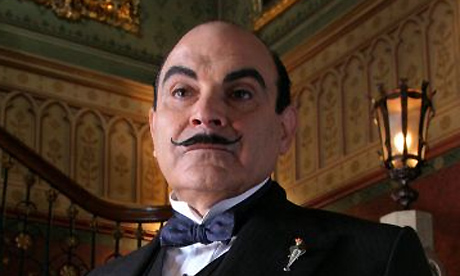
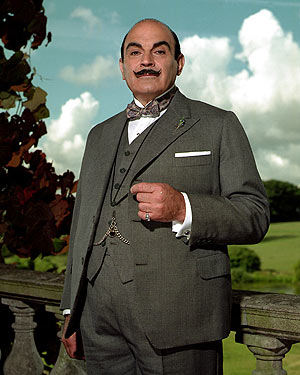
There are few murder mysteries that are recognizable even to non-mystery fans: Ten Little Indians, The Fall of the House of Usher, The Girl with the Dragon Tattoo and Murder on the Orient Express. The last has recently been adapted for a movie, and it blows most mysteries out of the proverbial snow drift, painting everything in snow white and murky gray, meditating on faith and justice, filled with hubris and the empty feeling of being near death, leaving the main character and the audience as cold as the winter world outside the train cars on the Orient Express. The story follows Poirot on a trip aboard the title train. It is only through befriending the train's owner that he secures for himself aboard. Sometime the first night the lodger in the room next to him dies after being stabbed several times in several odd ways. Poirot, despite his reluctance, begins to solve the crime. Smart choices are made by the creators. The music during the opening scene (in which Poirot gives one of his celebrated analysis-turned-interrogation only to have the criminal commit suicide in front of him) is dissonant and perfect, like the sound Lost used to signify it was flashing back, forward, to the side or where ever else that show wanted to go. Toby Jones, last seen playing the Dream Lord on Doctor Who, brings another thankless but great small performance in the role of the victim. He gives us no question to his vileness or how he is used to getting what he wants, but leaves us to ponder his repentance. David Morrissey and Hugh Bonneville also give their normal level of top-notch performing. There are even brief moments of humor in an otherwise deeply serious film. At one point a character uses the word “Bastard” and then apologizes, asking everyone to excuse “her French.” “It is indeed a French word,” Poirot replies. Thematically, the connection between faith and justice is made. Poirot, a Catholic, believes in justice through the courts, yet many of the other train passengers clearly believe in picking up where God, if he exists or not, exacting revenge. Shots of rosaries, one of the few things that could logically be on a train are used throughout. The thing that is particularly smart about all of this is that the story never makes a blatant judgment on the moral standings of these characters. It would be easy to descent into this, but by making no one right and no one wrong, the audience if left to contemplate the nature of right and wrong on their own. Films without answers are always the ones that stay with us the longest, and, even though the mystery of who murdered the train passenger is solved, the mystery of what is right and wrong, of what God asks us to do, and what justice really is remain as mysterious as the murder was in the beginning.
In most films with this kind of moral conundrum, the murderers would then be shown as self-made monsters, who, now that they have taken the law into their hands once are willing to do it once again. Instead, they wisely speak to one another, as a counsel, as their own appointed God, and this leaves their previous actions look all the more noble, since they are capable of sticking themselves to a very hard, though different from Poirot’s, moral standard. It's not a flawless film. Poirot's habit of speaking in third person is still irritating. The film also flirts around an Imperialist interpretation of the so-called Middle East. Turkey, where the film begins, is depicted with every stereotype of the region you can think of: violent, hateful towards women and uncivilized. Poirot himself has always been the weakest thing about these outings. These days, with characters on tv on other mystery shows like Bones, Law and Order, CSI, etc. that contain detectives as dark, interesting and surprising as their suspects, it's no longer acceptable to have detectives who blandly sit in as the observer for the audience. They have to being going through something during the crimes, they have to be emotionally invested, and, if possible, dark and just barely able to put on the show of being okay. Poirot, despite the revelation at the end, stays as static at the end of the film as he was at the beginning. He’s shaken, sure, but he shows no signs of changing his views. He’s just as much as an unfeeling and severe hardass at the beginning as he is at the end. No matter how glazed over his eyes are through much of the film or the waterworks that happens at the end, the audience is left with no question as to his unbowed point of view. What would be really fun to watch is him changing his mind, or even better, changing how he handles crime. As chilling as the weather or the crime in this story, nothing is as chilly as someone unable to consider the other side’s argument. No one wants to watch a guy so hard-wound that he specifies to waiters that he wants his eggs to be the exact same size.
 by Clare MacGregor


 Although I might be later embarrassed to admit this, I am an A.F.I. fan. I first became aware of them when they were mostly a punk band, and I liked the supernatural melodrama of their album The Art of Drowning, which struck me as a perfect soundtrack to shows like Buffy the Vampire Slayer. Later on, when they released their Sing the Sorrow, I was impressed by the breath of influences (80s neoromantics, metal, punk, goth, pop) and their lyrical content, which focused on the same apocalyptic themes but with more imagery. In songwriting, it is so easy to tell listeners; it is so much harder to show them. Then Decemberunderground came out, and I was so disappointed by the B-side-esque quality of the most of the music, I was simply to afraid to try their next album, Crash Love. If it was bad, it would break my heart, because then it meant that A.F.I. was no longer the band I had loved. So I put off listening to it, even though I purchased it in late 2009.