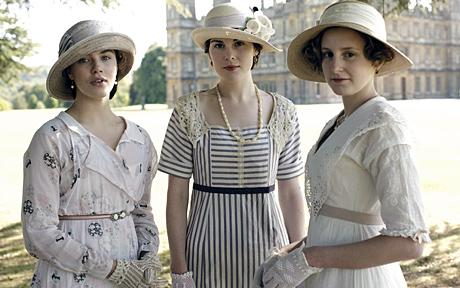
This time, in the penultimate episode of Downton Abbey, the carnival comes to town! Which mostly means various couples try their luck with each other and fail (or in the case of Matthew and Mary, fail again.) Then Grandma has her revenge by knowing some medicine and letting poor Mr. Mosley win the flower competition. And if there was not enough cattiness between Grandma and Matthew's Mom, don't worry: Mary and Ingrid are still at each other's throats.
If this makes it seem like not much happened in this episode of Downton Abbey, well, yes, not much did. Even though not much developed in the way of the story, not the way the previous two episodes did (or, the fourth episode hopefully will), it was a mostly enjoyable episode. Most of these characters are interesting enough at this point that just watching them interact together is enough.
As usual, the politics of some of the things going on are troubling. Thomas must be the most hurtful person on earth, asking Daisy out, even though he knew that William was interested. But at the same time, there's something bothersome in the character of Thomas. He is a terrible human being, but because he is also interested in men, making him into a villain is just another way of making gay men evil, and really, there are enough villain-gay men in the world. Even one of the cooks described him as a "troubled soul," which, although slightly more forgiving than some viewers might be inclined, is still sad. Would it really kill this show to depict how both lonely and scary being a closeted gay man in a homophobic world? Or are they too busy making him into the bad guy, who, at this point, I have concluded probably had the Turkish gentleman poisoned in revenge. It is the sort of terrible thing this show would do.
It is so nice, so refreshing, to have a miniseries that engages with the problems of women. Sadly, it is high class women that are mostly explored, but Mary's struggle to accept "just marriage" is sad to watch. It is interesting to note that Mary is not the one who takes up feminism, but her younger sister Sibyl, even though feminism has just as much to offer Mary as it does the other women. "The world is changing," Countess Cora says to Mary, "just not fast enough for you." Mary is right to be angry that no one wants to fight for her.
 The show also gave Mrs. Hewes a difficult choice: continuing her job at Downton or marriage to the man she spurred many years ago. She chose her job (and, in modern parlance, her career), but there was something sad about this. She too, is limited by the roles appropriated for women. She can be a career woman or a family woman, but she could never dare be both. Also interesting to note that she did not even consider love in her decision: she never said she loved her beau, just that he was "nice man."
The cutest couple award for this show goes to Sibyl and Gwen. Sibyl, a budding young feminist, is all about helping out Gwen the maid become Gwen the secretary. So far there has not been any luck, but Sibyl's encouragement (and the lending of clothes) has been heartwarming to watch. They are both nice girls, and I would really like to see a full-blown romance develop between them.
If this makes it seem like not much happened in this episode of Downton Abbey, well, yes, not much did. Even though not much developed in the way of the story, not the way the previous two episodes did (or, the fourth episode hopefully will), it was a mostly enjoyable episode.
 Most of these characters are interesting enough at this point that just watching them interact together is enough.
As usual, the politics of some of the things going on are troubling. Thomas must be the most hurtful person on earth, asking Daisy out, even though he knew that William was interested. But at the same time, there's something bothersome in the character of Thomas. He is a terrible human being, but because he is also interested in men, making him into a villain is just another way of making gay men evil, and really, there are enough villain-gay men in the world. Even one of the cooks described him as a "troubled soul," which, although slightly more forgiving than some viewers might be inclined, is still sad. Would it really kill this show to depict how both lonely and scary being a closeted gay man in a homophobic world?
 Or are they too busy making him into the bad guy, who, at this point, I have concluded probably had the Turkish gentleman poisoned in revenge. It is the sort of terrible thing this show would do.
It is so nice, so refreshing, to have a miniseries that engages with the problems of women. Sadly, it is high class women that are mostly explored, but Mary's struggle to accept "just marriage" is sad to watch. It is interesting to note that Mary is not the one who takes up feminism, but her younger sister Sibyl, even though feminism has just as much to offer Mary as it does the other women. "The world is changing," Countess Cora says to Mary, "just not fast enough for you." Mary is right to be angry that no one wants to fight for her.
 The show also gave Mrs. Hewes a difficult choice: continuing her job at Downton or marriage to the man she spurred many years ago. She chose her job (and, in modern parlance, her career), but there was something sad about this. She too, is limited by the roles appropriated for women. She can be a career woman or a family woman, but she could never dare be both. Also interesting to note that she did not even consider love in her decision: she never said she loved her beau, just that he was "nice man."
The cutest couple award for this show goes to Sibyl and Gwen. Sibyl, a budding young feminist, is all about helping out Gwen the maid become Gwen the secretary. So far there has not been any luck, but Sibyl's encouragement (and the lending of clothes) has been heartwarming to watch. They are both nice girls, and I would really like to see a full-blown romance develop between them.