Showing posts with label women. Show all posts

Thursday, July 14, 2011

Heavier Than Heaven: A Biography of Kurt Cobain

by Courtney Hilden
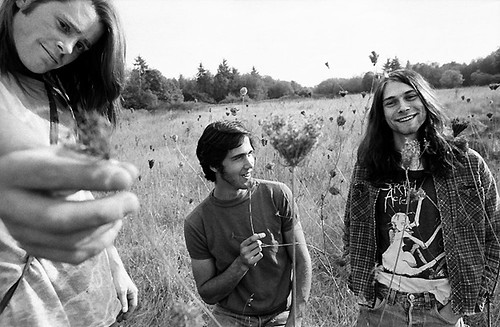
Heavier than Heaven: A Biography of Kurt Cobain by Charles R. Cross, covers the life and infamous times of the well-loved musician. The book charts the struggles within his family, his adolescent stints as both homeless and creative, his lovers (some of whom are famous in their own right), and, of course, the explosive band he served as frontman for, Nirvana.
The most difficult things about biographies is the tone. The feelings of the biographer inevitably come out, and usually this is either admiration or hatred, with little in-between. Cross manages to avoid writing a hagiography, but it is still a mostly admirable view of Cobain, and, depending on your view of Cobain, may or may not have been deserved.
Cross gives all sorts of interesting, and often surprising, details about Cobain. Cobain, famous for jumping into drum sets, destroying sets, and yes, smashing guitars, drove like "a little old lady" in the words of his bandmates, to the point where they often did not want him to drive.
Despite being fairly long, there were multiple parts of the book that begged for more details. As a teenager, Cobain became a born-again Christian while living with and befriending other born-again Christians. Given that Cobain seemed, at the least, agnostic later on in life, and famously covered Christian songs, this section of his story deserves more research, especially given that a clear reason for his falling out with Christianity never is explained.
The book focuses mostly on Cobain, but his relationships with his bandmates is only glanced at. The book does spend time discussing Chad Channing's split from the band, and how it was handled relatively maturely by Cobain and his fellow bandmate and best friend, Krist Novoselic. Minimal time is spent on Cobain's relationship with Novoselic and less on Dave Grohl, who, among other things, was Cobain's roommate.
The book also comes with a collection of black and white photos of Cobain. One of the things missing is photos of his art, which was Cobain's other great creative expression. As a fan (yes, yes, I will admit that I am really a fan of Nirvana), this could easily be a whole other book, probably in coffeebook style.
The most fascinating thing about Cobain was actually the women around him. Cobain struggled with his relationship with his mother, who Cobain seems to have seen as what we would now call a cougar, but was also put in impossibly difficult situations, with at least one unwanted pregnancy and an abusive husband. (Not Cobain's father but stepfather.) Cobain's younger sister is a lesbian, and this was almost entirely brushed over. Cobain's girlfriends, Tracy Marander, Tobi Vail, Mary Lou Lord, Courtney Love, were all interesting in their own right. The later three were all musicians themselves; Vail was a member of the seminal Bikini Kill and Love famously fronted Hole; Lord was a folk singer. Marander in particular sacrificed for Cobain, economically supporting him when Cobain was out of work. It is too bad that there are not books (or in some cases, more) about these women, who unfortunately, have become footnotes in Cobain's life and not the full people they obviously are, though this is through no fault of Cross.
For a fan, Heavier than Heaven is a must read. The less interested in Nirvana, though, the less interested most readers would be in this book.
Wednesday, March 16, 2011

Motor City Blues

Spoiler Alert!: The most important spoiler for the season so far is in this review.
by Courtney Hilden

Oh, hi, Detroit 187, it's been a long time since we've checked in with you.
The first thing this episode covered, and probably the biggest change on the show, is the death of Detective Stone. He sort of died off screen, as the audience watched him get shot and then they ended the episode there. And when we returned, there were the detectives, mourning his loss. Given that Stone was one of the few white and young actors on the show, it's surprising that they killed him off. This is actually sort of admirable, because usually when they kill off characters they are the person of color who has always been relegated to a side character anyway. Here's hoping the show will allow the other characters, almost all who are people of color, will be the focus of the show. They are far more interesting.
That said, the characters got over Stone's death pretty quickly. By about fifteen minutes into the episode, it was easy to conclude that no one on the team had died, judging by how business as usual the characters were. Sanchez, as a woman (and the only woman really on this team, as one of the others is a boss and the other is federal) was the only one allowed to mourn, which adheres to our culture's insistance that only women can (should, are weaker for) showing emotion and that men never feel anything, especially not for a colleague or friend. The scene between Sanchez and Fitch, talking about Stone, rang incredibly false. The actress playing Sanchez seemed to struggle to be sad.
Speaking of feminism, it would have been easy for this show to turn Fitch's wife, Linda, into a sterotype, but instead, they showed her as someone who wanted her son to know his father and wanted to avoid a confrontation with him. This is possibly the most heartaching and realistic-kid-centric divorced couple I've seen on television.
That said, taken in the context of Sanchez, Latina as female stereotype and Linda, white woman as not a female stereotype, I was bothered. Linda, a white character, is allowed to be more than her identity as a white woman, while Sanchez is confined to the stereotypes of Latinas as histronic. Or, put another way, Sanchez, as a woman of color has been defined solely as a woman of color, and nothing beyond that.
(As of this episode, Sanchez is also the character with the least to do or the least backstory. The show has spent time showing the audience Fitch's family problems, Washington's relative family bliss, Longford's struggle with whether or not to retire, and Mahajan, with his romantic life. When are they going to give Sanchez something to do other than be a love interest of Stone and Fitch? When is she going to be defined as more than a woman for male characters to desire?)
That said, this show as a whole has done been doing some wonderful things with their soundtrack and set. The soundtrack has been a wonderful blend of old school and new school, with an emphasis on music that has come out of Detroit. The graffiti in this episode was also great. "At least Katrina was quick." That's a wonderful bit of on-the-nose politics. Nice. And the best moment? Bobby freaking out Washington by calling him on the phone.

Monday, February 28, 2011

Any Human Heart Episode Three

by Courtney Hilden

I am usually sad to see a miniseries come to an end on Masterpiece Theater, Classics Edition, but here I found I was desperate to see this particular story, with increasingly wonky structure, no discernible meaning, and despicable characters, end, so then finally, blessedly, I would never have to revisit this work.
The first two episodes were relatively simple: Logan, the main character, moves between a netherworld where all his former selves reside, the story of his life, and then his old age self. Episode three found the story also moving between several stories of the older self (played by Jim Broadbent), and this became particularly confusing, as it wasn't exactly clear when things were happening. (When exactly, in the chronology, was Logan at the beach? He was suddenly in the cabin burning things, then we cut back to the beach scene, where he's drinking a beer and looking miserable.)
Midway through the episode, Logan asks himself "is my luck running out?" What I find myself wondering is when he ever had luck. His entire life was just one mistake after the next, and the fact that he spends his entire life thinking it's luck, when it's clearly all about the decisions he makes (and, the decisions other's make), his continued illusions just make him seem far too stupid. (The only thing easier to see through is the makeup that the various young actors had to put on.)
But all these things are tiny quibbles next to the various problems of the work as a whole, which I found myself struggling with. The place of women within the story was troublesome. Logan spends his entire life treating women poorly. He sleeps with women he knows are involved with his best friend, Peter. He marries two separate women because he wants to be in a relationship, not because he loves them. When one tells him she's divorcing him, he throws an abusive fit at her. He longs for children, but never to really be there or do anything remotely supportive, he just wants their love and affection, particularly the love and affection of female children, in what is an obviously creepy role. And then he sleeps with whatever he can. And yet, the work never passes any judgement on his poor behavior, never reveals the obvious misogyny and patriarchy that destroys several of these women's lives. If nothing else, it seems to revel in Logan's relationships with women, even depicting them as the underpinning of his life. But, of course, Logan's life is not about how much he loved these women, it's about a pathetic man too oblivious to realize how much harm he does and how treating women badly is impractical because it just leaves him feeling empty and hopeless, which just causes him to repeat the cycle of lovelessness all over. The work glorifying him as a model is problematic because there is nothing really good about him, just selfish, pathetic, or both.
The other troubling depiction is of the socialist collection Logan works for in this particular episode. Like other parts of this story, this just seems to be another way for the work to show how important its star is ("Look!" the works says. "There's the former King of England, there's the second World War, there's a reference to "Hills Like White Elephants." Please. Let's not pretend that this isn't just a cherry picking of historical events to make the audience feel as if somehow Logan is important, when the truth of someone's life within historical events is often far more complicated and rarely so involved in things only a Masterpiece Theater audience would be familiar with.) This socialist collective could have been fascinating, a critique of the collective's most anti-woman, racist leanings, which is vaguely danced around. Instead, it became a series of jokes, poorly made and apolitical. This miniseries might leave you to believe that the collective was ridiculous to have security measures, but the truth was that organizations like this were under constant watch from various governments, and they did work, through spies to infiltrate and disrupt their activities. (Whole books, yes, whole books, have been written on the subject, and yet this miniseries, with its dedication to HISTORY, is ignorant of them.) Two girls who engage in lesbian sex are depicted as evil, mean and stupid, and just another attempt to make lesbians villains. Moreover, this part of the episode totally brushes over what the collective was trying to do, making it into a silly game of silly young people, instead of important work to end oppression, work that still, in various ways, goes on today. It is an insulting depiction of activists. If you think that activists are unimportant, then clearly you haven't been paying attention to the work going on in Egypt.
Overall, the work was toggling between boring and offensive. I would much rather seen the life story of almost every female character than Logan, and I would have much rather seen historical events depicted in the way they happened, not from a reactionary, simplistic point of view. The only thing that I liked about this miniseries is that it is over and that, unlike say, Downton Abbey, there isn't talk of a second season.

Monday, January 24, 2011

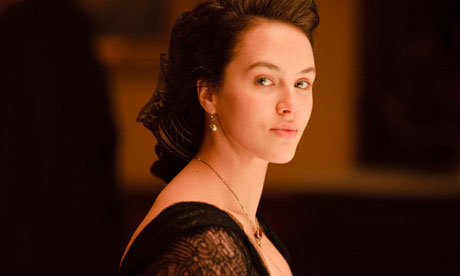
Downton Abbey: Episode 3

by Courtney Hilden

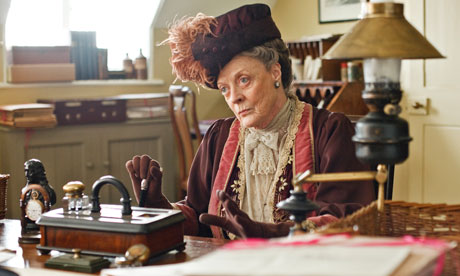
This time, in the penultimate episode of Downton Abbey, the carnival comes to town! Which mostly means various couples try their luck with each other and fail (or in the case of Matthew and Mary, fail again.) Then Grandma has her revenge by knowing some medicine and letting poor Mr. Mosley win the flower competition. And if there was not enough cattiness between Grandma and Matthew's Mom, don't worry: Mary and Ingrid are still at each other's throats.
If this makes it seem like not much happened in this episode of Downton Abbey, well, yes, not much did. Even though not much developed in the way of the story, not the way the previous two episodes did (or, the fourth episode hopefully will), it was a mostly enjoyable episode. Most of these characters are interesting enough at this point that just watching them interact together is enough.
As usual, the politics of some of the things going on are troubling. Thomas must be the most hurtful person on earth, asking Daisy out, even though he knew that William was interested. But at the same time, there's something bothersome in the character of Thomas. He is a terrible human being, but because he is also interested in men, making him into a villain is just another way of making gay men evil, and really, there are enough villain-gay men in the world. Even one of the cooks described him as a "troubled soul," which, although slightly more forgiving than some viewers might be inclined, is still sad. Would it really kill this show to depict how both lonely and scary being a closeted gay man in a homophobic world? Or are they too busy making him into the bad guy, who, at this point, I have concluded probably had the Turkish gentleman poisoned in revenge. It is the sort of terrible thing this show would do.
It is so nice, so refreshing, to have a miniseries that engages with the problems of women. Sadly, it is high class women that are mostly explored, but Mary's struggle to accept "just marriage" is sad to watch. It is interesting to note that Mary is not the one who takes up feminism, but her younger sister Sibyl, even though feminism has just as much to offer Mary as it does the other women. "The world is changing," Countess Cora says to Mary, "just not fast enough for you." Mary is right to be angry that no one wants to fight for her.
The show also gave Mrs. Hewes a difficult choice: continuing her job at Downton or marriage to the man she spurred many years ago. She chose her job (and, in modern parlance, her career), but there was something sad about this. She too, is limited by the roles appropriated for women. She can be a career woman or a family woman, but she could never dare be both. Also interesting to note that she did not even consider love in her decision: she never said she loved her beau, just that he was "nice man."
The cutest couple award for this show goes to Sibyl and Gwen. Sibyl, a budding young feminist, is all about helping out Gwen the maid become Gwen the secretary. So far there has not been any luck, but Sibyl's encouragement (and the lending of clothes) has been heartwarming to watch. They are both nice girls, and I would really like to see a full-blown romance develop between them.

Saturday, December 25, 2010

Doctor Who: A Christmas Carol

by Courtney Hilden
Most of the episode's spoilers are unrevealed in this review.

By now, even Americans are well-aware that Doctor Who, the alien traveler who takes humans as companions, has their own Christmas special. This Christmas, the Doctor, Amy and Rory headed out to a strange planet where the clouds have to be controlled and where the sky swims with fishes and sharks. In an attempt to save a crashing spaceship, the Doctor has to work on the miserable old man who controls the sky by going back into his past and changing his childhood.
As usual, the crew who worked on set design deserve a huge award for the episode, which was beautifully constructed. The planet was phenomenal and strange. The fish were a wonderful touch to a planet that otherwise seemed like a vaguely steampunk remake of last year's Christmas speical Dickens-esque London.
The delightful episode had lots for older, sci-fi fans, like with the spaceship that was meant to emulate the Bridge in the most recent Star Trek movie. The nerd references continued, with discussion of how you can tame the sky (Firefly perhaps?) and with "Bored Now" (a classic quote from Buffy the Vampire Slayer.)
Matt Smith gave a wonderful, energetic, manic performance. His bon mots were inspired and delivered perfectly. Casting him and his Doctor as the Ghost of Christmas Past (and later Christmas Future) was a good idea, because, more than any other character, he lives in the past. Smith works magic with children, and his interactions with child!Sanders was more of two children talking to one another than an adult (alien) and a child. David Tennant's Doctor, for all his silliness, gave off the air of being adult and filled with adult desires. There is something strangely adolescent about Smith's performance, one that has desire but is still terribly confused by it. This is a fascinating touch to add to a character, one that has made watching the Doctor more psychologically penetrating.
Michael Gambon's performance, unsurprisingly, was made of win. He made a great Scrooge-like character. Unfortunately, the only sad thing about this episode was how little we saw of Rory and Amy, and the complete lack of everyone's favorite character, River Song.
The trading of a woman's body was incredibly creepy. Anthropologists have documented the way in which women's bodies have been traded throughout societies, and the unanswered question of what Mr. Sanders would do with this young lady's body went unanswered. They showed us where they went (a frozen storage facility.) Sanders strange infatuation with Abigail taken as "security" also emphasizes the anthropological theory of women as a sexual trading object.
As a finaly note: Does anyone know where I can get a sonic screwdriver to float in my fish bowl?

Wednesday, November 24, 2010

Chuck Versus Phase Three

On the most recent episode of Chuck, Sarah tries desperately to find Chuck.  Sarah became, in the words of Casey, "unpredictable."  Casey discussed how he disliked Sarah pre-Chuck, which is really interesting, because it implies that Casey saw something good in Sarah and Chuck's relationship.  It gives Casey's character an extra and interesting shade, since he's never said anything on the subject before and he so rarely says anything positive at all.  The episode also showed off Sarah as emotionally invested and the actress's chops.  She's always a strong character, and that's great, but seeing the intimate moment of her grief was a wonderful quiet moment in a show that usually is about the flash bang.  The episode also featured far more of the other characters and not Chuck himself, again, a nice change up from the usual. 
The best part of this episode is that it acknowledged Chuck's fear for marrying Sarah, who Morgan called "a big fish."  But then we see that Chuck wants to get over that; he doesn't want his fear of a strong woman to stop him from being with her.  It might not quite be feminism, since Sarah felt the need to say that she was nothing without Chuck, but the show positively depicts both a strong woman and the man who wants to be with her.  Sadly, you don't see that on tv too often, so in this way, the show has not only done something unique but positive for how people see gender on tv.  The only thing that isn't okay is that Sarah was in some ways "crazy" without her man.  Casey acknowledged that, given the circumstances, she had the right to be upset, but Beckman still wanted her watched.  It was borderline "hysterical woman" meme, and that's tired. 
The dream sequence that the episode opened up on was delightful strange, especially considering that it featured the show's favorite freak, Lester.  (Does Lester ever wear normal clothes, or is it only work uniforms and costumes for this guy?)
This episode also featured some great villians.  "The Belgian" was so creepy, especially with his glasses magnifying his eyes so he looked like an insect.   


In terms of disappointments, the episode tried hard to skirt around the issue of torture, which was really a pity.  Torture has been such a difficult issue in American politics lately, that it seemed too easy for Sarah to just talk a Thai diplomat and terroritsts into giving pertinant information.  Not that torture needed to happen, but the lack of dialogue over it was a little too American.  The closest they got to dialogue on violence at all was when Morgan suggested maybe they shouldn't use guns.  Again, Morgan has been aware of Chuck's situation for long enough that it seems strange that he is now opposed to guns.  And that the dialogue was limited to Morgan not wanting to be sacrificed, so then of course he's okay with guns.  And then even Casey had to admit that guns were unnecessary when they tried another tactic.  The show only kind of deals with violence in a comical way, almost never in a serious way.  Again, no dialogue on the subject.   
The episode also discussed how as spies, Casey and Sarah didn't have juristiction over certain places.  Why are we several years into this show and only now discussing bureaucracy?  Usually it's the first excuse a show like this would use to justify certain actions and storylines. 
It would also be nice for Casey to actually put his foot down and truly tell Morgan no.  The show has already established how tough Casey is, so why doesn't he just throw Morgan into a cell or tie him up to a chair?  Morgan trailing along on these missions is far too unrealistic.  "I definetely know how to use this, dirtbags"?  I would have riddled his body with bullets if he said that to me. 
And, even though the show had some good pro-women moments, how disappointing that Sarah can't save herself.  I would much rather watch her save Chuck without anyone's help.  And there was no need for her to make herself wet, except for the male gaze.  So even though yes, she's a strong woman, and yes, Chuck loves that about her, why is it her power is always being subverted by other things?  Can't we just have her be a badass without everything els
e becoming an issue?
And wouldn't it have been great if Ellie got exposed to the Intersect when she got into that computer?

Friday, November 19, 2010

The Babe in the Bar

by Courtney Hilden

In this episode of Bones a woman is discovered in a giant chocolate bar. Like many of the show's openings, this happened to have the gross-out moment where putrefied body liquid came out of the bar. Luckily (or maybe not) the body liquid looked like carmel and raspberry filing, not corpse juice.
Meanwhile, other characters were dealing with other storylines. Cam's daughter was about to apply to college, and decided she wanted to go to Central Maine State. It was so nice to see a character applying to a college that no one has ever gone to. Every time characters go to college on tv, they go somewhere well-known and usually prestigious, so showing a state school is a nice change. The not so good thing about this decision? Michelle's motivation for going to the school, which was where her boyfriend was going to be at. The storyline also emphasized Cam's lack of confidence in Sweets. When Angela suggested Cam talk to him, Cam said that she didn't want to "talk to a child about a child." Ouch. It was really unfair, considering that Sweets did make a reasonable argument for why Cam should back off. Of course, just because Sweets made a reasonable argument doesn't mean Cam listened, which includes applying for her adopted daughter.
Also, Hodgins finally decided it was time to announce his and Angela's pregnancy. You already knew how the baby surprise storyline was going to end, since the writers have been setting everyone up since the beginning of the season. Poor Hodgins had no idea that everyone already knew the surprise. Angela was forced into asking people into pretending they were surprise, which of course means they would accidentally tip Hodgins off.
As for the central storyline, I was hoping that the victim had lied to her family about training to be a chocolate maker. It was additionally strange that no matter what the size of evidence, there's always a table big enough to hold it, even when it's a giant chocolate lab. (And don't defend this by saying they had borrowed the table. Did you see how big that table is? Who has a table like that just so someone can borrow it?) Also lame? Making the victim, named Harriet, a spy.

Wednesday, August 18, 2010

Everything is Broken

by Courtney Hilden
Spoiler Alert!: Almost all of the surprises in this episode are revealed in this review.

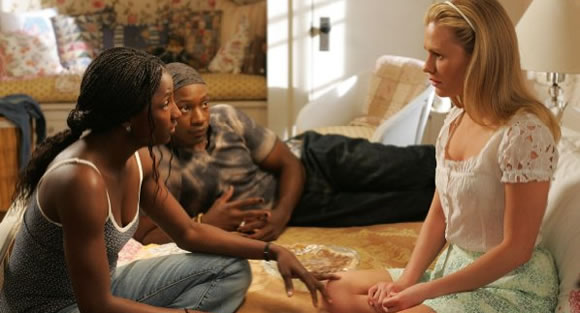
In the latest episode of True Blood, "Everything is Broken," Sookie and Hadley met up in an aquarium to see Hadley's son, Eric gave a testimony to the Authority, white womanhood continued to be the chief concern of Jason, Tara continued to heal from her rape, and Sam cut loose after another series of struggles over parenthood.
First and foremost, our show's heroine: Sookie. It's interesting to note that even though Sookie would provide a safe sanctuary for Eric and Pam, he chooses someone else. Even though Eric has decided to get his revenge, he also is still loyal to Sookie.
Sookie will probably never be able to appreciate Eric's loyalty, because, as the episode showed, she is too busy being happy with Bill. Her and Bill shared one of the show's few calm moments with an intimate shower between the two. Then Bill and Sookie had a conversation about the secrets Bill has been hiding from Sookie. She rightly asserted that she is not a thing and not something that needs protection, especially now when she has been through so much. It was a nice change of pace from the usual powerless Sookie that fans are always complaining about.
As discussed in the review of the last episode, there is a lot of defending white womanhood. A lot of it apparently centers on Jason, who this episode was taking care of Crystal, his new potential girlfriend. Parts of it were admirable, since Jason told Crystal's boyfriend that Crystal was allowed to do what she wanted. But parts of it weren't, since it quickly turned into him controlling her.
Black womanhood, in the form of Tara, continues to be sidelined, though she too has gone through a terrible, traumatic event. (And unlike Sookie, recognizes how much danger she was in.) Sam wisely suggests that she consider a shrink. These scenes are troublesome because, again, it's a man protecting a woman, but nice in that they show that these characters do really care for one another. It was so wonderful to see Tara yell at Franklin for being a rapist. But again, as part of the whole "men saving women" meme on this show, Jason ended up saving Tara. For once, can a woman be the one to defend herself?
I will credit the show for at least trying to be progressive. It was also great to see women coming together to support each other. Hopefully, this group will help Tara deal with her situation and save herself from further emotional damage. Women coming together to help each other and fight rape culture? That's feminism. It doesn't make up for the rest of this show, but it's a start.
In terms of race, the show introduced a really interesting concept: snitching. Snitching has been an issue within minority races, particularly African Americans. But the connection between meth-doing, rapist shapeshifters and the African American community is a very dangerous one to make. The outside community doesn't understand why they are the way they are, but at the same time they beat Crystal. It's an unflattering portrait of people of color at best.
One of the many nice things about this episode was the lack of Bill. Sadly, one of the scenes we did get with Bill included another romp through the heaven-garden, which was even more boring than the first time when it was Sookie running around.
Eric and Pam's scene together afterward made up for it. Eric and Pam genuinely do care for one another and it was nice to see that. Eric is not just loyal, he's strong. And far more admirable than Bill.
Finally, after waiting a few episodes, the audience got to see this mysterious Authority, which, unsurprisingly, is represented in the form of Nan Flanigan, the spokeswoman for vampires across America. This Authority is just as unfrightening as it sounded it would be, though Eric took it seriously enough. (Seriously, though, web cams? Those things are scarier in dystopian novels.) Eric has a lot on his plate these days, and Alexander Skarsgaard does a great job of making himself look like a scared puppy. (He even swallows dramatically.) Watching him rat out Russell was a joy, especially since giving this kind of information is usually a thankless task. Watching Russell becoming unhinged at the end of the episode was also a pleasure. His speech almost came off as a piece of slam poetry. And unlike the Authority, he was slightly scary.
Sam is basically a parent now, and managing it better than Bill has done so far with Jessica. At least Sam tries to be a positive influence and guide his adopted kid to being a normal, successful citizens. It's too bad that parenting Tommy is such a thankless task. (Sam parenting Jessica would also be fun to watch, though she would probably realize what was for her own good.)
Gross out moment of the night was brought to you by Talbot, whose remains were disgustingly pawed by Russell at the beginning of the episode. It was creepier than what happened later in the episode, when Russel started carrying around a jar with Talbot's remains inside. It's so macabre and strangely Victorian. Quote of the night goes to Andy, who discussed how he has an ulcer so big coffee was coming out of his bellybutton. The cutest nickname of the night award goes to Lafayette, who was referred to as "Lala" by his Mom. Aww. And the fashion moment of the night was also brought to you by Lafayette (who has by far the best wardrobe on this show) wearing a rosary as a necklace. Haven't seen that look since the late nineties with the Spice Girls. Nice.
Also, as a final note, Holly seems like a wonderful and kind person, which means that she is probably really evil and about to destroy someone's life.

Tuesday, August 17, 2010

The Ghost

by Courtney Hilden
Spoiler Alert!: The "twists" at the end of this film is revealed in this review.

The Ghost is about a woman, Margaret, whose husband, John Hitchcock, is slowly dying in 1910 Scotland. But don't think she's in despair about her husband. Margaret is having an affair with John's doctor, Dr. Charles Livingstone. Charles kills John, planning to run away with Margaret and John's money. Of course, John's money goes missing, which would probably be the biggest problem if it wasn't of course for all the creepy things going around the house at night.
The film hits all the Gothic cliches: dramatic music, creaking chain sounds, dark and stormy nights, people channeling the dead, blood appearing out of no where, secret passages. Charles even looks just like Edward Norton in The Illusionist. (Or maybe Norton's look was based on this film.)
There are lots of flaws in the film. Despite being set in Scotland, only one (small) character has a Scottish accent, Mr. Fisher. There's almost no mystery as to what is happening in the film. The audience knows the moment Catherine the maid is guaranteed her job for the rest of her life that she is obviously helping John's plan. John is clearly not dead and manipulating events so that Margaret will believe that Charles is betraying her, killing him in the process. It's no surprise when John shows up, telling Margaret the truth.
The best part of the film? Without a doubt Barbara Steele, a horror movie veteran by the time this film was made. Her eyes are large and expressive and she conveys each emotion crystal clear. She's a perfect example of the old acting mantra "acting is reacting."
The film is meant to scare people in more ways than one. It is common when someone is terminally ill for a spouse to cheat on them, though in the vast majority of cases the man cheats in a heterosexual coupling, not the wife. By making the wife the cheater in the story, it makes a moral judgment on women and their capacity of be faithful. The movie is on some level a criticism of women's desires, since that's apparently where the trouble is.
The only thing that might saves this movie is the ending, in which Margaret has her revenge. Neither John nor Charles is particularly appealing, and both come off an infants who demand her attentions. When John returns, he accidentally drinks poison, only to have Margaret taunt him with the antidote which she purposely spills in front of him. John slips behind the secret passage right as Scotland Yard arrives. Margaret is taken away as a murder (although she has only committed one murder, not two), and John dies, boarded up in his own house, his plan have fallen apart. No one really gets away with their behavior in this movie, three of the main characters dying and the fourth carted away to jail. Since Margaret is the only survivor, it leaves in question who is morally the most reprehensible: the cheaters or those who seek revenge.

Friday, August 6, 2010

Is Salt a Feminist Movie?

A review of Salt.
by Courtney Hilden
Spoiler Alert!: Part of this plot, though not the final twist, is given away in this review.  

There was a lot of talk on blogs and forums on the Internet about Salt, a movie starring Angelina Jolie.  Before the movie came out, there was a lot of enthusiasm over how the movie was originally written with a male main character, but once Jolie became interested in the project, the gender was changed to reflect their star's.  Feminists celebrated this as a moment where gender didn't determine the casting of an actor.  After the movie came out, the movie was given mixed reviews, discussing it as a fun and well-made popcorn movie, but complaining it was not especially deep.  But it must have captured someone's attention, as it managed to make $70.8 million in ten days
But after the movie came out, there was not much of a discussion about if the film was feminist in and of itself.  And, given that other reviews have already dissected so much of the other aspects of the film, it seems important to talk about how this movie, being the only film I can think of where the gender of its main character was purposeless changed, about how gender operates in the movie
First and foremost, it was a relief to see Jolie not play up her sexiness or body.  She wore frumpy work clothes that looked unflattering and unfashionable.  She had a miserably bad haircut throughout the beginning of the movie, her blond locks looking like a bad dye job.  (While her character's actually dye job looked utterly normal on her, the kind of hair someone who only washes it every other day looks.)  Considering Jolie is the woman who, about ten years ago, played Lara Croft, where, because she apparently was not what the directors and producers wanted, had to wear fake breasts.  In a world where one of the most beloved film stars has an imperfect body, you know the standards are far too high.  It almost felt like Salt was purposeless not more than just a woman with a government job.  It was nice to have a heroine who was relatively ordinary.
But the plot's reliance on Salt's dedication to her husband is troublesome.  Early on in the film, Salt's husband, Mike, is taken by Orlov's group.  After he is killed by Orlov's men, it becomes Salt's apparent motivation, leading her to follow enough of Orlov's plan to dismantle it.  (I say apparent motivation here because it is possible that other things are motivating her, but her husband's murder is the only clear force propelling her.)  Salt's dedication is admirable, but it's troublesome that her only motivation throughout the movie is her love for her husband.  If this movie really had been about a man, it is hard to believe that it would follow this same plot.  A male character in those circumstances would have other things motivating him.
It is also important to note the lack of female character, beyond Salt.  All the other characters are male, and apparently, other than Salt, everyone important at the CIA is male.  Although women have historically struggled with jobs in the CIA, they do exist.  The complete lack of other female characters within the story just serves to remind the audience that even if the main character's gender was changed, that it was because one of the biggest stars in the world became attached to the project, not because it was a moment to make a statement about gender and characters in the movies.  And of all the things about this movie, from the ludicrous chase scenes and the McGuyver moments and the unbelievable idea that Russia has trained children to eventually bring down the U.S., that indifference to gender within the story is the most disappointing. 

Wednesday, July 28, 2010

"He May be Blood, but He Ain't Family"

A review of "I Have a Right to Sing the Blues"
by Courtney Hilden
Spoiler Alert!: Some of the surprises at in this episode of True Blood are given away or eluded to.


In the latest episode of True Blood, Jason continued to woo Crystal, only to discover that she is engaged to another man (who also looks like he is perpetually in a bar fight.)  Crystal is bringing out the sweetest and gentlest aspects of Jason and will hopefully this will distract him from his desire to become a cop without doing anything to earn being a cop.  Lafayette spent a day and evening with Jesus, only to have it ruined by a bunch of rednecks who beat up on Lafayette's new car with a baseball bat.  Tara was able to con Franklin into letting her out of her chains, and attempted to save herself and Sookie. Sam discovered what was really happening to his little brother, and went out to try and save him.  And the King of Mississippi discussed how much he hates normal humans. 
Lafayette and his new beau, Jesus, deserve the award for cutest couple on the show.  I'm terrified that Jesus is going to turn out to be a bad guy, as so many of the romantic potentials on this show turn out to be exactly that, especially when he got going on his religious beliefs over the Gods that Lafayette has in his house.  It was heartbreaking to watch a group of homophobes take down Lafayette's car, because it lead to Jesus realizing he didn't want to be around them.  
Erik's desire for his father's crown looks like it's going to be his motivation for the rest of the season.  It's a pity, since Erik is usually so much more interesting and complex than this.  The only good thing that has come of this storyline so far is that it has allowed the audience to see a man using sex to get what he wants, instead of just the female characters on this show. 
The costume people deserve points for their great work with Lafayette's costumes alone, but this show also had a great moment in women's costumes, when a customer at Merlotte's was wearing curlers in her hair.  What a hilarious costume.  Sophie-Ann, meanwhile, is also rocking out a great queenly look crossed with a business power suit crossed with the 1920s.  All the blood on the Lorena's costume in the second half of the episode was also perfect.  It's a little sad to see such pretty clothes being destroyed, but it also looks great and goes well with the horror tone of the show.  Melinda's nice blouse and combed hair was also a nice change for her, who has always looked liked she was rolling around in mud.  
It's also a relief to see Tara attempting to gain some control over her situation with Franklin.  It's good to see she is smart enough to realize how to get to Franklin and how to manipulate him, hopefully to her gain.  It's also a pleasure to see Tara and Sookie planning to save each other.  So many shows have men saving a damsel in distress, or, if the audience is lucky, a woman saving the day.  It is a nice change of pace to see a woman attempting to save herself and another woman.
The season seems to have a lot of people trying to save each other, or save themselves.  In Sam's case, he's trying to save his family, which are doing things he has only started to glimpse.  His own mother's belief that he isn't truly family is heart-breaking, given how much he does want to save them.  
In the not-so-good department, Sookie and the King's question and answer game was one of the longest, drawn-out and boring scenes, which is sad because it's suppose to be one of the most terrifying moments on the show.  The entire storyline involving Bill's time in Mississippi is long and boring.  The more characters it brings in, even the great ones, do not help the situation.  The only good thing that has come out of this storyline is Bill's small speech to Lorena about how much he wished he could have seen her before she turned.  It was the beginning to the great break moment between Lorena and Bill. 

Wednesday, July 14, 2010

Make Your Move

by Courtney Hilden
Spoiler Alert!: This is one of those romance novels with a mystery, and some of the clues are given away in this review.

Make Your Move by Samantha Hunter is about a young woman and entrepreneur, Jodie, and her business partner and best friend, Dan. Jodie and Dan own their own bakery with cookies that contain a "special ingredient" that work somewhat similarly to Spanish Fly combined with an aphrodisiac. In his day job, Dan works as a scientist at a university, which is how he developed the ingredient. Dan's in love with Jodie and they both decide to give it a try. This would all be fine and lovely if it weren't for the fact that someone has broken into the bakery and stolen the ingredient, blackmailing them both.
Usually, romance novels suffer from a lack of plot, but this one works to at least have obstacles for the characters to overcome, both romantically and professionally. There's a small mystery to solve, and Hunter smartly sets it up so that there's easily a least four potential thieves at the beginning of the novel. It's almost too bad that Hunter didn't stretch this mystery out a little more, since it would be a great opportunity to set up more time for Dan and Jodie to explore their feelings for one another, and bring to light some of the emotionally problems Jodie has with men. It's also a pity that the thief turned out to be the most obvious answer, instead of someone less expected or more complicated.
The "science" of this special ingredient is handled well. Often, when writers create something that is fantastic, they break their own rules of the story to make something else go a particular way. Here, Hunter defines the rules early and sticks to them. Although some of the characters themselves confuse the "science" with other things, they get set right, and the story itself never deviates. So much of science-fiction and fantasy, not just in books but in film, could learn from this example.
On the issue of feminism, this book, like so many others, makes Dan stereotypically macho, with him showing possessiveness and being violent. Although Jodie is in no way helpless or pathetic, since she has built a business from the ground up, is often sidelined for Dan, who is so smart and manly. It would be nice, for a change, for men and women to be defined by something other than their gender. Also, making Jodie's business a traditional womanly art is not really as feminist as it might first appear. And Ginger, Jodie's best friend, is not somehow better for getting back together with her husband who just left her and then suddenly changes into a good man.
One of the stronger romances out there, and one that actually attempts a plot. (And, it should be said, a plot that could probably stand on its own as a short story.) Like most romances and romance novels, it's imperfect and quick.

Tuesday, July 13, 2010

"There Are Things God Will Never Forgive"

A Review of Murder on the Orient Express
by Courtney Hilden
Spoiler Alert!: Some of the clues to this shockingly good mystery are revealed in this review.

There are few murder mysteries that are recognizable even to non-mystery fans: Ten Little Indians, The Fall of the House of Usher, The Girl with the Dragon Tattoo and Murder on the Orient Express. The last has recently been adapted for a movie, and it blows most mysteries out of the proverbial snow drift, painting everything in snow white and murky gray, meditating on faith and justice, filled with hubris and the empty feeling of being near death, leaving the main character and the audience as cold as the winter world outside the train cars on the Orient Express.
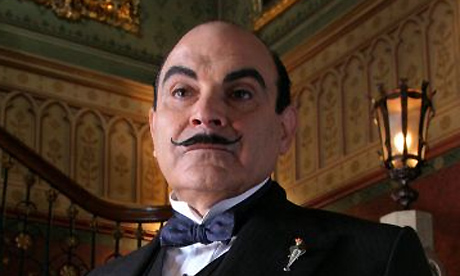
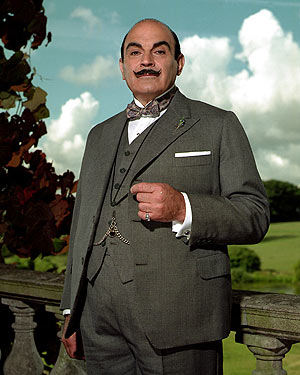
The story follows Poirot on a trip aboard the title train. It is only through befriending the train's owner that he secures for himself aboard. Sometime the first night the lodger in the room next to him dies after being stabbed several times in several odd ways. Poirot, despite his reluctance, begins to solve the crime.
Smart choices are made by the creators. The music during the opening scene (in which Poirot gives one of his celebrated analysis-turned-interrogation only to have the criminal commit suicide in front of him) is dissonant and perfect, like the sound Lost used to signify it was flashing back, forward, to the side or where ever else that show wanted to go.
Toby Jones, last seen playing the Dream Lord on Doctor Who, brings another thankless but great small performance in the role of the victim. He gives us no question to his vileness or how he is used to getting what he wants, but leaves us to ponder his repentance. David Morrissey and Hugh Bonneville also give their normal level of top-notch performing.
There are even brief moments of humor in an otherwise deeply serious film. At one point a character uses the word “Bastard” and then apologizes, asking everyone to excuse “her French.” “It is indeed a French word,” Poirot replies.
Thematically, the connection between faith and justice is made. Poirot, a Catholic, believes in justice through the courts, yet many of the other train passengers clearly believe in picking up where God, if he exists or not, exacting revenge. Shots of rosaries, one of the few things that could logically be on a train are used throughout. The thing that is particularly smart about all of this is that the story never makes a blatant judgment on the moral standings of these characters. It would be easy to descent into this, but by making no one right and no one wrong, the audience if left to contemplate the nature of right and wrong on their own. Films without answers are always the ones that stay with us the longest, and, even though the mystery of who murdered the train passenger is solved, the mystery of what is right and wrong, of what God asks us to do, and what justice really is remain as mysterious as the murder was in the beginning.

In most films with this kind of moral conundrum, the murderers would then be shown as self-made monsters, who, now that they have taken the law into their hands once are willing to do it once again. Instead, they wisely speak to one another, as a counsel, as their own appointed God, and this leaves their previous actions look all the more noble, since they are capable of sticking themselves to a very hard, though different from Poirot’s, moral standard.
It's not a flawless film. Poirot's habit of speaking in third person is still irritating.
The film also flirts around an Imperialist interpretation of the so-called Middle East. Turkey, where the film begins, is depicted with every stereotype of the region you can think of: violent, hateful towards women and uncivilized.
Poirot himself has always been the weakest thing about these outings. These days, with characters on tv on other mystery shows like Bones, Law and Order, CSI, etc. that contain detectives as dark, interesting and surprising as their suspects, it's no longer acceptable to have detectives who blandly sit in as the observer for the audience. They have to being going through something during the crimes, they have to be emotionally invested, and, if possible, dark and just barely able to put on the show of being okay.
Poirot, despite the revelation at the end, stays as static at the end of the film as he was at the beginning. He’s shaken, sure, but he shows no signs of changing his views. He’s just as much as an unfeeling and severe hardass at the beginning as he is at the end. No matter how glazed over his eyes are through much of the film or the waterworks that happens at the end, the audience is left with no question as to his unbowed point of view. What would be really fun to watch is him changing his mind, or even better, changing how he handles crime. As chilling as the weather or the crime in this story, nothing is as chilly as someone unable to consider the other side’s argument. No one wants to watch a guy so hard-wound that he specifies to waiters that he wants his eggs to be the exact same size.