Showing posts with label feminism. Show all posts

Monday, January 24, 2011

Downton Abbey: Episode 3

by Courtney Hilden

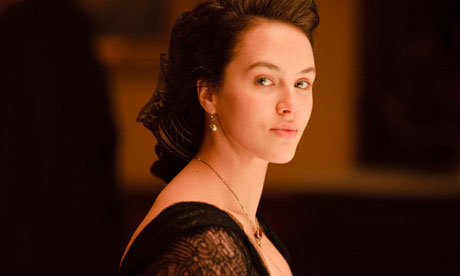
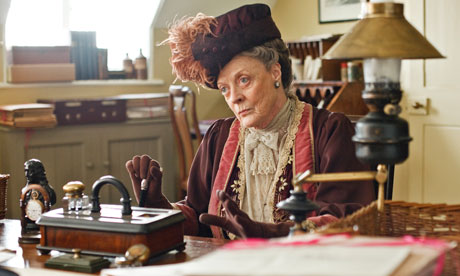
This time, in the penultimate episode of Downton Abbey, the carnival comes to town! Which mostly means various couples try their luck with each other and fail (or in the case of Matthew and Mary, fail again.) Then Grandma has her revenge by knowing some medicine and letting poor Mr. Mosley win the flower competition. And if there was not enough cattiness between Grandma and Matthew's Mom, don't worry: Mary and Ingrid are still at each other's throats.
If this makes it seem like not much happened in this episode of Downton Abbey, well, yes, not much did. Even though not much developed in the way of the story, not the way the previous two episodes did (or, the fourth episode hopefully will), it was a mostly enjoyable episode. Most of these characters are interesting enough at this point that just watching them interact together is enough.
As usual, the politics of some of the things going on are troubling. Thomas must be the most hurtful person on earth, asking Daisy out, even though he knew that William was interested. But at the same time, there's something bothersome in the character of Thomas. He is a terrible human being, but because he is also interested in men, making him into a villain is just another way of making gay men evil, and really, there are enough villain-gay men in the world. Even one of the cooks described him as a "troubled soul," which, although slightly more forgiving than some viewers might be inclined, is still sad. Would it really kill this show to depict how both lonely and scary being a closeted gay man in a homophobic world? Or are they too busy making him into the bad guy, who, at this point, I have concluded probably had the Turkish gentleman poisoned in revenge. It is the sort of terrible thing this show would do.
It is so nice, so refreshing, to have a miniseries that engages with the problems of women. Sadly, it is high class women that are mostly explored, but Mary's struggle to accept "just marriage" is sad to watch. It is interesting to note that Mary is not the one who takes up feminism, but her younger sister Sibyl, even though feminism has just as much to offer Mary as it does the other women. "The world is changing," Countess Cora says to Mary, "just not fast enough for you." Mary is right to be angry that no one wants to fight for her.
The show also gave Mrs. Hewes a difficult choice: continuing her job at Downton or marriage to the man she spurred many years ago. She chose her job (and, in modern parlance, her career), but there was something sad about this. She too, is limited by the roles appropriated for women. She can be a career woman or a family woman, but she could never dare be both. Also interesting to note that she did not even consider love in her decision: she never said she loved her beau, just that he was "nice man."
The cutest couple award for this show goes to Sibyl and Gwen. Sibyl, a budding young feminist, is all about helping out Gwen the maid become Gwen the secretary. So far there has not been any luck, but Sibyl's encouragement (and the lending of clothes) has been heartwarming to watch. They are both nice girls, and I would really like to see a full-blown romance develop between them.

Saturday, September 25, 2010

The Mastodon in the Room

by Courtney Hilden
Spoiler Alert!: Some of the early details of this episode are totally spoiled in this review. The crime itself, however, is not.

In this episode, where they "get the band back together," as it were, opened up on vacation clips of what various characters were doing. It was about as boring as actually vacation clips of characters doing things. It was sort of a lost opportunity, since the episode could have shown various characters doing legitimately interesting things in their various locales. Having a few episodes that focused on characters that were finding themselves deeply embedded in mysteries where ever they were and realizing they missed the work and their teammates would have been great. They would have given the actors, especially the lesser characters, a chance to have an episode all to themselves. Instead, they were just suppose to give us a taste of what they were doing, which was apparently exactly what you expected: Daisy still be annoying in Indonesia with Brennan stoically carrying on, Booth saving the day in Afghanistan, and Cam about to douse her career into flames.
Why was Cam's apparently impending career fail the genesis for bringing these characters back together? Somehow, this felt totally false. The case felt like a reject case from lots of other police procedural shows. Another case, a much bigger case, should have brought the characters together, or even better, a character's death should have been the case that called all the characters back to D.C. (Maybe they could have killed off one of those annoying interns. I'd still vote for Daisy, who is still so annoying and socially clueless that it's a shock Sweets has not diagnosed her on the autism spectrum.)
The episode was unrealistic in a lot of other ways. Daisy was beyond stupid to bring her engagement ring to Indonesia. She was dressed totally inappropriately with her skimpy underwear and cute clothes. (And was the camera's focus on her butt in an early scene necessary? No, it wasn't.) The only good thing about these Indonesian scenes is that Brennan was at least capable of wearing clothing that was practical for the environment and that did not do her any favors.
The costume choices continued to be strange throughout the episode. Sweets looked terrible doing the jazz look, but this was hard to notice, giving his terrible facial hair. His new look makes him look like an extra from Shakespeare in Love, and not in a good way.
On a feminism note, Brennan's comment to Booth that she had to beat people up because he "wasn't there to save her" was totally out of character, considering the pilot episode showed her perfectly capable of beating people up herself and not needing the least bit of help from Booth. What happened to that Brennan? Is she still lost out in the jungle?
Cam's anger at Brennan for pursuing the career she clearly loves was uncalled for. It smacked of all that "women need to sacrifice everything for everyone else" rhetoric. If Brennan had been a man, no one would have blinked at the decision to go do research in Indonesia. It also just reeked of trying to create drama for drama's sake. And it was another example of how unrealistic this episode was. If a program was that important to both the Jeffersonian and the FBI, someone would have stepped in to keep it going. And, given the reputation that Brennan apparently has, forensic anthropologists would have probably fought over it.
This doesn't mean everything in the episode was bad. For example, most of the interns are now out of the picture, leaving the least irritating one, Wendell. (Too bad about Nigel Murray. He had real potential.)

Saturday, August 14, 2010

Little Dorrit

 by Courtney Hilden

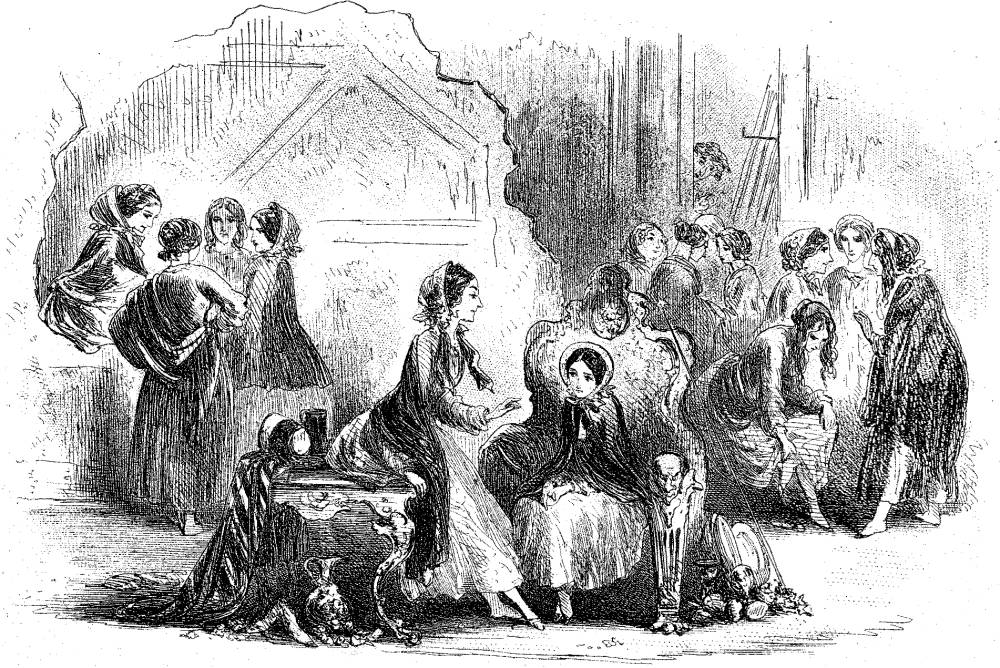
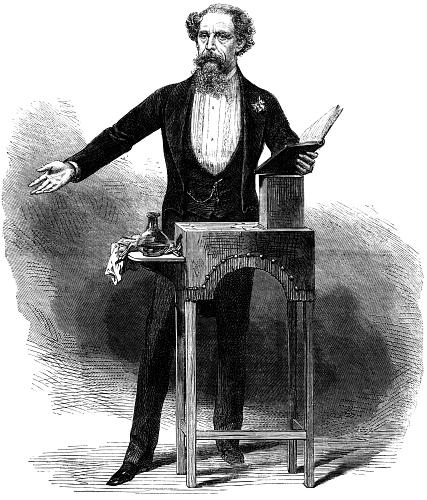
Little Dorrit is one of Charles Dickens last (his eleventh, to be exact) and lesser known novels.  It follows the main character, Amy "Little" Dorrit, who, because her father is a debtor, is imprisoned in the Marshelsea Prison of London.  The story is a classic rags-to-riches story, in that the family regains their wealth, but it also twists this storyline by making sure no one is actually happier for it.  Meanwhile, Arthur Clennam, a friend of the family, is discovering that his connection to the Dorrit family is much deeper than he realized.  The novel is famously based on Dickens's own personal experience with debtor's prisons.  (His father having served time there himself.) 
There are a lot of good things happening withing Little Dorrit.  The central metaphor of the novel (the prison as existing in more ways that simply the obvious one) is explored in multiple ways.  When the Dorrit family becomes respectable once again, they become entrapped in the expectations of their class, which of course means that everyone continues to suffer, especially Little Dorrit herself, who finds it difficult to simply forget the entire beginning of her life.  Every character within the novel is imprisoned in some way or the other.  Mrs. Clennam is imprisoned to her chair and her house because of illness and old age.  Arthur Clennam is imprisoned by societal norms and his family's own poor choices.  Mr. Dorrit is imprisoned not only by his debt and later society, but by his own pride and ignorance.  Every marriage (except the last one, of Dorrit and Arthur) is a marriage of convenience, based on money and social standing; no one is in love with one another.  Many of the women within the story are imprisoned by ideas of what women should or shouldn't do.  Those female characters who stand up to those ideas are shot down and those who acquiesce are miserable. 
The novel is considered one of Dickens's most radical and severe works, and it's easy to see how much he detests certain institutions within society.  His chapter on the Circumlocution Office (meant to stand in for the British bureaucracy at large) is the sort of writing that would make Sinclair Lewis proud.
But the novel is also has troubling parts.  Little Dorrit as a character is an idealized woman of the 19th century: industrious, loyal and quiet.  She is always working for the men in her life, mostly her father, but later on for her husband, Arthur Clennam.  She never asserts her own needs, always simply doing as they demand of her, regardless of what it does to her emotionally.
The "bad girls" of the novel, the ones that are annoying, selfish, and apparently undesirable, are the ones who are more independent.  Flora, Arthur's once flame, is now a widow, and is independently wealthy.  So she's apparently not good enough for Arthur to desire anymore (or for the audience, who sees much of this novel through his eyes, despite the fact that the title is of a female character.)  Fanny, Dorrit's sister, is undesirable because she is a woman who works for herself and because she is determined to marry whomever she wants, so clearly, she must also be a catty, witchy woman, the kind that the audience is suppose to find detestable. 
Other women are demonized within the novel.  Pet spurs Clennam's affections, so clearly she has to be miserable for the rest of her life with an artist husband.  Tattycoram, a young woman treated as a slave by a family who insists they are good because they have "adopted" her, is mocked in the novel for being stupid enough to run away.  And Miss Wade, another woman, is motivated only by revenged at being jilted by her once lover.  Women are nothing more but examples of "good" and "bad" behavior, the good girls being the ones that do as they are told and the bad girls being those who somehow threaten masculinity. 

Friday, August 6, 2010

Is Salt a Feminist Movie?

A review of Salt.
by Courtney Hilden
Spoiler Alert!: Part of this plot, though not the final twist, is given away in this review.  

There was a lot of talk on blogs and forums on the Internet about Salt, a movie starring Angelina Jolie.  Before the movie came out, there was a lot of enthusiasm over how the movie was originally written with a male main character, but once Jolie became interested in the project, the gender was changed to reflect their star's.  Feminists celebrated this as a moment where gender didn't determine the casting of an actor.  After the movie came out, the movie was given mixed reviews, discussing it as a fun and well-made popcorn movie, but complaining it was not especially deep.  But it must have captured someone's attention, as it managed to make $70.8 million in ten days
But after the movie came out, there was not much of a discussion about if the film was feminist in and of itself.  And, given that other reviews have already dissected so much of the other aspects of the film, it seems important to talk about how this movie, being the only film I can think of where the gender of its main character was purposeless changed, about how gender operates in the movie
First and foremost, it was a relief to see Jolie not play up her sexiness or body.  She wore frumpy work clothes that looked unflattering and unfashionable.  She had a miserably bad haircut throughout the beginning of the movie, her blond locks looking like a bad dye job.  (While her character's actually dye job looked utterly normal on her, the kind of hair someone who only washes it every other day looks.)  Considering Jolie is the woman who, about ten years ago, played Lara Croft, where, because she apparently was not what the directors and producers wanted, had to wear fake breasts.  In a world where one of the most beloved film stars has an imperfect body, you know the standards are far too high.  It almost felt like Salt was purposeless not more than just a woman with a government job.  It was nice to have a heroine who was relatively ordinary.
But the plot's reliance on Salt's dedication to her husband is troublesome.  Early on in the film, Salt's husband, Mike, is taken by Orlov's group.  After he is killed by Orlov's men, it becomes Salt's apparent motivation, leading her to follow enough of Orlov's plan to dismantle it.  (I say apparent motivation here because it is possible that other things are motivating her, but her husband's murder is the only clear force propelling her.)  Salt's dedication is admirable, but it's troublesome that her only motivation throughout the movie is her love for her husband.  If this movie really had been about a man, it is hard to believe that it would follow this same plot.  A male character in those circumstances would have other things motivating him.
It is also important to note the lack of female character, beyond Salt.  All the other characters are male, and apparently, other than Salt, everyone important at the CIA is male.  Although women have historically struggled with jobs in the CIA, they do exist.  The complete lack of other female characters within the story just serves to remind the audience that even if the main character's gender was changed, that it was because one of the biggest stars in the world became attached to the project, not because it was a moment to make a statement about gender and characters in the movies.  And of all the things about this movie, from the ludicrous chase scenes and the McGuyver moments and the unbelievable idea that Russia has trained children to eventually bring down the U.S., that indifference to gender within the story is the most disappointing. 

Wednesday, July 14, 2010

Make Your Move

by Courtney Hilden
Spoiler Alert!: This is one of those romance novels with a mystery, and some of the clues are given away in this review.

Make Your Move by Samantha Hunter is about a young woman and entrepreneur, Jodie, and her business partner and best friend, Dan. Jodie and Dan own their own bakery with cookies that contain a "special ingredient" that work somewhat similarly to Spanish Fly combined with an aphrodisiac. In his day job, Dan works as a scientist at a university, which is how he developed the ingredient. Dan's in love with Jodie and they both decide to give it a try. This would all be fine and lovely if it weren't for the fact that someone has broken into the bakery and stolen the ingredient, blackmailing them both.
Usually, romance novels suffer from a lack of plot, but this one works to at least have obstacles for the characters to overcome, both romantically and professionally. There's a small mystery to solve, and Hunter smartly sets it up so that there's easily a least four potential thieves at the beginning of the novel. It's almost too bad that Hunter didn't stretch this mystery out a little more, since it would be a great opportunity to set up more time for Dan and Jodie to explore their feelings for one another, and bring to light some of the emotionally problems Jodie has with men. It's also a pity that the thief turned out to be the most obvious answer, instead of someone less expected or more complicated.
The "science" of this special ingredient is handled well. Often, when writers create something that is fantastic, they break their own rules of the story to make something else go a particular way. Here, Hunter defines the rules early and sticks to them. Although some of the characters themselves confuse the "science" with other things, they get set right, and the story itself never deviates. So much of science-fiction and fantasy, not just in books but in film, could learn from this example.
On the issue of feminism, this book, like so many others, makes Dan stereotypically macho, with him showing possessiveness and being violent. Although Jodie is in no way helpless or pathetic, since she has built a business from the ground up, is often sidelined for Dan, who is so smart and manly. It would be nice, for a change, for men and women to be defined by something other than their gender. Also, making Jodie's business a traditional womanly art is not really as feminist as it might first appear. And Ginger, Jodie's best friend, is not somehow better for getting back together with her husband who just left her and then suddenly changes into a good man.
One of the stronger romances out there, and one that actually attempts a plot. (And, it should be said, a plot that could probably stand on its own as a short story.) Like most romances and romance novels, it's imperfect and quick.