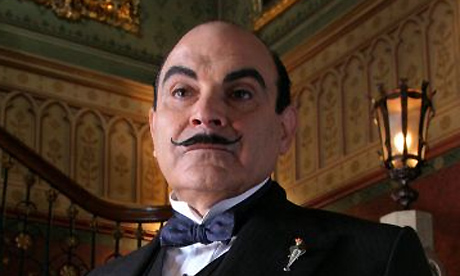
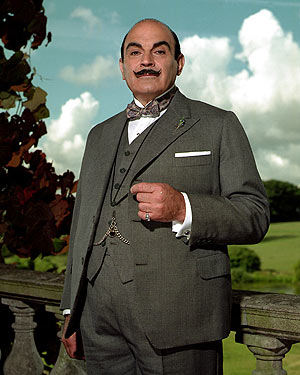
Appointment with Death follows Poirot as he travels to the so-called "Middle East" to see a dig of an ancient city, where a Biblical character is said to be buried. As always, there's murder in store when the archeologist's wife, who supplies him with the financial resources to dig, turns up dead at the site. As always, Poirot is on the case, and, as always, there are several red herrings to distract everyone from the crime at hand.
Poirot, like all great detectives, is all about the details, and in this outing the show itself was all about the details. Poirot, for example, was doing things in style, using an interesting cane device with a built-in binocular that allowed him to see things in the distance. Some of the details were even creepy, like one man referring to his much younger fiance as his "child bride." The first victim's unshuttable eyes were also a nice detail, as they emphasized how horrifying her death was. Even Poirot himself was a little creepy, telling someone that his "gray cells" were "singing" to him while he was trying to solve the case.
Some of details were also pertinent to the place. They made a point at depicting the call to prayer, and then later showed a group of local men praying. It's nice, given that this story is almost chiefly about British characters, that the show's producers and director and creators remembered to show that they are not the only ones around, although almost none of these "Arabs" (a word that is itself very troubling) had speaking parts in the story. They're more like set pieces, in someways, much like Wedgwood plates and Edwardian furniture in those houses that Poirot so frequently inhabits.
Speaking of faith, just as is Murder on the Orient Express, this episode emphasized Poirot's Catholic faith. One of the villains of the story was masquerading as a nun, but Poirot stayed with his faith, even passing it on to one of the ultimate victims of the story, the four children who were brutally abused by the the first murdered victim. It's too bad that the child abuse aspect of the story was kept at such a minimum, since it was the most interesting and depressing part of the story.
"Third Girl," the latest in this series of Poirot's adventures, is by far the most messy and difficult to understand story. The story involves a young woman named Norma, who visits Poirot, telling him that she believed she had committed a crime. This is apparently all Poirot needs, because he is off, tracking this girl down and trying to decide if she, indeed, has done something wrong. He discovers her involvement in a crime, including that of her two roommates, Frances, an actress, and Claudia Reese-Holland, a secretary and lover of Norma's Father, and Norma's boyfriend David, a painter. It's an embarrassingly bad and bland attempt at making a mystery interesting. Other than that, it is hard to know where to begin with this dead carcass of a mystery. It is slow moving. The majority of the characters are impossible to care for, and Mr. Rodderick and Norma's interactions feel more like a creepy incestuous relationship than that of a father or daughter. At least one of them was suppose to believe that they were in a real relationship. Sonia and her relationship with a much older man was also creepy. The music was also melodramatic and miserable. Music is only suppose to be that on the nose in soap operas.
Once again, Jemima Rooper manages to give a great, relateable and believable performance as the title character. If her miraculous work making her the only consistently good thing on Hex and this episode of Poirot is any indication, Rooper deserves bigger and better roles, because she can clearly work material into something good. There are other, smaller things that made this better. Poirot being insulted several times for being too old was a nice touch of levity (and perhaps another meta comment on the series, as part of the inclusion of a stand-in for Christie herself.) It was also nice to show Poirot being compassionate and solving this mystery for genuine concern for Norma, and not for being harsh and unyielding like he has become in other outings. Next time, he should be allowed to feel for his victims. Helping others should be his motivation, not enforcing the law on other's.
A Review of Murder on the Orient Express by Courtney Hilden Spoiler Alert!: Some of the clues to this shockingly good mystery are revealed in this review.
There are few murder mysteries that are recognizable even to non-mystery fans: Ten Little Indians, The Fall of the House of Usher, The Girl with the Dragon Tattoo and Murder on the Orient Express. The last has recently been adapted for a movie, and it blows most mysteries out of the proverbial snow drift, painting everything in snow white and murky gray, meditating on faith and justice, filled with hubris and the empty feeling of being near death, leaving the main character and the audience as cold as the winter world outside the train cars on the Orient Express. The story follows Poirot on a trip aboard the title train. It is only through befriending the train's owner that he secures for himself aboard. Sometime the first night the lodger in the room next to him dies after being stabbed several times in several odd ways. Poirot, despite his reluctance, begins to solve the crime. Smart choices are made by the creators. The music during the opening scene (in which Poirot gives one of his celebrated analysis-turned-interrogation only to have the criminal commit suicide in front of him) is dissonant and perfect, like the sound Lost used to signify it was flashing back, forward, to the side or where ever else that show wanted to go. Toby Jones, last seen playing the Dream Lord on Doctor Who, brings another thankless but great small performance in the role of the victim. He gives us no question to his vileness or how he is used to getting what he wants, but leaves us to ponder his repentance. David Morrissey and Hugh Bonneville also give their normal level of top-notch performing. There are even brief moments of humor in an otherwise deeply serious film. At one point a character uses the word “Bastard” and then apologizes, asking everyone to excuse “her French.” “It is indeed a French word,” Poirot replies. Thematically, the connection between faith and justice is made. Poirot, a Catholic, believes in justice through the courts, yet many of the other train passengers clearly believe in picking up where God, if he exists or not, exacting revenge. Shots of rosaries, one of the few things that could logically be on a train are used throughout. The thing that is particularly smart about all of this is that the story never makes a blatant judgment on the moral standings of these characters. It would be easy to descent into this, but by making no one right and no one wrong, the audience if left to contemplate the nature of right and wrong on their own. Films without answers are always the ones that stay with us the longest, and, even though the mystery of who murdered the train passenger is solved, the mystery of what is right and wrong, of what God asks us to do, and what justice really is remain as mysterious as the murder was in the beginning.
In most films with this kind of moral conundrum, the murderers would then be shown as self-made monsters, who, now that they have taken the law into their hands once are willing to do it once again. Instead, they wisely speak to one another, as a counsel, as their own appointed God, and this leaves their previous actions look all the more noble, since they are capable of sticking themselves to a very hard, though different from Poirot’s, moral standard. It's not a flawless film. Poirot's habit of speaking in third person is still irritating. The film also flirts around an Imperialist interpretation of the so-called Middle East. Turkey, where the film begins, is depicted with every stereotype of the region you can think of: violent, hateful towards women and uncivilized. Poirot himself has always been the weakest thing about these outings. These days, with characters on tv on other mystery shows like Bones, Law and Order, CSI, etc. that contain detectives as dark, interesting and surprising as their suspects, it's no longer acceptable to have detectives who blandly sit in as the observer for the audience. They have to being going through something during the crimes, they have to be emotionally invested, and, if possible, dark and just barely able to put on the show of being okay. Poirot, despite the revelation at the end, stays as static at the end of the film as he was at the beginning. He’s shaken, sure, but he shows no signs of changing his views. He’s just as much as an unfeeling and severe hardass at the beginning as he is at the end. No matter how glazed over his eyes are through much of the film or the waterworks that happens at the end, the audience is left with no question as to his unbowed point of view. What would be really fun to watch is him changing his mind, or even better, changing how he handles crime. As chilling as the weather or the crime in this story, nothing is as chilly as someone unable to consider the other side’s argument. No one wants to watch a guy so hard-wound that he specifies to waiters that he wants his eggs to be the exact same size.