Drood by Dan Simmons is a story of friendship, deceit, madness, and mystery. The narrator, Wilkie Collins, a friend and collaborator of Charles Dickens, begins the tale in the year 1865, recounting the Staplehurst railway accident and the aftermath of the accident. During the accident Dickens encounters a mysterious man by the name of Drood. Deeply intrigued by this phantom-like man Charles Dickens discovers Drood’s whereabouts and insists that Collins come along with him when he visits Undertown. Reluctantly, Collins goes with him, but is only permitted to go so far. Days after this night-time visit to Undertown, Wilkie Collins meets a police officer who enlists him to act as an informant regarding the man named Drood. Drood’s influence seeps deeper and deeper into Wilkie Collins’s life and imagination, but it’s not only Drood who haunts Willkie Collins’s mind, Willkie is convinced that there is another Willkie, one who looks just like him, but is not him, who begins making additions to whatever story or play Wilkie Collins is currently working on. At first Collins is infuriated that “the other Wilkie” who is contributing to the stories while Collins is sleeping; but as things progress Collins begins to rely on his doppelganger more and more. One evening while Dickens is visiting, Collins hears Dickens, Drood, and the doppelganger of himself conspiring against him. As Dickens health begins to decline, Drood assigns the task of writing his biography (a tasks once entrusted to Dickens) to Collins. He adamantly refuses, but Drood will not be dissuaded. Already obsessed with Drood, Collins’s mind and life begins to increasingly overflow with paranoia. A few days before Dickens suffers a stroke, he reveals a secret about Drood.
Drood will appeal to fans of historical fiction, thrillers, mystery, horror, and fans of the movie/play Amadeus as Charles Dickens and Wilkie Collins have a Salieri/Mozart-like friendship.
Spoiler Alert!: Yes, even an art exhibit can have spoilers. This review reveals some of the real identities of the art featured in this exhibit.
The Detroit Institute of Arts is currently running an exhibit called "Fakes, Forgeries and Mysteries," on art forgeries of various kinds.
There is something very daring about this exhibit: most of the art featured is from the DIA itself, and they admit in this exhibit that they have not always gotten authorship of their art right, and that sometimes other scholars or museums have caught errors in their work. It is hard to imagine other art institutes proudly displaying their mistakes and discussing how these mistakes happen.
Of course, the exhibit also discusses how these mistakes get corrected, spending some time on the kind of analysis they do. The exhibit features videos featuring scientists who analyze art using things like thermoluminesce, tree rings, and paint makeup.
One of the strong things about this exhibit is that they invite patrons to see a "fake" in comparison with "the genuine article." There's something very fun about this, putting yourself in the shoes of the art expert. The exhibit adds notes to help you pick things out, but otherwise, the exhibit lets you trust your eyes.
The exhibit also discusses the art market and how to tell if something is a fake. It discusses how when a particular kind of art floods the market, this is a sign someone is making forgeries. They discuss the ways sellers of forgeries try to fool buyers, using the work of lesser known artists and making fake paperwork. It discusses the beauty of fakes, that, despite the lack of value, can be beautiful in their own way. Some of the forgeries are impressively good. Finally, the exhibit even brings up the issue of art that has been "disowned" by their artists. "Tennessee Stud," the last piece of the exhibit, illustrates this issue. The artist had made a larger piece and sent it to be cut. One of the pieces cut from it (that were not meant to be displayed) was later sold as a genuine piece of his work. So, in addition for displaying the clear fakes, the exhibit talks about pieces that were taking without permission of the artist, works "in the style of" and the art of students in workshops as the gray areas of fakes.
The last two rooms of the exhibit has the best art of the exhibit. "Tewkesberry Road" was sold to the DIA as a Degas, but later researched revealed it was by a lesser-known English artist. "Head of a King," an Egyptian fake, is the most flawless forgery, and it is hard not to admire the work that went into this piece. The exhibit also features a painting that might be the work of Van Gogh, that has not been officially listed as by him, but in comparison with another Van Gogh, it is compelling evidence.
This is one of the more original exhibits out there, with lots of interesting information and fun interactive videos and displays. It is well worth going to.
by Courtney Hilden Spoiler Alert!: Some of the early details of this episode are totally spoiled in this review. The crime itself, however, is not.
In this episode, where they "get the band back together," as it were, opened up on vacation clips of what various characters were doing. It was about as boring as actually vacation clips of characters doing things. It was sort of a lost opportunity, since the episode could have shown various characters doing legitimately interesting things in their various locales. Having a few episodes that focused on characters that were finding themselves deeply embedded in mysteries where ever they were and realizing they missed the work and their teammates would have been great. They would have given the actors, especially the lesser characters, a chance to have an episode all to themselves. Instead, they were just suppose to give us a taste of what they were doing, which was apparently exactly what you expected: Daisy still be annoying in Indonesia with Brennan stoically carrying on, Booth saving the day in Afghanistan, and Cam about to douse her career into flames. Why was Cam's apparently impending career fail the genesis for bringing these characters back together? Somehow, this felt totally false. The case felt like a reject case from lots of other police procedural shows. Another case, a much bigger case, should have brought the characters together, or even better, a character's death should have been the case that called all the characters back to D.C. (Maybe they could have killed off one of those annoying interns. I'd still vote for Daisy, who is still so annoying and socially clueless that it's a shock Sweets has not diagnosed her on the autism spectrum.) The episode was unrealistic in a lot of other ways. Daisy was beyond stupid to bring her engagement ring to Indonesia. She was dressed totally inappropriately with her skimpy underwear and cute clothes. (And was the camera's focus on her butt in an early scene necessary? No, it wasn't.) The only good thing about these Indonesian scenes is that Brennan was at least capable of wearing clothing that was practical for the environment and that did not do her any favors. The costume choices continued to be strange throughout the episode. Sweets looked terrible doing the jazz look, but this was hard to notice, giving his terrible facial hair. His new look makes him look like an extra from Shakespeare in Love, and not in a good way. On a feminism note, Brennan's comment to Booth that she had to beat people up because he "wasn't there to save her" was totally out of character, considering the pilot episode showed her perfectly capable of beating people up herself and not needing the least bit of help from Booth. What happened to that Brennan? Is she still lost out in the jungle? Cam's anger at Brennan for pursuing the career she clearly loves was uncalled for. It smacked of all that "women need to sacrifice everything for everyone else" rhetoric. If Brennan had been a man, no one would have blinked at the decision to go do research in Indonesia. It also just reeked of trying to create drama for drama's sake. And it was another example of how unrealistic this episode was. If a program was that important to both the Jeffersonian and the FBI, someone would have stepped in to keep it going. And, given the reputation that Brennan apparently has, forensic anthropologists would have probably fought over it. This doesn't mean everything in the episode was bad. For example, most of the interns are now out of the picture, leaving the least irritating one, Wendell. (Too bad about Nigel Murray. He had real potential.)
A Review of Murder on the Orient Express by Courtney Hilden Spoiler Alert!: Some of the clues to this shockingly good mystery are revealed in this review.
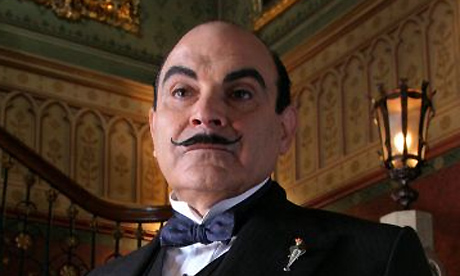
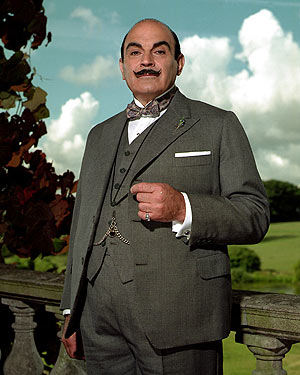
There are few murder mysteries that are recognizable even to non-mystery fans: Ten Little Indians, The Fall of the House of Usher, The Girl with the Dragon Tattoo and Murder on the Orient Express. The last has recently been adapted for a movie, and it blows most mysteries out of the proverbial snow drift, painting everything in snow white and murky gray, meditating on faith and justice, filled with hubris and the empty feeling of being near death, leaving the main character and the audience as cold as the winter world outside the train cars on the Orient Express. The story follows Poirot on a trip aboard the title train. It is only through befriending the train's owner that he secures for himself aboard. Sometime the first night the lodger in the room next to him dies after being stabbed several times in several odd ways. Poirot, despite his reluctance, begins to solve the crime. Smart choices are made by the creators. The music during the opening scene (in which Poirot gives one of his celebrated analysis-turned-interrogation only to have the criminal commit suicide in front of him) is dissonant and perfect, like the sound Lost used to signify it was flashing back, forward, to the side or where ever else that show wanted to go. Toby Jones, last seen playing the Dream Lord on Doctor Who, brings another thankless but great small performance in the role of the victim. He gives us no question to his vileness or how he is used to getting what he wants, but leaves us to ponder his repentance. David Morrissey and Hugh Bonneville also give their normal level of top-notch performing. There are even brief moments of humor in an otherwise deeply serious film. At one point a character uses the word “Bastard” and then apologizes, asking everyone to excuse “her French.” “It is indeed a French word,” Poirot replies. Thematically, the connection between faith and justice is made. Poirot, a Catholic, believes in justice through the courts, yet many of the other train passengers clearly believe in picking up where God, if he exists or not, exacting revenge. Shots of rosaries, one of the few things that could logically be on a train are used throughout. The thing that is particularly smart about all of this is that the story never makes a blatant judgment on the moral standings of these characters. It would be easy to descent into this, but by making no one right and no one wrong, the audience if left to contemplate the nature of right and wrong on their own. Films without answers are always the ones that stay with us the longest, and, even though the mystery of who murdered the train passenger is solved, the mystery of what is right and wrong, of what God asks us to do, and what justice really is remain as mysterious as the murder was in the beginning.
In most films with this kind of moral conundrum, the murderers would then be shown as self-made monsters, who, now that they have taken the law into their hands once are willing to do it once again. Instead, they wisely speak to one another, as a counsel, as their own appointed God, and this leaves their previous actions look all the more noble, since they are capable of sticking themselves to a very hard, though different from Poirot’s, moral standard. It's not a flawless film. Poirot's habit of speaking in third person is still irritating. The film also flirts around an Imperialist interpretation of the so-called Middle East. Turkey, where the film begins, is depicted with every stereotype of the region you can think of: violent, hateful towards women and uncivilized. Poirot himself has always been the weakest thing about these outings. These days, with characters on tv on other mystery shows like Bones, Law and Order, CSI, etc. that contain detectives as dark, interesting and surprising as their suspects, it's no longer acceptable to have detectives who blandly sit in as the observer for the audience. They have to being going through something during the crimes, they have to be emotionally invested, and, if possible, dark and just barely able to put on the show of being okay. Poirot, despite the revelation at the end, stays as static at the end of the film as he was at the beginning. He’s shaken, sure, but he shows no signs of changing his views. He’s just as much as an unfeeling and severe hardass at the beginning as he is at the end. No matter how glazed over his eyes are through much of the film or the waterworks that happens at the end, the audience is left with no question as to his unbowed point of view. What would be really fun to watch is him changing his mind, or even better, changing how he handles crime. As chilling as the weather or the crime in this story, nothing is as chilly as someone unable to consider the other side’s argument. No one wants to watch a guy so hard-wound that he specifies to waiters that he wants his eggs to be the exact same size.
by Courtney Hilden Spoiler Alert!: The mysteries are revealed in this review.
"The Secret of Chimneys" finds our heroine, Miss Marple, visiting an old friend and niece, Virginia, at the family's lavish country estate. A count from Austria comes to visit them to secure a business deal, and in the process, is killed. Marple, as usual, is on the case, this time aided by an Inspector Finch, who doesn't bumble around but holds his own and respects her abilities. It's this Inspector Finch who is the most enjoyable part of the episode. It seems clear that the show is setting up a possible love interest for Miss Marple, who always plays such a quiet role in this series. Possibly Finch is not just a love interest but someone who is spying on her. It would be interesting to see if Finch returns, in what capacity, and what motivations of his will be uncovered. There were also some lovely touches. The Count was hilariously overdressed in a Dracula-like black cloak and red-ribboned medal. Several of the characters attempting to decode the musical message with a piano was delightful. Having Marple find the diamond and then pull it out of her purse, revealing the rest of the mystery's clues, made for a shocking conclusion, because Marple herself so rarely becomes directly involved (or puts away a brother-in-law.) Although not as good as previously episodes, it's still a solid entry in the series.
 by Clare MacGregor