Tuesday, January 18, 2011

Larger Than Life

by Courtney Hilden

In this latest episode of House, a man, spending time with his daughter, tries to desperately save a random woman from a train. Then he himself begins to have medical problems, opening up another round of cynical House and optimistic Masters.
As someone who lives in New York, I can tell you that the opening sequence, of a man trying to save a woman having a seizure who is stuck on the subway track, is one of my nightmare's. The horror of fellow subway passengers, desperate to know if he was okay and their held breaths at the thought he didn't make it, rang all too true.
House also brought the talent tonight, including Matthew Lillard (how is it possible that he is old enough to play a father?) and Sprague Grayden (from the cancelled-too-soon John Doe). Watching these two was watching a master class on chemistry. The history between their two characters was totally believable. Can someone make a show about this couple?


Other good things about this episode including the cinematography, which took a different take on the show, focusing in on characters as the scene runs. Usually a show this far in does not do anything different, especially for a normal episode, but here it was noticeable because so little else in the episode was.
Sadly, none of these touches could make up for the overall show, which is saddled with an increasingly unlikeable character. House really does not deserve the people in his life. The nice thing about the show once upon a time was watching him struggle with kindness, but here House was, trying to get out of dinner with his girlfriend and her Mom on her birthday and then trying to get out of his best friend's festival. At this point, House is just spinning his wheels. And given Hugh Laurie's phenomenal performance, maybe he should just be teaching acting instead of trying to make something enjoyable out of this poor writing.

Monday, January 17, 2011

The Museum of the Moving Image

This week is the reopening of the Museum of the Moving Image, dedicated to movies, television and other forms of art.
Having been there this week, I can say that there are some wonderful things there to see, especially if you are a film buff of any kind. There are numerous artifacts from various movies, including the mask from The Mask, razzle-dazzle suits from Chicago and even the creepy possessed girl from The Exorcist. The museum has lots of fun bits of pop culture, even with a room dedicated to video games, having numerous old-school arcade games including Space Invaders.
The upstairs is dedicated to various forms of reality, which is actually a little disappointing. Most of things installed there are either rather boring or something most museum goers would already have access to. (For example, there is a video of Second Life and a Wii-like game.)
By far the most artistic and fascinating thing is Dictators Versus Dolls, an eleven minute video. The animation is superb and beautiful, and it depicts battles of various dolls (including Barbie) with various world dictators, including the leaders of Libya and South Korea. It is visually stunning and makes you wish that you could see more films done this way.

Saturday, January 15, 2011

National Museum of the American Indian

The Museum of the American Indian should be a place where Native Americans/First People/Indigenous Peoples should be celebrated and where the ongoing issues these nations face can be discussed in an intelligent manner. Instead, the museum showcases the “acceptable” things about Native Americans (their material culture, mostly) and ignore the uncomfortable affects of imperialism.


The crowning achievement in what makes this museum offensive is in the atrium of the second floor, which opens up onto what at first appears to be a beautiful room. And then you look at the walls, which are decorated with images of ships and cargo being loaded onto docks, the signs of Western political and economic domination. In between these fresco are images of various conquerors, including Columbus, Verrazzano and Cortez.


For those of you who are not aware, Columbus landed in Hispaniola, where the native people were almost completely wiped out by disease, and then the rest were enslaved, their culture disappearing soon afterwards. Cortez conquered what is now mostly Mexico, and famously massacred unarmed native nobility in an attempt to scare them into submission. In addition to this, he owned a large number of slaves, almost all of them with African descent, another people of color who have been exploited by capitalism and imperalism.
This is offensive because this is a museum to Native Americans, and here, in a space that should truthfully depict history, there is art that glorifies the very forces and people who brutally conquered them. The art does not show native people being murdered, enslaved or dying of disease. There is not even an attempt to explain that this art was created before the mainstream realized the destructive nature of imperialism, instead, it is presented as simply art, as apparently ahistorical and apolitical. If this were a museum to the Holocaust or on Jewish history, this would be the equivalent of having art that depicted the Nazi war tanks and European leaders who discriminated and killed Jews as heroic, brave and admirable. Anyone walking into that room would realize the tonality and content were completely offensive and inappropriate, and in this way, this room in the Museum of the American Indian is also offensive and inappropriate.
Perhaps museum curators are afraid Americans (white Americans, right?) are uncomfortable with confronting the problematic nature of their privilege. But museums should make people think, even if it is uncomfortable kind of thinking. What this museum should be doing is showing how crushing discrimination and racism have destroyed, as much as possible, Native American political, economic and social power and celebrating Native American activists whose work have aided their communities.
Moreover, the building itself is problematic. The museum is in the Customs House, which holds, among other things, U.S. Customs and Border Protection. This is the government agencies who works to impede desperate Chicanos and Chicanas from entering the country (who almost always have Native ancestry), making this building particularly unsuited for this museum.
Native Americans deserve a museum, but maybe the problem is that the government is funding and providing for this one. The U.S. government has already taken their land; does it really need to take their cultural objects, put them on display, and then ignore the parts of their history that makes the government look bad? Apparently so. Native Americans, at the very least, deserve to run their own museum of their own history, one that tells their story appropriately and fully, in a building named after one of their leaders, not Alexander Hamilton.

Monday, January 10, 2011

Downton Abbey: Episode 1

by Courtney Hilden
Spoiler Alert!: Some of the episode's best surprises are given away in this review.

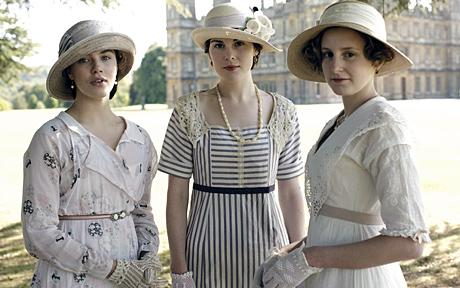
Downton Abbey, Masterpiece Theatre's premiere show this season, centers on the title house and the two classes of citizens it contains: the elite, wealthy family and their servants. In this first episode, Robert, an Earl and patriarch, discovers two of his relatives, and heirs to the estate, have passed away aboard what is certainly but not named to be the Titanic. This causes Robert's wife Cora to try to gain part of the estate for herself and her eldest daughter, Mary, and for Robert to invite the new heir, Matthew Crawley, to the estate. Meanwhile, the "downstairs" family deals with a new servant, who, because he was wounded a war, has trouble fulfilling his duties, but much more trouble because most of the other servants treat him so poorly.
It's not as if anything is wrong with the show, it just feels very much like other movies and miniseries that also feature both the wealthy family and servants, and in fact, there doesn't seem to be anything different from this than other earlier shows. So we trend on the familiar ground of the servants and the family and their intertwining drama. The servants, of course, have the more interesting, lesser-seen drama. The family's drama has been part of so much of the Masterpiece stories and Austen adaptations as to be boring to anyone who is familiar with either. This is, after all, the same situation Mrs. Bennett was trying to prevent in Pride and Prejudice, which takes place some one hundred years before. At least in this version, the economic situation of the elite female characters is not avoided. Countess Cora spends time trying to get some money to live off of, but she is blocked even from trying to get her dowager money back out of the estate. In a system like this, the economy is structured to take from women (their bodies, ones that are forced to stay sexually monogamous) and give them nothing or close enough in return.
There are some highlights in terms of great characters. The eldest daughter, Lady Mary, shows a delightful lack of care towards her dead fiance, a perfect reminder of the love that was not present in these marriages.
The show also deserves credit for having a "lame" character. John Bates had served Robert in the "war with the Boers", and now has taken a job as Robert's valet. The show does an excellent job at depicting both how relatively fine Bates is at his job and the way the majority of servants look down on him for his disability. "Crippled" characters are few and far between on television, so it is nice to see a show that depicts him in a way that is judgemental of those who are judgemental of him.

Unfortunately, the depiction of homosexuality leaves much to be desired. Thomas, the first footman, spends time scheming (first against Bates, then later against his former lover). The other gay character spends time manipulating Thomas and Lady Mary. Gay men are not evil, and showing them this way just plays into stereotypes and homophobia.
As for the next episode, it seems obvious that the solution to the problems of the estate rest with the lawyer, Matthew Crawley. Countess Cora would be wise to enlist Crawley to figure out how to separate her money from the rest of the estate or to simply let her have it, as that is what would make both him and Cora happy.
So, even though the show manages to create sympathetic female and disabled characters, ones who are forced to fight through difficult circumstances, the show fails a rounded depiction of homosexuality. It acknowledges their difficulties of being so closeted, but tonally makes the judgement on them that they are dangerous. Coupled with the already-explored aspects of the story, Downton Abbey is somewhat admirable but in no way splendid.

Tuesday, January 4, 2011

From Dead to Worse

by Courtney Hilden
Spoilers: This review gives away almost all of the surprises of this books.

When sitting down to review From Dead to Worse, the eighth book in the Southern Vampire Series, I found myself wondering what I could possibly say as to what the plot was. The plot was really several episodes thrown in together. One involves Sookie meeting a new, mysterious (of course he’s mysterious, this series is nominally a mystery series) relative, another has a Nicene war within the local werewolf pack, another features a hostile takeover, and finally there’s a broken marriage thrown in for good mix. The plot sort of meanders along, and although this would usually be a good thing, it is unlike previous books in Harris’s series, and feels less controlled. This tight, no-flab writing was one of the most admirable things about Harris’s series, which lacked the bloat of other popular urban fantasies and romances. The book felt like Harris is setting up for something else (what I do not know, as I have yet to read further), maybe giving us pertinent information for future books, but otherwise feeling like a letdown.
The other majorly disappointing thing about the book is staving off (yet again!) the romance between Sookie and Eric. Eric, finally remembering everything that took place four books ago, has yet to have an important “talk” with Sookie. This is getting dragged out to the point of boredom. And also, when is Bill going to disappear? His earliest scene, talking to an undressing Sookie, felt forced, and in light on the events of the book, was totally unnecessary to the rest of the plot. His later moments in the book, talking to her on her porch and then arriving at her house during a crisis, felt more like a way to insert an otherwise useless character into the plot and way to compensate Bill/Sookie shippers for having thrown in their lot with not only a jerk of a character but a bland jerk of a character. He is the sort of person, excuse me, vampire, who desperately needs a hobby.
It seems increasingly unlikely that Sookie would still want Bill, given that he has not done much other than talk about wanting to love her. Meanwhile, Eric has shown all the initiative to respect her enough to be there for her when she meets her mysterious relative (telling her he’s there for her but backing off and allowing her to make her own decisions.) And he has shown pragmatism and care for his followers and employers. Of all the tyrants in this series, he is the least interested in power for power’s sake and the unhappiest with what power he has. Why can’t Sookie see that?
Also getting more “page time” in the series is Sam, who was also steadfastly by Sookie’s side throughout the book, helping her when he could. His back story near the end felt a bit rushed, but otherwise Sam’s a lovable character, and a great match for Sookie too.
The last quibble with this book is over lesbian relationships. Even though Amelia could be in either a heterosexual or homosexual relationship, and the book flirts briefly with Amelia and Pam as a couple, Amelia’s longer relations are always with me. Other women with women pairings are shown in earlier parts of the series as dangerous, and there’s something deeply sad and disappointing about this.
Readers could do worse than this series or even this book, which is one of the lower books within the series. The writing is still interesting, the world still imaginative, and there was even a surprise or two.

Saturday, January 1, 2011

Fakes, Forgeries and Mysteries

by Courtney Hilden
Spoiler Alert!: Yes, even an art exhibit can have spoilers. This review reveals some of the real identities of the art featured in this exhibit.

The Detroit Institute of Arts is currently running an exhibit called "Fakes, Forgeries and Mysteries," on art forgeries of various kinds.
There is something very daring about this exhibit: most of the art featured is from the DIA itself, and they admit in this exhibit that they have not always gotten authorship of their art right, and that sometimes other scholars or museums have caught errors in their work. It is hard to imagine other art institutes proudly displaying their mistakes and discussing how these mistakes happen.
Of course, the exhibit also discusses how these mistakes get corrected, spending some time on the kind of analysis they do. The exhibit features videos featuring scientists who analyze art using things like thermoluminesce, tree rings, and paint makeup.
One of the strong things about this exhibit is that they invite patrons to see a "fake" in comparison with "the genuine article." There's something very fun about this, putting yourself in the shoes of the art expert. The exhibit adds notes to help you pick things out, but otherwise, the exhibit lets you trust your eyes.
The exhibit also discusses the art market and how to tell if something is a fake. It discusses how when a particular kind of art floods the market, this is a sign someone is making forgeries. They discuss the ways sellers of forgeries try to fool buyers, using the work of lesser known artists and making fake paperwork. It discusses the beauty of fakes, that, despite the lack of value, can be beautiful in their own way. Some of the forgeries are impressively good. Finally, the exhibit even brings up the issue of art that has been "disowned" by their artists. "Tennessee Stud," the last piece of the exhibit, illustrates this issue. The artist had made a larger piece and sent it to be cut. One of the pieces cut from it (that were not meant to be displayed) was later sold as a genuine piece of his work. So, in addition for displaying the clear fakes, the exhibit talks about pieces that were taking without permission of the artist, works "in the style of" and the art of students in workshops as the gray areas of fakes.
The last two rooms of the exhibit has the best art of the exhibit. "Tewkesberry Road" was sold to the DIA as a Degas, but later researched revealed it was by a lesser-known English artist. "Head of a King," an Egyptian fake, is the most flawless forgery, and it is hard not to admire the work that went into this piece. The exhibit also features a painting that might be the work of Van Gogh, that has not been officially listed as by him, but in comparison with another Van Gogh, it is compelling evidence.
This is one of the more original exhibits out there, with lots of interesting information and fun interactive videos and displays. It is well worth going to.

Monday, December 27, 2010

Christmas Concert with the Hard Lessons


by Courtney Hilden

The Hard Lessons, the best punk/indie band in Detroit, has been giving an annual Christmas concert (the day after Christmas, natch) for five years. This year, instead of their usual three or four bands playing, they had six bands, and it made it the best of their Christmas concerts yet.
The opening bands were surprisingly good. All three of them sounded similar to The Hard Lessons and gave solid performances. The only thing disappointing about their performances was the reaction from the audience, which was antsy and waiting for the main performance to start. Their loss, because if they had listened they would have heard how good these openers were.
The Barretts, a barbershop quartet featuring Koko Louise (the female vocals and piano of the Hard Lessons) was stunning perfect. They had the clear sound of choral music, and all four members were in sync with one another. The harmonies blended together like a delicious mixed drink, and was just as enjoyable. Their version of "Mr. Sandman" was inspired and fun. Can't these ladies perform more often?
After a brief break, Frontier Ruckus came on. I must here make the confession that I am somewhat biased when it comes to this band. I took a class a couple of years back with the drummer, Ryan. At the beginning of the class, I was familar with the band but unaware of his connection to them. I liked Ryan as a fellow student because he was smart, well-read, and engaged in the class. Only later another student in the class tipped me off that he was in Frontier Ruckus.
The band's been touring the US for quite some time now, and having them back in Michigan (which features heavily in their songs) makes their recent homecoming all the sweeter. Frontier Ruckus is more rock than Bon Iver and more twang than The Builders and the Butchers, with Bob Dylan's love of long, winding narratives thrown in for good measure. They are not the sort of band that needs to be seen live, but they are all excellent musicians. Watching them is watching a master's course in subtle performance. Zack's work, with multiple instruments including the saw, is particularly impressive. Matt is right to kneel down at his feet, a strange libation to make several times mid-perfomance.
Finally, the crowd could stop anticipating, because The Hard Lessons were finally on. Again, I have to pause to explain my bias. I attended a school where the guitarist and male vocalist, Augie, taught for about a year.
The Hard Lessons consistently give carthatic performances. Their albums pale in comparison with their live show. This was no different. Once again, they played a perfect set, one that reflected their entire career well. After their release of their B and G Sides, they were playing mostly off of that album, and for all it's strengths, it was a very different album than their previous work, and their live shows weren't quite as energetic as before or after. Their "Don't Shake My Tree," "Bamboo," "Milk and Sugar" and "Carey Says Alright" were all crowd pleasers. The audience was clearly loving it, singing along, screaming, dancing and throwing their hands up for "The Arms Forest." The band's Christmas concert is an excellent night out, and I personally cannot wait for the next one.